One of the trickier wealth management questions that many clients ask us is: What should I do with my ESOPs (Employee Stock Options) or RSUs (Restricted Stock Units) to protect and grow my wealth?
For wealth managers who operate with the sole objective of gathering assets, the answer is easy – ‘You’re running a big concentration risk. Sell your ESOPs /RSUs and give us the money, we will manage it for you.’
At PrimeInvestor we tend to put the client’s interests first. Therefore, we don’t have a one-line answer to this question. What you should do with your ESOPs/RSUs depends your age, personal circumstances, net worth and the prospects of the company in which you own stock. We therefore tailor these recommendations to the individual case.
It’s a trade-off
The decision to sell your ESOPs or RSUs, like most investing decisions, involves a trade-off.
We’ve met employees with large ESOP holdings in Indian IT services or US SaaS companies who have seen a 50% plus wealth erosion in just the last 3 years. Markets have ruthlessly derated their stock on fears that AI disruption will decimate these companies’ business models. For these employees, selling their ESOPs or RSUs 3 years ago would have been the right wealth protection move. However, we also meet employees have created generational wealth by simply hanging on to their ESOPs and RSUs. These folks, employed with Nvidia, Google and other Magnificent Seven companies have seen their wealth multiply by between 2 and 10 times in the last five years.
It would be silly to pretend that any of these Magnificent Seven employees would have been better off dumping all their ESOPs and RSUs five years ago. They could not have created comparable wealth from any other traditional investment avenue.
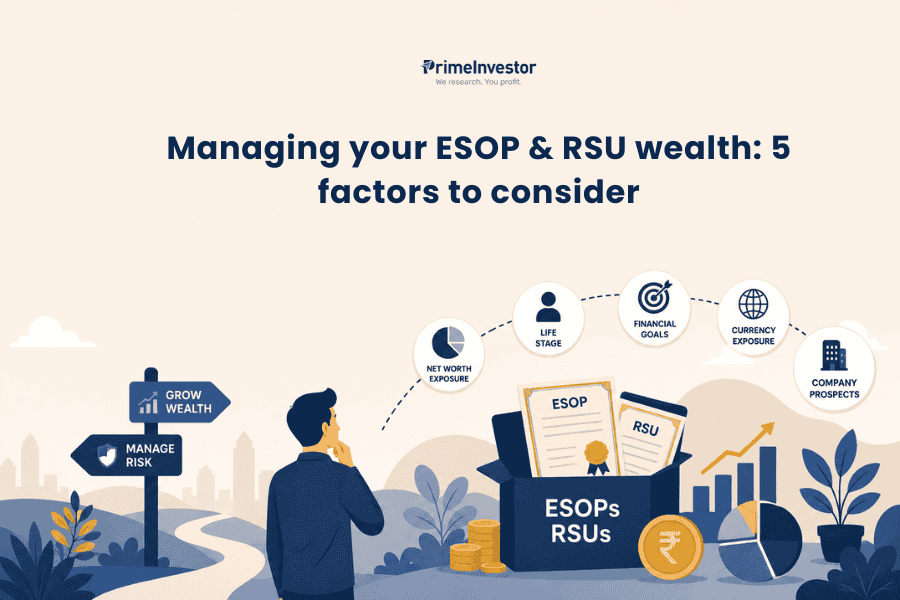
Therefore, the decision on whether to retain or sell your ESOPs or RSUs is not an easy one-shot affair. It needs to be based on several factors. Here are the factors to consider.
#1 Net Worth Exposure
What proportion of your entire net worth is parked in your employer’s stock? That’s a critical input to deciding how much of a concentration risk you are running with ESOPs/RSUs. If your net worth is Rs 3 crore and ESOPs/RSUs make up about Rs 40 lakh, that’s a concentration risk you can afford to live with (subject to the company’s prospects). But if the personal wealth you have built amounts to just Rs 40 lakh and the sum sitting in your employers’ stock is Rs 3 crore, too much of your financial future depends on this one company. Here your portfolio really needs urgent derisking, requiring you to sell majority of your ESOPs and RSUs and invest in a diversified basket of stocks or mutual funds. While there’s no standard prescription on the amount of concentration risk you can run, having over 20% of your entire net worth in a single stock should be deemed risky.
While calculating your net worth here, be sure to take only liquid financial assets and not illiquid ones like plots of land or the home you live in. Do deduct your loans from asset value. In the event of a job loss or other career risk, only your liquid net worth – after paying off liabilities – will matter to your financial security.
The other aspect to be considered is the composition of your net worth, excluding your ESOPs/RSUs. If you run a well-diversified portfolio with stocks, mutual funds, debt instruments, gold etc and ESOP/RSU holdings are only a part of your diversified equity exposure, you’re not running too much concentration risk. But if your ESOP or RSU holding is your only equity investment and the rest of your portfolio is parked in debt, gold, real estate etc, then you need to exit your ESOPs/RSUs and invest in a diversified equity portfolio for effective wealth-building.
#2 Life Stage
When it comes to running any kind of risk with your investments, age is a factor. We’ve met investors in their late 50s or 60s whose entire retirement plan hinges on their ESOPs/RSUs. This is positively dangerous. If a bluechip index like the Nifty50 can fall by 40% or 50% in a bad year (it did in 2008 and 2020), individual stocks can tank much more.
If you harbour under the notion that quality stocks don’t fall much, history tells us differently. When the dotcom boom ended, industry leading Infosys and HCL Tech fell over 80% from their peaks. This was despite their maintaining a healthy pace of earnings growth. US tech stocks are particularly prone falling off cliffs. In 2022, the Meta stock crashed 26% in a single day and over 70% through the year as markets questioned its investments in the Metaverse project. Apple Inc suffered a 52% single day crash in 2000 and a 25% drop in the first quarter of 2025. The most feted AI stock of this era – Nvidia has suffered some gut-wrenching falls, plummeting 17% in a single session in January 2025 when China’s DeepSeek was first released.
Many of these stocks did recover from these crashes. But it took time. Employees in the early stages of their career may be able to take such swings in their stride because their current lifestyle or income is not at risk from market volatility. However, for an employee who is on the home stretch to retirement or relying on them for post-retirement income, such crashes can be panic inducing. A planned from RSU/ESOP holdings to invest in a diversified income-generating portfolio ahead of retirement, is the ideal course.
#3 Financial Position
How well are your finances positioned to meet your life goals, if you exclude your ESOP/RSU holdings? Do you have sufficient investments beyond ESOPs/RSUs to fund your home purchase, travel plans, Masters’ degree, child’s schooling or your planned switch from a full-time job to consulting? If you don’t, you will need to plan your exit from ESOPs or RSUs to fund them.
For goals approaching within the next 3 years, you can’t wait until the nth hour to liquidate your stock. It would be better to plan, liquidate in phases and park the funds in a safer, diversified portfolio. If you are an early and mid-career employee with proximate goals, you should look at planned transition of your ESOP/RSU holdings to prepare for them. If you find your debt burden mounting and robbing you of savings potential, you can think of exiting your ESOP or RSU holdings to repay debt and free up your income and net worth.
The advantage with such planned exits is that you need not implement them all at once. You can time your exits to upcycles in the company’s earnings or stock price, and sell in well-timed tranches to mitigate timing risks.
#4 Dollar Diversification
For Indians employed in multi-nationals, particularly US ones, ESOPs/RSUs act as a natural hedge against Rupee depreciation. The decision to exit such holdings therefore needs to factor in the need for dollar diversification. If you plan to pursue a Masters’ degree overseas, send your children abroad for higher education or holiday abroad, those funding needs can be more easily met through dollar-denominated assets. You can earmark your ESOP/RSU holdings towards such goals, while using India-based assets to meet domestic goals.
Your residential status also plays a role in the decision. Generally, to avoid currency risk, it is best to own your investments in the currency in which you expect to incur your expenses. If you plan to live and work abroad, holding the bulk of your assets in dollar or euro-denominated ESOPs and RSUs makes sense. If you plan to live and work in India, then owning the bulk of your investment portfolio in Rupee-denominated assets works better. Yes, in the long run, the Rupee has tended to depreciate against the US dollar by 3-4% a year. However, exchange rate direction can be very difficult to predict over shorter periods. Spells of Rupee depreciation are often followed by gains or stability in the exchange rate.
#5 Company Prospects
As a holder of ESOPs or RSUs, you may be in a good position to assess the above factors, because they relate to you. However, at the end of the day, an ESOP or RSU holding represents part ownership in a business and you cannot afford to forget it. Therefore, the overriding factor in deciding whether to sell or hang on to your stock, is an assessment of company’s earnings trajectory and business prospects. A recommendation to an employee holding RSUs in Nvidia or Alphabet cannot be the same as that for an employee holding ESOPs in Wipro or ITC. The former are high-growth global businesses, while the latter are dividend-yielding mature businesses.

Let experts manage your wealth
At PrimeInvestor, our Portfolio Management Services are built on one principle: protect on the downside, compound on the upside. Whether you’re starting your wealth journey or looking to bring discipline to an existing portfolio — we have a strategy for you.
Explore our PMS →There are also other strong reasons why you need an independent view on your ESOP/RSU holdings. Long-standing employees are often unduly pessimistic about their employer organization. Young employees may be overly optimistic. Behavioural biases such as recency bias and anchoring bias are also very much in play when it comes to decisions on whether to sell or hang on to your employer’s stock. An outsider would be better placed to overcome these to provide impartial advice on whether to hold or sell the company’s stock.
In addition, employees usually have a worm’s eye view of their employer organization. But a dispassionate assessment of a stock’s prospects requires a bird’s eye view of the economy, sector, markets and competition, and how they impact the company’s growth trajectory. All this requires the skills of a professional equity researcher. Therefore, if you’re deciding what to do with your ESOPs or RSUs, do get advice from a professional research outfit.
At Primeinvestor PMS, we’ve helped several clients with customized wealth solutions on their RSU/ESOP holdings. If you would like to consult us, schedule a call with us.