
When we screen investment ideas for the PrimeInvestor PMS, we regularly find companies that tick most of the boxes — a passionate entrepreneur, strong capabilities, a growing industry with visible tailwinds. But for a company to actually make it into our portfolio, that isn’t enough. We also need clear answers to three questions:
- What is the likely earnings growth rate — or quantum of profit — for this company three years out?
- What specific factors will drive that earnings growth?
- Are we paying the right valuation for that growth?
Without honest answers to these, we are really just buying a company and hoping to get lucky. The stock may still click but with no repeatable process behind it. In a personal portfolio that can be acceptable, an individual can be patient for as long as they like and can afford a few misses alongside a few hits. Managing other people’s money professionally, we don’t have that latitude.
This article is about the errors that we, as professional investment managers, cannot afford to commit, even though some of them are survivable in a personal portfolio.
The errors that hurt us most fall into two buckets:
- Justifying valuations instead of valuing the business — paying a price that no realistic earnings outcome can pay back.
- Being brave without conviction — acting on impulse and bias in an “unpopular” situation, rather than on a reasoned, non-consensus view.
Beneath both sits the same analytical hazard — getting the earnings wrong. As a rough rule, if the company we are buying is not going to roughly double its earnings over three to five years (a 15–23% CAGR), returns will be hard to come by — unless we are buying it at genuinely cheap valuations.
Error 1 — Justifying valuations instead of valuing
Valuation practice has evolved over the decades, from price-to-book and PE in the Graham era, to intrinsic value in Buffett’s time, to the new-age metrics used today. But the arithmetic underneath never changes: we make money only if the earnings eventually pay back the price we paid. The trap is that, in the presence of a strong narrative, the market tends to find a justification for whatever valuation already exists, instead of valuing the company from scratch.
There is no better illustration than the recent SpaceX IPO, which simply defied gravity on valuation. The AI-and-innovation narrative, the Elon Musk factor, the multi-trillion-dollar values enjoyed by US mega-caps and the flood of money into US markets combined to make that issue happen. In situations like these, it is the refusal to “miss out” plain FOMO — that leads investors to justify a price rather than test it.
We saw the same thing here about five years ago, in the first wave of new-age listings — there is now an Internet Index made up of these companies. Many of those IPOs are still to deliver against investor expectations, the standout exception being Eternal. Even there, the Q-commerce optionality that has since driven the stock was viewed as a concern at the time of listing, not something to pay up for; had it not played out, there would have been little money made in Eternal either.
Nor is this confined to new-age names. Bajaj Housing Finance, subscribed 50x and listed at a large premium, has given up around half its value in the two years since and now sits close to its IPO price, despite the parent’s pedigree.
Estimates themselves can be the problem. When NTPC Green listed, a major brokerage put out a “subscribe” with the following valuation basis (image below):
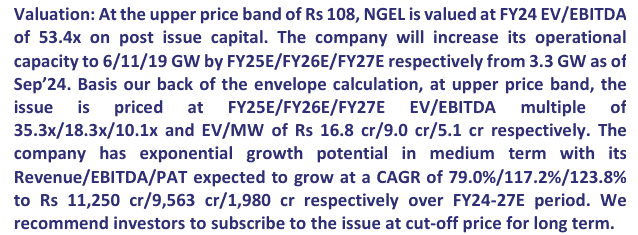
It described the issue as priced at an FY26 EV/EBITDA multiple of 18.3x. The actual FY26 numbers put that multiple closer to 43x. That is the scale of estimation error that can hide inside a confident-looking note. As we write, the largest depository, NSDL, is back at its IPO price after a stellar debut.
The cost of overpaying: return decay
Investment decisions that justify a valuation lead to what we call “return decay”, inferior returns on time invested (RoTI). An individual investor can wait it out. For a manager, holding an investment that produces nothing for three to five years carries a real cost. Rs 100 invested should grow to about Rs 200 over five years at a 15% CAGR; if instead it sits at Rs 100 or lower, that return decay is a permanent drag on the portfolio.
Crucially, this happens even with genuinely best-in-class businesses. Over the last five years, names such as DMart, Bajaj Finance, Page Industries, Kotak Bank, Nykaa, Metro Brands, Asian Paints, HUL, SBI Cards and Astral have all shown return decay — not because the businesses faltered, but because of the entry valuation. That high entry price could always be justified at the time:
- DMart carried the scarcity premium of the only scalable national retailer
- Nykaa rode new-age IPO sentiment; SBI Cards listed at 15x book on a perceived niche plus scarcity premium.
- There was nothing to fault in how Page, Asian Paints or Metro Brands ran their businesses — the margins and return ratios remained best-in-class.
DMart is the sharpest example. In 2021 a brokerage recommended it as a 100-bagger, with earnings estimates running all the way to FY46 — overlooking the Q-commerce disruption and the sharp deceleration in earnings that followed:

The pattern shows up clearly across these names over the last decade: PE multiples expanded through 2016–2021 and then contracted, while the most recent three years have been a period of single-digit earnings growth.
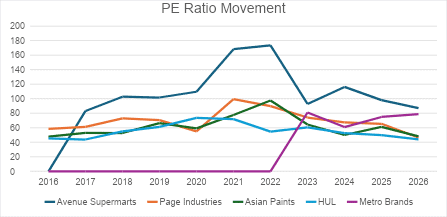
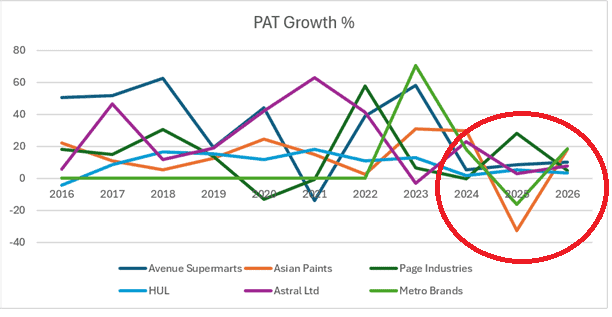
The exceptions are instructive. Titan, and to a degree Pidilite and Divi’s, kept delivering returns despite expensive ten-year median PEs of 50–80x — and in every case it was continued earnings growth, not multiple expansion, that did the work.
We are not free of this mistake ourselves. In Prime Stocks we have held names — HDFC Bank and Dalmia Bharat among them — that showed return decay, either from a rich entry valuation or from a prolonged wait for earnings to arrive. In our Finance Squared smallcase, which has returned about 20% CAGR over four and a half years, we owned Aptus Value Housing. It had IPO-ed at 7x price-to-book in August 2021, we bought below 5x in 2022, and the multiple still de-rated to 2.5x even as earnings compounded at 20–25%. We eventually exited around our buy price.
The honest conclusion is that justifying valuations in an age of powerful narratives is easy. Actually valuing companies is hard and riddled with forecasting error. Some businesses, new-age and high-growth in particular, are so complex that even a valuation expert like Aswath Damodaran has struggled to value them with accuracy.
The second face of return decay- the momentum round-trip
Return decay also arrives a second way. A stock bought at an expensive valuation runs up 30–50% on momentum, but then falls back below the original buy price. Trent, Max Healthcare and Kaynes Technology all delivered stellar early returns and then went through deep corrections. Given enough time, even an investor who bought at a “good” price sees their three-year CAGR fade to ordinary. The same story played out in diagnostics during Covid — investors who bought above 100 PE are only now breaking even — and in IT, where stocks bought above 35x in the post-Covid digital-transformation boom have surrendered their entire gains after sliding to multi-year lows.
This is the most painful version, because we hand back the gains and end up with mediocre or nil returns simply because the entry valuation was taken on trust.
One template we use to spot the trap is “peak earnings and peak valuations”, which we have written about separately. When both are at work together, the odds of ending up in a no-return scenario are very high.
We can’t escape this error entirely. Running away from high-growth companies, disruptors and momentum sectors altogether is even more painful in this business than the occasional overpay. What helps is structure. A diversified portfolio built on a core-and-satellite approach, combined with a position-sizing framework that weighs four variables — earnings growth, entry valuation, timing of entry and downside risk. Together they keep this error contained.
Error 2 — Bravery without conviction
The second error is the mirror image of the first: not overpaying for a popular story, but plunging into an unpopular one just because it’s a contrarian bet. It isn’t only individual investors who catch falling knives. Markets can move in a way that stirs even experienced, expert investors into impulsive, brave-looking decisions.
Veteran investor Rakesh Jhunjhunwala plunged into DHFL in 2018, in the middle of the NBFC crisis, only to realise the casualty much later. Finance is the worst sector for that kind of plunge, because the business runs at 5–10x leverage over its own capital. Anchoring and recency bias usually drive this, with confirmation bias piling on top. The pull towards contrarianism plays its part too.
Contrarian is not the same as being convinced
The clearest recent example is the West Asia crisis of the last few months. That situation called for cautious optimism, not bravery. We have set out in our client communications how we looked at stocks and deployed capital through it — with caution rather than raw courage. In hindsight, being brave might look more rewarding, had one plunged into small- and micro-caps amid the escalation. But hindsight is not a process.
The antidote: variant perception
Being non-consensus is fine — provided the decision rests on a clear, reasoned view that differs from the market. That is “variant perception,” and it is a very different thing from simply buying what is cheap or unloved.
Take IT today. If we can argue that these companies’ earnings will grow at a certain rate, against what the market is pricing in for its own X, Y and Z reasons, then we hold a variant perception. It may still be wrong — it is exposed to estimation error — but the decision rests on a view about earnings, not on cheap optics. We currently hold two mid-cap IT companies in the PMS growing at around 20%, and are evaluating a third idea with a similar revenue-growth profile.
Variant perception can also mean buying a low-market-share player where the evidence points to share gains the market hasn’t yet discounted. In 2018 it was easy to buy Maruti and Hero on their market-share dominance — only to find, in hindsight, that the winners were M&M and TVS. Backing those winners at low share and inferior earnings required a variant view, not just a contrarian instinct.
Rakesh Jhunjhunwala’s call on PSU banks in 2019 is another example. He gave two clear reasons:
- Provisions had peaked — and a provision is not a write-off, since a good deal of money has since been recovered through the NCLT.
- Deposits are the lifeline of banking, and PSU banks have them in abundance.
Both proved to be the critical drivers of the returns that followed. The power of deposits is visible even now, in the struggles of the largest private bank and in the outperformance of regional banks that today trade above their larger peers.
Another veteran, Ramesh Damani, called PSUs in the aftermath of Covid — reasoning that the government’s enormous capex would sit on PSU balance sheets, which is exactly what happened; the huge cash piles against orders are there to verify. Geopolitics and the global defence narrative then added momentum on top. His current thesis of buying a basket of PSU metal stocks runs along the same lines — that the government will eventually want to control rare-earth and metal supply through them rather than lean on the private sector.
Unpopular is not automatically right
These cases all point the same way: investing in “unpopular” areas works when it is backed by clarity about what will drive the outcome, not by bravery alone.
Over our last five years as research analysts, our own variant-perception bets have included Asahi India Glass, Bharat Forge and Bajaj Holdings, among others. As Daniel Kahneman put it in Thinking, Fast and Slow, the lesson is to put System 2 (slow, deliberate thinking) to work rather than let System 1 — impulsive, bias-ridden and constantly bombarded with noise — make the call. In investing, being brave on its own simply doesn’t work.
Why these errors cost more in professional management
The objective is the same whether you are investing your own money or managing someone else’s. What differs is the margin for error.
In personal investing, a seasoned investor enjoys two real advantages:
- the luxury of allowing an investment as much time as it needs, regardless of what the market is doing
- the freedom to take concentrated bets.
A recurring inflow of fresh capital forgives a great many mistakes, because there is always new money to deploy into new ideas and over the long run that makes a material difference.

Let experts manage your wealth
At PrimeInvestor, our Portfolio Management Services are built on one principle: protect on the downside, compound on the upside. Whether you’re starting your wealth journey or looking to bring discipline to an existing portfolio — we have a strategy for you.
Explore our PMS →Take the recurring inflow away and the luxury disappears; mistakes become as costly as they are in professional management. Lose 30% on an idea and you need a 50% return just to get back to par. Once return decay is added to the bill, the ask only grows. This is why active investing is so often called a loser’s game. The returns are made by avoiding mistakes and staying invested for longer.
If you are an investor with finite capital chasing a healthy CAGR, you have to know your numbers and keep your mistakes to a minimum. That is precisely the part we are here to deliver. Learn more about our PMS and schedule a call.







1 thought on “Two investing mistakes professional managers can’t afford”
Interesting view.
Once information is available then Market will price that by increasing PE so not sure of 20% growth factor.
Assuming it grows as per projection then in 3 year time what can happen ?.
I agree professional money manager uses GARP or growth at any cost or value approach.
As a personal level, Sell Displine is key.
Now coming to Value approach and references not sure about their research capability (They consume research from external sources). Their strenth lies in taking complete risk and put as much as they can when they believe on something (This is their key to make big money). If you have mentioned “Prashant Jain” or “Kenneth Andrade”, I could have agreed on integrity & their ability to read market cycle well enough & their research.
PSU banks are classical boom bust that happens regulalry. Looks like FMCG is getting into some kind of cycle with nothing happening for few years now. Now market darling sector is Auto and lets see what happens in next few years.
Best wishes and Good luck for your PMS offerings.