
The recent surge in aerospace and defence stocks has brought the sector firmly into the spotlight. Yet, identifying the winners requires more than tracking stock prices. Investors need to assess where each company sits within the value chain, the capabilities it has built, its order visibility, ability to scale and track record of delivery. These factors separate companies with real competitive advantages from those riding market enthusiasm.

Why global aerospace is turning to India
Five structural trends are converging that could make aerospace one of India’s significant growth sectors over the next few years.
#1 A record 15,000-aircraft backlog
Airbus and Boeing together have an order backlog of around 15,000 aircraft. At current deliveries of roughly 70–80 aircraft a month (800–900 a year), that is 16–18 years of work at the current run-rate, versus 8–9 years pre-COVID. This excludes replacement demand for ageing aircraft. The sheer size of this backlog gives component suppliers exceptional long-term visibility.
#2 Ageing workforce and rising labour costs in the West
COVID hit aerospace workers hard, especially in Western countries where the workforce was already ageing. Many skilled workers never returned, causing labour shortages and wage inflation, particularly among smaller Tier 2 and Tier 3 suppliers. Boeing and Airbus began looking for new manufacturing partners, not just to save costs but to find engineers capable of complex aerospace work. India fits well, with a large pool of trained engineers, improving government policies and existing relationships with global aerospace companies. Machining costs in India are also typically 30–50% cheaper than in China, mainly due to lower labour and overhead costs.
#3 China +1
China’s own aircraft maker, COMAC, is now seen as a serious future rival to Boeing and Airbus, not just a supplier hub. With COMAC growing on heavy state backing, and export controls and geopolitical tension rising, Western OEMs have become cautious about relying on Chinese suppliers. They are spreading sourcing across more countries, a strategy often called “China +1”. India has become one of the biggest beneficiaries of this shift, giving it a strategic edge beyond cost.
#4 Global OEMs are doubling down on India
Global OEMs have made their India ambitions public. Airbus, which sourced around $1.4 billion from India last year, has committed to crossing $2 billion well before 2030. Boeing has set a similar goal, aiming to roughly double its current $1.4 billion in annual India sourcing. Rolls-Royce has gone further, announcing plans to at least double its India sourcing by 2030 across civil aerospace, defence, and power systems. Pratt & Whitney is targeting $150 million in annual India sourcing by 2030. Together, these commitments point to a rapidly widening opportunity for Indian suppliers.
#5 A small base with a long runway
Indian aerospace companies have grown revenues at 20%+ a year for the last three years, but from a small base. The bigger listed players make around Rs.1,000 crore (~$100 million) in revenue and Rs.100 crore (~$10 million) in profit, a fraction of what global giants earn.
India makes up less than 1% of the world’s commercial aerospace exports today, so there is a lot of room to grow. If Indian companies can scale up and move closer to the size of global players, early investors could benefit meaningfully from that journey. The gap in scale is stark:
Where Indian companies sit in the aerospace value chain
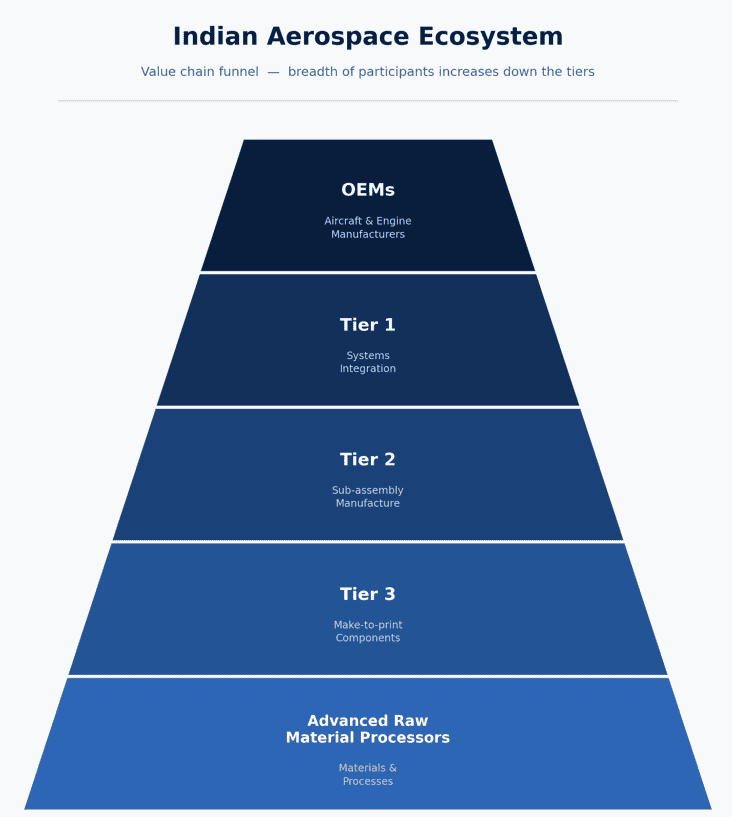
The global aerospace value chain functions as a funnel — a small number of aircraft and engine OEMs at the top, supported by a much larger base of systems and component suppliers spread across three tiers. India currently has no commercial aircraft OEM, but it has defence PSU OEMs such as Hindustan Aeronautics (HAL) and a steadily developing supplier ecosystem, with only a handful of Tier 1 players and progressively more suppliers at each tier below.
Source: PrimeInvestor Research
The OEMs
At the top sit the aircraft and engine OEMs, which design, assemble and bring the final product to market. Despite their small number, they shape demand, set technical standards and decide how work flows to suppliers. They include Airbus, Boeing, Dassault and Embraer on the aircraft side, and GE Aerospace, Rolls-Royce, Pratt & Whitney and CFM International (a JV between GE Aerospace and Safran) on the engine side.
Their financial health varies widely: Airbus has a record order backlog and a cash position of ~€12B, while Boeing is still in a turnaround, highly levered and with negative free cash flow.
Tier 1 suppliers
Tier 1 suppliers work closely with aircraft and engine OEMs, supplying high-value components such as aerostructures, fuselages, landing gears, subsystems and wing structures. Their relationships are built over years of reliable execution with near-zero tolerance for quality issues, and they are among the biggest beneficiaries of the OEMs’ growing order backlogs.
Many Tier 1 suppliers do not start at the top; they begin as Tier 2 or Tier 3 suppliers and move up the value chain by building capabilities and earning customer trust. This is the shift from “build-to-print” (manufacturing a component exactly to the OEM’s design) to “build-to-spec” (helping determine how it should be designed and made). Once qualified and embedded into an aircraft programme, replacing a supplier can involve years of requalification and significant risk for the OEM. As the relationship deepens, suppliers move from individual components to larger assemblies and eventually co-development, increasing their content per aircraft. The moat is therefore not simply manufacturing capacity but a combination of engineering capability, process know-how, certifications, programme track record and customer trust, which take years to replicate.
In India, listed players in this space include Aequs, Dynamatic Technologies, Azad Engineering and Bharat Forge, while several other larger Tier 1 capabilities are housed within unlisted businesses or diversified conglomerates, including Tata Advanced Systems, L&T Precision Engineering and Adani Defence & Aerospace.
Tier 2 and Tier 3 suppliers
The companies in the Tier 2 and Tier 3 space are largely component and sub-component manufacturers that are still building trust with end customers. Their products range from something as small as a nut and bolt to a turbine nozzle vane, wiring harness or other precision components. While individual components may be low in value, stringent quality, traceability and qualification requirements create meaningful entry barriers.
For investors, the key is to identify companies in this tier that are not merely adding capacity, but are building the capabilities to climb the value chain described above.
The Indian Tier 2 and Tier 3 ecosystem includes players such as Raymond, Sansera Engineering, Sigma Advanced Systems, Rossell Techsys, Samvardhana Motherson to name a few.
A notable feature of the Indian ecosystem is the growing participation of auto-component and precision-engineering companies leveraging their existing manufacturing capabilities to enter aerospace. However, aerospace requires significantly higher standards of quality, traceability, process control and customer qualification, making the transition more demanding than conventional component manufacturing.
The special tier: advanced raw-material processors
At the most specialised and critical end of the value chain, only a handful of Indian companies possess the metallurgical capabilities required to process aerospace-grade titanium and superalloys into complex components.
PTC Industries and defence PSU MIDHANI (Mishra Dhatu Nigam Ltd) are among the key Indian players here, with capabilities in vacuum melting, titanium casting and forging. These capabilities require specialised equipment, metallurgical expertise, stringent process controls, certifications and years of process development. As a result, companies in this niche can become strategically important suppliers to aerospace OEMs and engine programmes, rather than standard component manufacturers.
PTC’s key differentiation is its ability to recycle aerospace titanium scrap back into aerospace-grade metal. Aerospace machining can have extremely high material wastage, and the resulting scrap is often contaminated with coolant, tool fragments and oxygen, making it unsuitable for conventional remelting. PTC refines this scrap into aerospace-grade material again, a closed-loop capability that is rare and difficult to replicate. This allows PTC to capture value both from its specialised processing and from material that would otherwise be sold as scrap.
Why aerospace has high entry barriers
While aerospace presents an exciting long-term opportunity, building and scaling a business in the sector is far more challenging on the ground, especially for new entrants. These barriers shape the pace at which Indian players can grow.
#1 Certification and an obsession with quality
Aerospace sets an extremely high bar for quality and process control, because even a minor defect in a critical component can have serious safety consequences. AS9100D, the aerospace-specific quality standard built on ISO 9001, requires suppliers to have robust systems for traceability, risk management, configuration control and process discipline.
NADCAP (National Aerospace and Defence Contractors Accreditation Program) goes a step deeper by accrediting specific critical processes such as heat treatment, chemical processing, welding and non-destructive testing, and is recognised by leading aerospace OEMs globally. NADCAP accreditation alone can take 6–12 months.
On the shop floor, quality checks are embedded at every stage, with each step documented and signed off. A component may go through 5–10 quality checks before it is shipped to a global OEM. Established suppliers with the necessary certifications and process know-how therefore have a significant head start.
#2 The long gestation period
For a new entrant, the journey from setting up capabilities to generating revenue can easily span two years: obtaining certifications, establishing the facility and processes, and clearing stringent OEM audits before commercial supplies can begin. That means nearly two years of certification, facility, manpower and development costs before the first meaningful rupee of revenue. This is why several listed companies have recently entered aerospace through the inorganic route (e.g., Raymond Ltd taking a controlling stake in JK Maini Global Aerospace Ltd).
#3 Lumpy orders and heavy working capital
Ordering activity from aerospace OEMs tends to be highly lumpy, with periods of significant order inflows followed by quieter periods that are difficult to predict. The key comfort for investors is when a supplier becomes qualified and strategically important on an OEM’s aircraft or engine programme: business will eventually materialise, even if its timing and quantum remain uncertain.
Lumpy orders also mean lumpy cash flows. Suppliers must import expensive aerospace-grade materials such as titanium and Inconel well in advance, and OEMs expect them to hold sufficient raw-material inventory, making high inventory levels a structural requirement rather than a choice. Material wastage is also high: 100 kg of raw material may yield only ~8–10 kg of finished components. Together, these can result in working-capital cycles of 150–200+ days, making cash flows significantly more volatile than the long-term revenue opportunity may suggest.
#4 The trust factor
For an aerospace OEM, reliability is paramount. It needs suppliers that can consistently deliver critical components for decades, with virtually zero tolerance for defects or delivery delays. This trust takes years of consistent performance to build and makes established suppliers difficult to displace.
Aerospace and defence stock valuations
While the entry barriers have limited the pool of credible players, have also contributed to rich valuations across the space. With few certified suppliers able to participate, the market appears to be rewarding scarcity, and these valuations leave no room for error.
With several companies announcing their entry into aerospace, it is important to distinguish between being an aerospace supplier and becoming a critical aerospace supplier. Many companies operate in relatively small, competitive component categories where pricing power may be limited, yet the recent enthusiasm has led to sharp, narrative-driven rallies, with some stocks doubling within a matter of months.
As Howard Marks often highlights in his memos and books, the pendulum of investor psychology swings between greed and fear, pushing asset prices to extremes before eventually reverting towards the mean.
Aerospace is a slow, lumpy business, characterised by long development cycles, stringent qualification, uneven order flows and lengthy gestation periods. While the opportunity can be enormous, the underlying value creation will take years, not months. Investors therefore need to distinguish between the speed at which the stock is moving and the speed at which the business can actually compound. At current valuations, waiting for the pendulum to swing back towards more reasonable levels may prove more rewarding than chasing the momentum.
The securities quoted are for illustration purposes only and are not recommendatory.







7 thoughts on “India’s aerospace stocks: Real opportunity or hype?”
Great Insights.
A very insightful article ,and it goes beyond from the point of view of an investor .
Thank you Srikant.
I could not understand why HAL was not included in the list of companies for comparison.
A very insightful article ,and it goes beyond from the point of view of an investor . Thank you Srikant.
I could not understand why HAL was not included in the list of companies for comparison.
Thank you for the feedback. HAL is predominantly a defence aerospace OEM while the article was written from the perspective of opportunity for commercial aerospace component companies. But a lot of these aerospace component companies mentioned are also suppliers to HAL and there is an overlap.
At current prices, the valuations seems astronomical on all counts : PE , PB, EV / EBITDA. Perhaps at least a 25% correction will make them attractive. I feel one should adopt a wait and watch approach for the next couple of quarters before investing
we should not look at only current valuations. we should consider future earnings growth and then conclude on valuations.
Yes that is true. Even when future earnings growth is taken into consideration, a lot of stocks still trade at expensive forward multiples (greater than 40x in many cases) and hence investors need to wait for adequate margin of safety.