
The author is an experienced content writer and editor. She specializes in simplifying complex regulatory developments across tax, law, and finance for professionals and businesses. Her expertise spans domestic and international taxation, VAT, and financial regulations, with a focus on India, the UAE, and global markets. Views expressed are personal and not necessarily the views of PrimeInvestor. This article is educational in nature .Consult an expert for your own tax and regulatory needs.
With a high proportion of the working population actively seeking new investment opportunities, Indian investors are showing growing interest in stocks and alternate funds. As global mobility rises, Indians are also increasingly seeking opportunities in global securities markets.
Indian investors can invest overseas through SEBI-regulated domestic mutual funds. However, such funds are subject to an overall ceiling on overseas investments which is often exhausted quickly, and fresh subscriptions consequently get restricted. In contrast, under the GIFT City route, the limit applies at the individual investor level ($250,000 per annum) rather than at the fund level. Therefore, overseas investments through the GIFT City route are gaining traction among individual investors.
The Gujarat International Finance Tec-City, or the GIFT City, is a popular international investment destination. Though located in India, it is earmarked as a special zone and considered to be outside the territory of India. It is regulated by the International Financial Services Centres Authority (IFSCA), which is independent of other regulatory organizations like SEBI or RBI.
In an earlier article, we provided an overview of the eligibility conditions for individual investors, along with the tax benefits of investing through GIFT City. In this write-up, we discuss in detail how resident individuals can make overseas investments.
General Regulatory Permission – Liberalized Remittance Scheme (LRS)
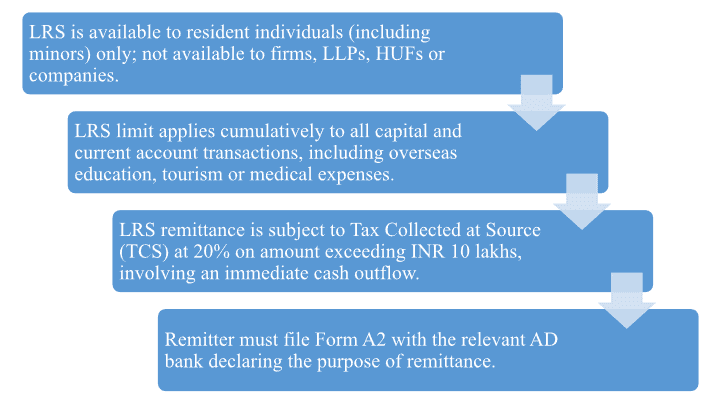
You may be aware that RBI has accorded a general permission to Indian resident individuals for making overseas remittances to the extent of $250,000 per financial year (April to March). This equates to around Rs 2.2 crore per year. Individuals can use this limit for all current or capital account transactions and for availing financial services or products within the GIFT City.
Some key aspects of the LRS facility are as follows.
Operational Framework – How to Invest Through the GIFT City
Indian investors desirous of exploring the GIFT City route must discuss the possible options with their brokers or investment advisors. Many broking/fund houses in India have established offices in the GIFT City and are in the right position to hand-hold the investors who are new to this mechanism.
Regardless, the following table compares four different investment routes available for resident individuals.
Benefits of Investments through GIFT City
A resident individual (resident and ordinary resident) is taxed in India on his global income. Thus, any income from the above investments is taxable in India. It is important to note that there is no blanket income tax exemption for resident individuals investing in the GIFT City. Yet, there are certain tax and incidental benefits of investing through the GIFT City:
- You get to enjoy gains arising from the appreciation of foreign currency;
- You don’t pay transaction charges like Securities Transaction Tax (STT), Commodity Transaction Tax (CTT), stamp duty on trades executed
- You get to take exposure in overseas securities.
Further, the general tax provisions applicable under the domestic income tax law to assets held by a resident would apply to investments made through GIFT City too. For example:
- Income generated from AIF Cat III Funds is taxable in the hands of the fund itself and is generally not taxable for the investors.
- Interest and dividend earned on GIFT City investments are taxed at the slab rates applicable to individuals. Any foreign withholding tax (WHT) deducted by the payer can be claimed as a tax credit in India under the tax treaties.
- Capital gains made on sale of securities are taxed as per the normal provisions in India. In case of listed securities, long term capital gains (LTCG) is taxed at 12.50% on gains exceeding Rs 1,25,000 and short term capital gains (STCG) is taxed at 20%. Tax rates applicable on the transfer of unlisted securities under the normal provisions will apply to GIFT City investments too.
Disclosure in Tax Return
Currently, there is no express technical guidance from the tax department on whether investments and securities held in the GIFT City should be considered as “foreign assets” for disclosure in the tax return. The disclosure may be required if the investor directly holds shares of a foreign company and may not be required if he merely holds units of a fund located in the GIFT City. This aspect must be examined based on the nature of securities held in consultation with your Chartered Accountant.
Know Your Transaction Costs
It is important for investors to understand the transaction costs involved in GIFT City investments as tabulated below.
When is it Advisable to Make Investments through GIFT City?
If the taxation and transaction costs for a resident individual are almost the same as those for domestic investments, whether (and when) it is advisable to make investments through GIFT City?
Many high net worth individuals, Indian families and family offices seek exposure to global securities, ETFs, and funds to enhance returns, diversify their investment portfolios and achieve other financial objectives. Such investors typically have substantial investible surplus, are willing to assume risk, and are able to meet the minimum investment requirements prescribed by AIFs or fund houses. Where the commitment value is high, they are also in a position to negotiate favourable currency conversion rates and other transaction costs. Accordingly, the GIFT City route is particularly suitable for high-net-worth individuals, family trusts, and family offices.

Let experts manage your wealth
At PrimeInvestor, our Portfolio Management Services are built on one principle: protect on the downside, compound on the upside. Whether you’re starting your wealth journey or looking to bring discipline to an existing portfolio — we have a strategy for you.
Explore our PMS →Small retail investors desirous of exploring the overseas securities market can also do so with limited financial commitment as fund houses have now opened up to investments as low as USD 500.
One may conclude that the GIFT City investment route is an attractive route for Indian investors to gain exposure to the global markets. Retail participation is also welcome through small ticket size. Investors can explore this option in consultation with their advisors on the risk-reward profile.






2 thoughts on “A primer on the GIFT City Route for Global Investing: How Indian Residents Can Invest Overseas”
Thanks for the article.
I am an NRE and currently hold a GIFT City Ac. If I become a resident say next FY, can I continue to hold the same Gift city AC after changing the status to Resident with the bank?
Not sure you can. Will need to check with your Gifty city intermediary. But in a month or so, we will have Gifty City Route for residents to invest in an international product managed by us, with lower initial sums compared with PMS and a MF route (based outside of India) to make it tax efficient. We will keep our investors posted once we are ready. Thanks, Vidya