
Costs and commissions on most investment products have been sharply pruned by Indian regulators in recent years. You can also buy mutual funds, NPS, PMS and AIF products directly online, entirely cutting out intermediaries.
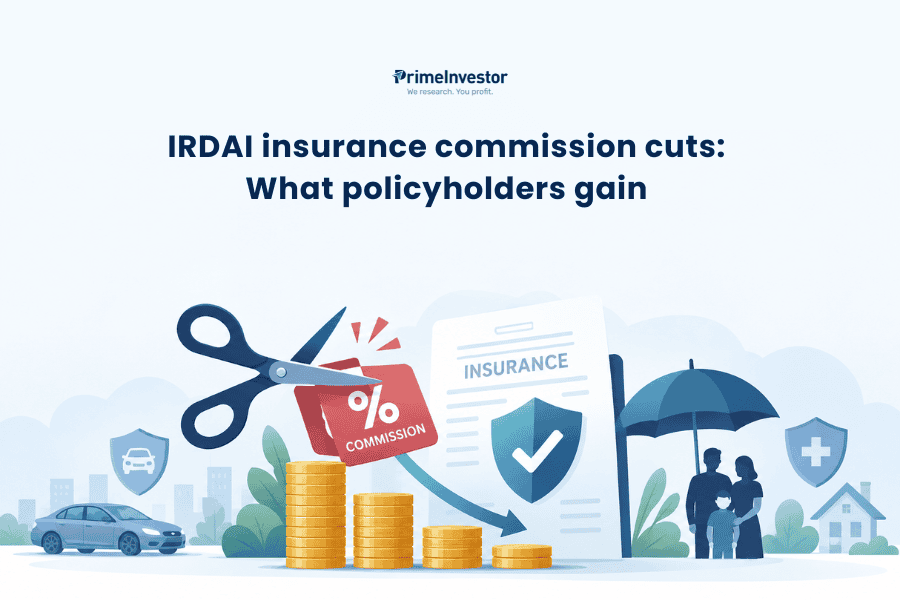
But the insurance industry is still well behind the times. Commissions on insurance policies are still front-loaded, sometimes going up to 100% of the first-year premium. Insurance companies actively discourage you from buying products online. You get a raw deal with rampant mis-selling and patchy settlement of claims.
Therefore, it is good to see the Insurance Regulatory and Development Authority of India (IRDAI) proposing a drastic overhaul of the way insurance products are sold now. It floated a consultation paper on reforming insurance distribution last week. This has generated several research reports on how insurance companies will face margin pressures and banks/NBFCs will take haircuts on fee income.
But what about you, the insurance buyer and the one who usually bears the brunt of problematic commission structures? In this article, we focus on you – how you, as an insurance buyer, will benefit if IRDAI’s consultation paper becomes law.
Life insurance commissions: IRDAI caps first-year payouts, favours term plans
Sky-high and badly structured commissions are at the root of most customer problems with insurance. IRDAI is looking to fix that by sharply trimming and streamlining commission structures across products.
Let’s take life insurance first. The first key issue with life insurance products is the heavy front-loading of commissions. Data compiled by IRDAI shows that commissions paid to distributors out of the customer’s first-year premium payment range from 14% to 51% on average. Some insurers end up paying as much as 33% to 81% of the first-year premium as commissions! After the first year, commissions on life products drop off a cliff to the 2% to 6% range.
Life insurance products are meant to protect dependents against the death of a breadwinner over extended periods of 15, 20 or 30 years. However, distributors plug life policies as limited-term products, leading to nearly half of the policy buyers dropping out within 5 years. For them, this leads to loss of capital as well as insurance cover.
The villain of the piece here is the heavy front-loading of commissions. High first-year commissions create a clear incentive for the distributor to constantly chase new business over retaining existing clients or getting their claims settled on time.
The second issue is high commissions on products that bundle investment with insurance, doing a bad job of delivering both. Wrong clients get sold the wrong products. Senior citizens or young employees who have just entered the workforce are sold pure term plans (they don’t need them if they don’t have dependents). Folks who can very well take on market risks are sold savings and income plans that yield dismal returns.
To fix this, IRDAI is now proposing to restructure commissions on life insurance policies on the following lines.
Term plans:
- Pure term plans will now earn far higher commissions of 25%-30% than savings or pension plans, which will earn 1% to 5%. This encourages insurance distributors to sell protection over savings products bundled with life cover.
- Commissions on pure term plans will be capped at 25% or 30% in the first year, against the current average of 51%. This will expand the capital pool out of which insurers make claims payouts.
- Renewal commissions on term plans will be capped at 7.5% or 10%, higher than the current 6%-8%. This creates an incentive for the distributor to remind clients about renewal premiums and prevent focusing on selling of new term plans instead.
Pension plans:
Commissions on pension plans will be capped at a modest 0.5%-5%. This may discourage distributors from selling pension plans, and you may need to specifically ask for them. But it will leave more money on the table for returns to the investor.
Other plans:
Commissions on investment-cum-insurance products (participating, non-participating, ULIPs) will be capped at a uniform rate ranging from 5% to 25% for the first year and 2% to 5% for renewals. Commissions will be higher for plans with longer premium-paying terms. This discourages the sale of traditional plans as short-term products.
Motor and health insurance commissions: Proposed cuts could make policies cheaper
If high first-year commissions are the problem with life insurance products, in health, motor and property insurance, the commissions are sky-high both in the first and subsequent years.
The data below shows that average commissions on individual health and motor policies hover at 24%-26% in the first year, and remain stuck at 14%-20% in the subsequent years. Some of the smaller players even fork out commissions as high as 70%-75% out of first-year premiums and 69% of subsequent premiums to bag clients. This clearly has a bearing on the surpluses they have left to settle claims.
IRDAI is proposing a drastic cut in these commissions on the following lines.
Motor insurance:
- On motor insurance, IRDAI contends that as third-party insurance is mandatory, there is very little case for the car dealer or point-of-sale person to earn any commission on selling this insurance to new car buyers. It is therefore proposing to allow no commissions for third-party covers on new cars sold by corporate agents or corporate entities. Individual agents selling the same will earn 2.5%.
- On old vehicles or renewals, commissions will be allowed at 2.5% or 5% of the premium. This is a massive saving for car buyers and owners who currently pay up to 75% of the premium as commission. Hopefully, this will reflect in the pricing of motor covers. Own damage covers are not mandatory, and these will earn commissions of 5% or 10% in new cars and 10% or 15% in old cars depending on who is selling the policy.
On health insurance:
- First-year commissions on individual health policies are to be trimmed from an average 24% to 15% or 20% depending on who is selling it.
- There are sharper cuts in renewal commissions from an average 20% to 5% or 10%.
- Group health covers, where commissions average 15% in the first year and 6% on renewals, are set to see a fall to 2.5% to 5%.
- Overall, these reductions in commissions can be expected to leave insurers with a much larger pool to settle claims. Whether this addresses the partial settlement and frequent rejection of claims remains to be seen.
Property insurance commissions are proposed to be capped at 15% to 20% in the first year and 10% to 15% on renewals, for retail policy buyers.
Other IRDAI proposals: Registered distributors, lower costs, no forced bundling
While the streamlining of commission structures is no doubt the main objective of the IRDAI consultation paper, there are other proposals too in the paper that benefit insurance buyers.
- Registered distributors: Today, while buying insurance, it is hard to figure out whether you are dealing with a genuine intermediary. Many a time, the intermediary pitching you an insurance product can’t answer even basic product queries. This is because so far, there have been 9 types of individual entities and 8 types of corporate entities allowed to sell insurance. Regulations allow folks who have passed 10th standard and completed just 15 hours of training to sell some types of insurance. IRDAI now proposes to clean up this mess. In future, there will be only two kinds of insurance distributors – Insurance Distribution Entities (companies, partnerships, firms) and Insurance Distribution Persons (point-of-sale persons, agents, bank officials). Henceforth, everybody selling insurance will need to be registered with IRDAI as a distributor, complete at least 100 hours of training and should have passed 12th standard. While the qualification bar is still low, buyers will at least be able to verify if they are dealing with an authorized IDE or IDP while buying insurance.
- Lower expenses of management (EOM): Apart from slashing commission payouts, IRDAI also wants to ensure that insurance companies don’t splurge on other costs to run their business. Therefore, it is proposing to reduce the ceiling on total EOM incurred by insurance companies. Private life insurers currently run up an average EOM of 20.2% on their gross premium income while general insurers incur 32.1%. IRDAI wants life insurers to shrink their EOM to 12.5% and general insurers to 20% in five years’ time by FY32. Should this happen, policyholders and shareholders in insurance companies will benefit – the former because the insurer will have a larger surplus to pay claims and the latter because profitability will improve.
- All costs are commissions: Today, apart from the high commission payouts, insurers splurge generously on rewards, gifts, junkets and trips for their distributors, all of which add to their costs and impact policyholder returns. IRDAI proposes to include all these incidental expenses incurred on distributors within the definition of commission and subject them to the above caps.
- No compulsory bundling: Today, borrowers taking car or home loans from banks and NBFCs are sold term insurance along with the loan under the ruse that such policies are compulsory to avail of the loan. Banks and NBFCs build the premium into the EMI and also collect hefty commissions on such bundled products. IRDAI is now proposing to ban this practice. Commissions on bundled insurance products are proposed at minimal levels.
- Direct platforms: Insurers will be required to set up direct online platforms to encourage buyers to purchase policies directly from the manufacturer, without the help of any intermediary.

Let experts manage your wealth
At PrimeInvestor, our Portfolio Management Services are built on one principle: protect on the downside, compound on the upside. Whether you’re starting your wealth journey or looking to bring discipline to an existing portfolio — we have a strategy for you.
Explore our PMS →Drastic as the above measures are, this consultation paper could see a lot of pushback from the insurance industry and its distributor ecosystem. However, if IRDAI is able to implement these proposals even in a watered-down form, insurance buyers can look forward to a much better experience than before.






1 thought on “IRDAI insurance commission cuts: What policyholders gain ”
maybe it’s time to have a Grading system for both the agents as well as the fund houses–something on the lines of “Risk-O-Meter” in case of MFs– i mean a system, which grades on the basis of past performance, persistency, claim settlement etc– also, declare publicly how the premium amount is going to be deployed, inlcluding the commission payable to the agent for selling the scheme-make it so transparent and then allow the customer to choose .