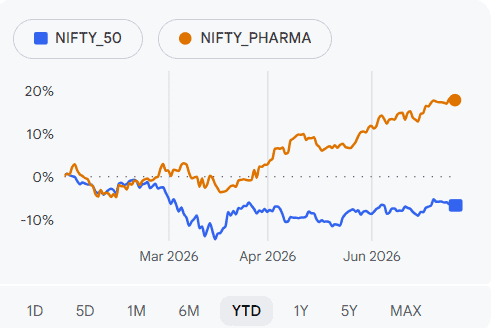
The Nifty50 has spent this year fighting a losing battle against FII outflows and geopolitical uncertainty. However, the Nifty Pharma index has delivered a YTD return of 17.74% as of August 13, 2026 while the Nifty50 is down 6.86%.
In our Prime Velocity, Synergy and Vision portfolios, where the pharma and healthcare theme holds a significant weight, these holdings have proved very good defensive bets, not falling during the Iran conflict and delivering strong gains thereafter. This is because the Indian pharma rally has multiple legs, as this analysis explains.
Indians still need their meds
The simplest explanation for pharma’s resilience is that whatever the scenario on geopolitics or oil prices, Indians still need their medicines. The Indian pharma market growth numbers from Pharmarack have reflected this with double-digit growth each month with the latest data indicating a 12.1% growth in July 2026 too. The sustained double-digit growth indicates its resilience and immunity to geopolitics, oil price shocks and FII outflows.
The therapy areas that have done most of the heavy lifting cater to chronic diseases. Cardiac and Anti-Diabetic drugs figure in the top growers with double-digit value and volume growth. Vaccines have also firmly grown in double digits both in value and volume terms. These stand out against acute therapies which tend to rise and fall.
Offtake of Anti-Diabetic drugs has grown powered by the rapid adoption of GLP-1 therapies especially after Semaglutide went off patent in India in March 2026. Wider diabetes screening and monitoring are now pulling patients into treatment for Diabetes earlier than before. Cardiac too has grown with rising cardiovascular disease prevalence, an aging population, and greater focus on prevention.
The top 5 corporates identified in the Pharmarack report in terms of contribution to the India pharma market include Sun, Cipla and Abbott, all Nifty Pharma constituents. Sun and Cipla together account for nearly 30% of the index. This resilient domestic engine has also proven strong enough to absorb some of the bad news on the export side with the Revlimid opportunity fading away. Sporadic and arbitrary tariff threats against Indian generic exports from the Trump administration have mostly been shrugged off by the market.
Sun Pharma moves the needle
The Nifty Pharma index is heavily skewed toward a handful of large constituents. Sun Pharma exerts a disproportionate pull on it with its 21.34% representation.
Sun Pharma’s YTD returns are running in excess of 14%. Q1 FY 27 revenues have grown by 10% but a big driver has been its acquisition of Organon a global healthcare company spun off from Merck that is, in scale, almost as large as Sun Pharma itself. This opened the doors for Sun to the EU with its six manufacturing facilities across the EU and emerging markets. The acquired portfolio has more than a 505 contribution from established brands in addition to innovative women’s health medicines and biosimilars.
This acquisition is not a risk-free move, and we are not entirely positive on it. An integration exercise of this scale carries significant execution risk. But it has been viewed favourably by the market, despite Sun’s ongoing FDA inspection challenges and its most recent issue involving eye drop contamination in India.
Beyond Sun Pharma, the rally has also been driven by other standout outperformers which have lower index weights.
Divi’s Laboratories, the next heavyweight in the index after Sun, hit a 52-week high on the back of a strong Q1 FY27 (27.8% topline growth accompanied by an expansion in operating margins from 30% last June to 41%) with Custom Synthesis leading the charge and generics holding steady. Backward integration into KSMs and intermediates has helped margins and supply stability. Divis has identified peptides as a strategic growth area going forward with indications that it has an innovator client. Contrast media is another emerging area for Divis with commercial supply of one iodinated product already commenced and another expected in the short to medium term. This was viewed positively by the market despite management being careful to flag the lumpy nature of the business urging investors to take an annual perspective rather than a quarterly one.
Cipla and Dr Reddy’s, the two heavyweights with 15% combined weights, have a mixed story on earnings and stock price performance, but shielded by a promising outlook for FY27.
The fading away of the Revlimid opportunity and the setback with respect to Lanreotide thanks to the FDA issue at Pharmathen, Cipla’s manufacturing partner, hit the North America business hard and therefore the margins too. Cipla also lost some tendered business in Africa. Despite this Cipla’s stock price did not take a beating. Management maintains that the US business is on track for a $1 billion run rate by the end of FY 27 backed by new launches including four respiratory products and one peptide (Ventolin already approved, Advair recently cleared, and CGT exclusivity secured for Ventolin, with a possible shot at CGT for the peptide product too). On Lanreotide, remediation is underway with Pharmathen and an alternate US site is being readied, though timelines remain uncertain pending regulatory review. Margins are currently below run-rate because launch costs have been incurred without matching revenue yet, but management continues to guide toward 18.5-20% margins as the new product launches ramp up.
The stock of Dr. Reddy’s Laboratories is sitting on a loss YTD. What stands out is a quality issue with generic Semaglutide that has forced it to pause supplies until October 2026. Add in a nearly 69% drop in net profit alongside a 5.5% fall in total revenue for Q1 FY27, a Rs. 240 crore inventory write-down tied to the Semaglutide batch issues, the fading of high-margin Lenalidomide (Revlimid) revenue, and rising freight, solvent, and supply-chain costs. But this has remained a company-specific issue and has left the rest of the index largely unaffected. Having said this, it remains one of the few players to ride the GLP-1 patent expiry wave and the short term hiccups should still not spoil the party for Dr Reddy’s.
CDMO companies that are normally characterised by lumpy revenue, too have reported a good Q1 thanks to a combination of factors. Structural changes pointing to a diversification of sourcing away from China in addition to projects progressing to commercial supply, volume uptick and favourable API prices have all aided top line and in preserving margins.
Laurus Labs reported its highest-ever quarterly revenue and EBITDA with its CDMO and formulations business. Small-molecule CDMO revenue reached Rs 835 crores, up 69.0%, driven by late-stage clinical and commercial deliveries. The stock has clocked in excess of 60% YTD returns.
Sai Life Sciences, down the order in weight, offers a similar story with around 50% in YTD returns. This full service CRDMO with a predominantly international business, a clean compliance record, a pipeline of over 150 programs, and client relationships going back more than 11 years is well-positioned to benefit from the China+1 shift in global sourcing and is backing that up with a planned capex of Rs. 1,100 to 1,300 crore.
But Wockhardt is arguably the most dramatic story in the index in 2026, though it has a miniscule weight of less than 2%. The stock has roughly doubled from around Rs 1,176 in March 2026 to over Rs 2,000 currently on the back of USFDA approval for Zaynich, a novel intravenous antibiotic for severe, drug-resistant complicated urinary tract infections. It’s the first new chemical entity fully discovered and developed by an Indian pharma company to win USFDA approval for superbug and multi-drug-resistant infections and some estimates are pegging the US market opportunity alone at roughly $9 billion. That approval, paired with a genuine financial turnaround, explains the scale of the re-rating.
A strong Q1 – the theme that cut across
Apart from the stocks covered above, a robust Q1 FY 27 performance has been the common theme across Nifty Pharma constituents which have reported their results so far.
Ajanta Pharma clocked a strong uptick in net sales thanks largely in part to a sharp 57% growth in its US generics business aided by two new launches. Aurobindo Pharma posted a single digit growth in US business that was compensated for by an over 25% growth in Europe business (around a third of topline). Biocon posted only a 10% growth in topline though margins remained resilient. Glenmark Pharma is meanwhile getting noticed for the marked change in its balance sheet quality thanks in part to a licensing deal with AbbVie. Lupin’s quarterly revenue crossed the Rs. 8,000 crore mark for the first time and even clocked a robust US revenue growth. With six new approvals and 3 new launches during the quarter, Lupin seems to be in a comfortable position. Torrent too posted a strong set of numbers both on the domestic as well as international front even as it negotiates integration of the JB Pharma acquisition.
Can the Index’s outperformance continue?
The obvious question on everyone’s mind is whether this can continue and if so for how long. Despite the kind of disruptions that we saw over the last two years in terms of tariff wars or geopolitical issues, the pharma sector’s earnings and outperformance was largely led by positive tailwinds from the US market itself. While the defensive nature of the pharma and healthcare sector makes a case for the sector, a broader market recovery can dampen the enthusiasm for defensive bets. Going forward, structural factors and catalysts could play a bigger role in stock performance – for instance the heavy investing in peptides by several players including Divi’s and Laurus Labs and Sai ramping up capacity to ride a China+1 shift. Company specific factors warrant attention beyond just the numbers.
This is not without risks.
While the domestic facing business may be robust and immune to global shocks, India’s pharma sector has a significant external facing side. Every now and then there has been the threat of tariffs. The latest being a stiff tariff to come into force two years hence in a phased manner with a 100% tariff on imported generic drugs in August 2028 which further rises to 200% a year hence. Our view is that manufacturing in the US simply will not match Indian made generics in terms of cost competitiveness and therefore, markets have been right in shrugging this threat off.
FDA inspection risk too is a recurring theme that none of the players are immune to, especially as the regulator has moved to more inspections overall and moving even non US sites to surprise inspections. Several of the index’s biggest bets are still in early to mid-stage of execution. Sun’s acquisition and integration of Organon, Sai’s and Divis capex and Zaynich’s following through for Wockhardt are all yet to play out as favourably as anticipated.

Let experts manage your wealth
At PrimeInvestor, our Portfolio Management Services are built on one principle: protect on the downside, compound on the upside. Whether you’re starting your wealth journey or looking to bring discipline to an existing portfolio — we have a strategy for you.
Explore our PMS →To conclude, the defensive quality of the sector will likely stay intact and greater oversight by the Indian regulators bodes well for larger listed players. But playing the sector will now call for taking active bottom-up calls on individual companies rather than playing the Nifty Pharma Index. Our PMS strategies continue to identify unique niche plays in the pharma sector which can capitalise on themes such as the GLP-1 opportunity, the rise of Indian CDMO players and the structural improvement in domestic offtake of chronic therapies because of better awareness, diagnosis and treatment.