
‘Won’t large-cap stocks be safer in these volatile times?’
‘Why don’t you have a mid/small-cap strategy? Only that can deliver alpha.’
These are questions we frequently get from investors interested in our Portfolio Management Service. We tell them that we don’t focus all that much on a company’s market cap, when screening companies for our portfolios. In fact, we are market-cap agnostic and screen companies more for their financials and business quality.
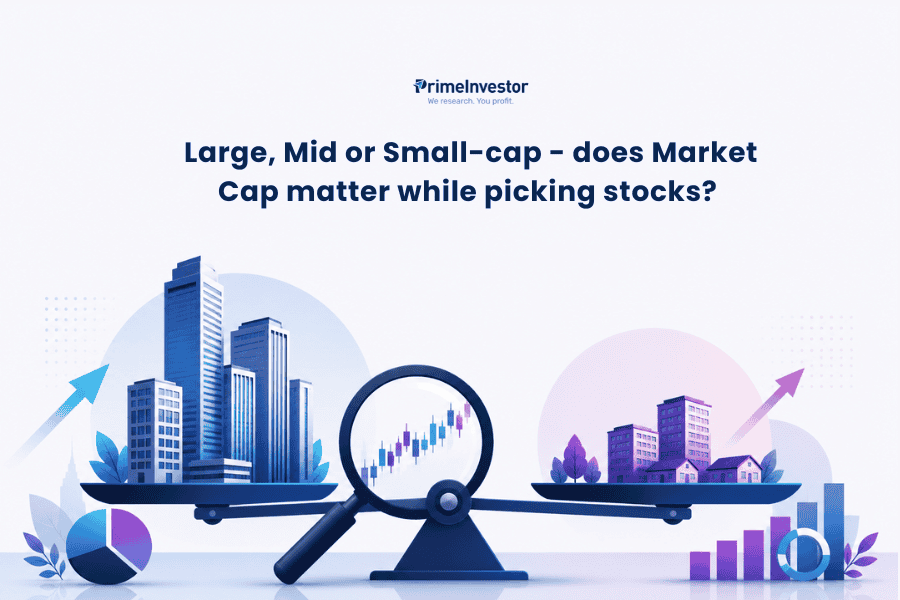
Now, many Indian investors equate market capitalization with business quality. Large-cap stocks are automatically assumed to be safer because they are ‘blue-chips’ with good governance. Mid- and small-caps are assumed to be a little dodgy, but carry more multi-bagger potential because their small size means infinite scaling possibilities!
However, we’ve learnt from experience that looking at businesses purely from a market cap filter leads to mistakes and missed opportunities. Yes, market cap can indicate how liquid a stock is and whether institutions can own it. But it tells you nothing about whether a company’s earnings are cyclical or secular, whether it is in a high-growth business or a mature one, whether its management is credible, whether it can scale up 5X.
These are the very features that distinguish an attractive stock from an avoidable one. So, here’s why you shouldn’t be building your portfolio based purely on market cap segmentation.
Are large-cap stocks really safer? Not always
When an equity investor talks of ‘safety’, it can mean one of three things.
One, the company will never go bust and subject you to loss of capital. Experience shows us that companies usually go bust due to a few reasons – Taking on too much debt, making over-sized acquisitions, making poor capital allocation decisions, failing to see sector disruptions or adapt to change or regulatory interventions that threaten the viability of a business model.
Now, if we go back to the list of companies that have landed in India’s bankruptcy courts in the last decade or so, it features many companies that were large-caps and even occupied Nifty50 slots when they defaulted and landed up in the bankruptcy courts. When the capex boom of 2003 to 2008 ended, several real estate, power and infrastructure names from the Nifty50 ended up with the NCLT. Unitech, Reliance Power, Suzlon Energy, Essar Steel, Jaiprakash Associates were sector leading, large-cap companies that featured in the Nifty50 at different points in time, took on too much debt for unbridled expansion and ended up with the IBC.
Two, investors believe that large-cap companies will never subject them to a 70% or 80% draw-down, like mid- or small-caps do. This is a mistaken notion. During raging bull phases, markets have a habit of overpaying for sector leaders. When a reality check arrives in the form of a sectoral downturn or disruption, valuation derating can very easily tank such stocks by 70% or 80%. Dotcom darlings such as Zee Tele and Digital Globalsoft a part of the Nifty50 in 1998-2000 went on to lose 70-80%. So did the real estate and infrastructure behemoths of 2006-08.
The Nifty Fifty bubble in the US in the 70s taught us that market cap concentration in quality names can end very badly. (Read about it here)
Three, investors seem to believe that a large cap status guarantees good governance, as the top 100 companies are tracked by an army of analysts. History tells us though, that large caps do run into governance issues – be it creative accounting, debt defaults or faulty acquisitions. Satyam Computers was home to the largest accounting scam in India till date, while occupying a slot in the Nifty50. Yes Bank ran into bad loan troubles and faced withdrawal restrictions by RBI while still in the Nifty. Zee Telefilms and DLF had run-ins with the regulator while being Nifty names.

Wondering Nifty IT Stocks Rally will it price bounce or a sector turnaround?.
Prime Velocity is a focused flexicap equity PMS built on a disciplined QQM framework — combining quantitative screening, deep qualitative research, and macro insights — to identify quality compounders at the right price, in the right marketcap allocation, at the right time.
Discover Prime Velocity →These examples underline that a company making it to the large cap club need not be a poster-boy for governance or business resilience. Market cap is simply a function of stock prices and the size of a company’s equity.
Market cap doesn’t indicate business quality
Another common myth is that when you pick a large cap stock, you get to own a ‘bluechips’ from the listed universe.
This depends on what you mean by a bluechip. For a fundamental investor, a high-quality business can mean only the following. It should preferably earn strong EBIDTA margins which translate into healthy cash flows. It should stay off frequent equity infusions that dilute its per share earnings. Earnings should grow predictably and the return on equity and return on capital employed (ROE and ROCE) should be as high as possible, on a sustained basis.
These financial metrics are decided by management quality, the intensity of competition, the pricing power that a company enjoys, capital intensity, cash conversion cycle and so on. Market cap doesn’t enter into this equation at all.
So, do large cap companies in India really rank higher on ‘quality’ than mid-caps or small-caps? Running a stock screener with our tool yielded the following data.
To compile these aggregates, we treated the top 100 companies by market cap as large caps, the next 150 as mid-caps and the next 500 as small caps. As the small cap universe has nearly 5000 stocks, we extracted the top 500 stocks from this bucket as a representative sample of small caps.
The data shows that when it comes to an important marker of quality like ROCE, there is not much difference between the median small cap or mid cap company and a large cap company. Both earned ROCE in the range of 16-17%. On EBIDTA margin, the median mid cap company is as good as a large cap one, while the median small cap company earns less. On operating cash flows to EBIDTA, mid cap companies are a shade better than large caps.
At the same time, this data also busts the myth that if you are looking for growth, large caps are a lost cause. In the last three years, the median large cap company grew at a much faster clip than its mid cap peer. It exceeded both mid and small caps on revenue growth and did better than mid caps on PAT growth.
Individual examples also help prove this point. If you’re buying an insurance stock, would you think of LIC as a better company than ICICI Pru Life? LIC with a Rs 5.4 lakh crore m-cap is large cap while ICICI Pru Life at Rs 72,600 crore m-cap is a midcap stock. In finance, would you pick Jio Financial Services (Rs 1.6 lakh crore m-cap) over Nippon Life Asset Management (Rs 75,000 crore m-cap)? Does a m-cap of Rs 1.7 lakh crore make Wipro a better stock than Persistent Systems (Rs 83,000 crore)? The answer, from most serious investors, would be no.
Market cap doesn’t tell you about growth prospects
Finally, looking at stocks through a market cap lens can lead you to miss out on up and coming sectors and stocks with a long growth runway.
For one, it is wrong to assume that by staying with large caps alone, you can own the leaders from every sector. The large cap universe in India is dominated by a few sectors – banks, commodity processors, IT services, FMCGs. There are several attractive sectors outside of these, where the leading companies are yet to graduate from mid or small caps. The AMC business, for instance is one of the more attractive segments within finance for its frugal capital requirements and high operating leverage. The top three listed AMCs are all mid cap stocks. The top hospitality stock, Indian Hotels, is a midcap stock and so is the leading white goods maker LG Electronics.
Two, by their very nature, some industries require less capital than others. This makes all stocks in such sectors mid or small caps by default. This doesn’t make them unattractive as investments. In fact, sectors that can scale dramatically without needing periodic equity infusion can be great wealth creators. Credit ratings is a high-margin scalable business dominated by CRISIL, ICRA and CARE, their market caps range from Rs 5,000 crore to Rs 31,000 crore.
Three, most sunrise sectors are, by definition, unrepresented in the large cap space. To own them, you necessarily need to fish in the mid or small cap pools. CDMO players, small finance banks, EV makers and wealth management companies are all up and coming sectors that feature only in the mid or small cap segments of the market.

Let experts manage your wealth
At PrimeInvestor, our Portfolio Management Services are built on one principle: protect on the downside, compound on the upside. Whether you’re starting your wealth journey or looking to bring discipline to an existing portfolio — we have a strategy for you.
Explore our PMS →All this is why we describe Primeinvestor’s approach to stock portfolios as market-cap agnostic. Yes, we do use market cap as an initial filter to decide what stocks to stay away from. If a stock has a market cap below Rs 5000 crore or features low float or trading volumes, we steer clear of it to avoid liquidity risks and impact costs. But that’s about the only time we pay attention to market cap in our stock screening process.





1 thought on “Large, Mid or Small-cap – does Market Cap matter while picking stocks? ”
Very thoughtful article.