
If I had a rupee for every time a prospective client sat across the table and said, “I’m looking for a consistent 15% annual return”, I’d be able to generate that 15% myself. 🙂
But let’s be real. This is a common way people think about investing, especially when it comes to stock markets or mutual funds. Somewhere, somehow, this 15% number has gotten anchored in investors’ minds. Maybe 9% looks like FD returns (!) and 20% looks too greedy, so let’s settle in the middle.
It’s not terribly unreasonable, for sure. But the disconnect happens when that expectation is applied to an annual basis. Believing that you can (or should) peg your portfolio to a fixed 15% every single year, regardless of what the economy is doing, is a dangerous fallacy.
To understand why, we have to talk about the two most important Greek letters in finance: Alpha and Beta.
Are You an FD, Index Fund, or Active Fund Investor?
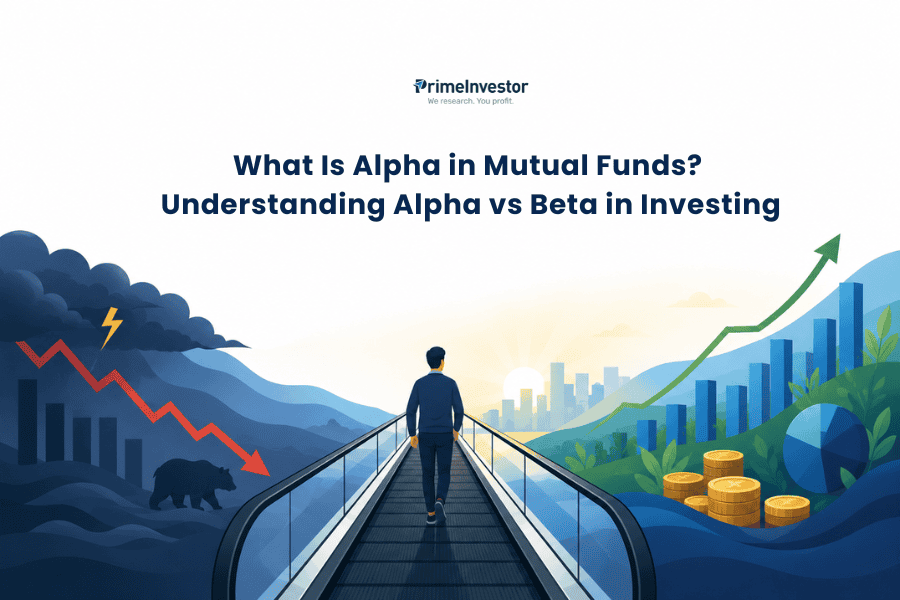
Let’s start with an example. There are these things in large airports (we in Chennai wouldn’t know – we have one stretch with about 15 gates and that’s it) where you can stand and let the moving belt do the walking for you beneath your feet.
Now there are three kinds of people – ones who skip this walkway and keep walking beside it, ones who hop on the walkway and stand on it and let the belt do the work. Then there are those (like me), who get on the walkway and walk briskly on them to get quickly to the gate or the airport exit.
When it comes to investing, the walkway is like the market. Some people choose not to walk on it at all and stay off it entirely. These are the FD investors. Among the ones who do walk on it, there are those who are happy to just coast along. This is index investing, where you let the market do all the work for you. Then there are those who aren’t happy with the walkalator’s speed and want something better. They invest in managed funds and portfolios to beat the market.
What Is Alpha & Beta in Mutual Funds?
That brings us to the concepts of Alpha and Beta in investments.
Simply put, beta is the market – what an index like Nifty 50 or the Nifty 500 (benchmark indices) can do if left to its own devices. It’s the walkway in the example above. The rate of return is the speed of the walkway.
In the Indian market, if you look at the average annual Nifty 50 return over the last 20 years, the number comes to about 12.4%.
Alpha is what a fund manager or a portfolio manager strives to earn above and beyond the market return. It is the faster walking that the manager does for you on the machine walkway.
So, a 15% return expectation is a request for a simple alpha of 3%. Not so unreasonable, right?
Not so fast!
Nifty 50 Average Return Over the Last 20 Years
The average Nifty50 returns from the past two decades have been 12.4%, but that average number hides a lot of variations and ups and downs.
If you look at the annual numbers (readily available on our website), you will see years with single-digit returns, losses, blockbuster returns, and, yes, the occasional standard-issue 12% year. In 2008, the Nifty fell over 50%. In 2009, it rose over 70%. The 12.4% average contains both of those years.
Let’s go back to the walkway. Extending the analogy a bit more (hoping the belt doesn’t snap), some years the belt runs fast, some years it crawls, and some years, and this is the part the 15%-expecter forgets, it malfunctions and runs backwards! A fund manager walking briskly on a reversing belt is doing the job you hired them for. But they will not arrive at your gate at the time you demanded.
When someone asks for “a consistent 15% every year,” they are demanding a fixed arrival time on a belt whose speed nobody controls. Not the manager, not SEBI, not the finance minister.
How Much Return Can You Really Expect from Mutual Funds?
So is the client across the table from me being unreasonable? Yes and no.
You cannot ask a manager for a return. You *can* ask a manager for alpha – the speed of the walking, not the speed of the belt. A manager who delivers a 7% portfolio decline in a year when the market falls 10% has earned you 3% of alpha. That statement sounds absurd to most investors (“you lost my money and you want credit?”), but it is the only honest way to evaluate this work. The manager controls the walking (alpha). The market controls the belt (beta).
Here is something I feel strongly about. Falling less in a bad year is alpha, and in my books, it is the more valuable kind. Not because of the arithmetic (though the arithmetic of drawdowns is brutal), but because of what it does to your behaviour.
Investors don’t abandon their equity investments in flat years. They abandon them in the minus 30% years, sell at the bottom, sit out the recovery and with that bitter taste in their mouth, never come back. A portfolio that falls less keeps you in your seat. That is any day worth more than a percentage point of upside in a bull year.
But what about the long run?
“OK, forget yearly returns. I can surely ask for a 15% return on an average over the long term, right? Over the next 15, 20 years?”
Well, not really. You may say that this has been the norm over the past couple of decades if not more. Yes, sure, but remember that warning – past performance is not an indicator of future returns? That just does not apply just to funds, it applies to the market also. That is the beta we are talking about.
So, who knows what will happen in the future? Nobody. That means, we are all adrift at sea, at the mercy of Aegean winds? Not quite.
There is one possible method we can use to predict the future of market returns. Legendary fund manager Prashant Jain is fond of saying, in almost every speech to investors, that we should use the economic growth of a country in money terms (called nominal GDP growth), as a proxy for market returns. Nominal GDP growth is made of two numbers – real GDP growth + the inflation rate. He used that to demonstrate history and predict the future.
So, it finally boils down to this. Over the long term, if you think the Indian economy will grow at say, 6% annually and the inflation rate would average 5%, then you can expect long-term market returns to average 11%. If you expect the economy to sustain 7% growth with inflation at 5%, you get 12%. This is roughly what you can expect from the market.
If the economy undershoots this growth rate or inflation rate, you should lower your equity return expectations. The very purpose of investing is to beat inflation. Therefore, the lower inflation rate would help you get by well, even with lower market returns!
A few percentage points above that is what you should expect from your fund manager over the long term.

Let experts manage your wealth
At PrimeInvestor, our Portfolio Management Services are built on one principle: protect on the downside, compound on the upside. Whether you’re starting your wealth journey or looking to bring discipline to an existing portfolio — we have a strategy for you.
Explore our PMS →So, in summary, beta is what the market delivers. It would on average be close to the nominal GDP growth rate of India, and alpha would be what your fund manager’s acumen could deliver in addition.
That is the ABC of investment expectations. Or at least the AB.







2 thoughts on “What Is Alpha in Mutual Funds? Understanding Alpha vs Beta in Investing”
wonderful analogy and comparison Mr. Srikanth.
Thank you! 🙂