
If you’re looking to invest in consumption plays, there can be few more obvious bets than the Indian dairy sector. Awareness among Indian consumers on the need for a more nutritious diet which meets protein requirements, is growing by leaps and bounds. At the same time, the vegetarian segment of the population in India cannot rely on the most straightforward protein sources – meat and meat based products.
This has led to dairy products occupying an increasing share of the consumer wallet. The industry is also offering opportunities for players to significantly improve their product mix by foraying from plain liquid milk, to multiple varieties of cheese, panneer, yogurt and high protein variants of these value-added products that command a significant price premium. However when it comes to playing this consumer trend, not all dairy companies are created equal. We take a deep dive into the listed dairy players to highlight the key success factors in this sector.
Divergent returns
Between July 2025 and June 2026, two of the four listed dairy companies, Heritage Foods and Dodla Dairy, declined 34% and 22% respectively, compared with a 5% decline in the Nifty 50.
In contrast, Milky Mist made its stock market debut two week ago, and it was far from a quiet one. The stock listed at Rs.165, an 18% premium to its issue price of Rs.140, and has since rallied further to around Rs.218, taking its market capitalisation to nearly Rs.16,700 Crs. Despite having the lowest revenue and PAT among the five companies, Milky Mist’s market capitalization is second only to Hatsun Agro (Rs.26,100 Crs market cap).
That makes the listed dairy players particularly interesting. The five companies operate with distinctly different business models, product mixes and capital requirements, and the market’s valuations reflect these differences. We compare the five players across their business models, product mix, margins and return metrics, examine why dairy stocks have struggled over the past year, and assess what lies ahead for the sector.
Why dairy is a tougher business to build than it looks
Typically, when consumer companies face input cost inflation, they have the pricing power to pass on the increase to end customers, even if with a short lag. This helps them protect their margins. For private dairy players, however, this equation is not straightforward.
Milk prices follow a seasonal rhythm that every dairy company has to navigate. Winter and the post-monsoon period, roughly October to March, constitute the ‘flush season’, when better fodder availability and fresh calving drive higher milk production and lower procurement prices. Summer, from April to September, is the ‘lean season’, when heat stress reduces cattle yields, pushing procurement prices higher.
Beyond this seasonal cycle, milk prices are influenced by rising cattle feed and fodder costs, which raise the underlying cost of milk production. Periodic disease outbreaks, such as the lumpy skin disease seen in FY23, can also affect milk productivity and milk availability. Erratic or excess rainfall can further disrupt fodder crops and rural milk collection, creating supply shortages that can persist for several quarters before easing. These factors make milk procurement costs both cyclical and difficult to predict.
The ability of private dairies to pass on these cost increases is further constrained by State dairy cooperatives which dominate the liquid milk segment in most States. Cooperatives are not run primarily to maximise profits; their mandate is to ensure fair farmer payouts while keeping consumer prices stable and affordable.
In several States, governments also provide direct per-litre subsidies to farmers supplying cooperatives, enabling them to maintain relatively low retail prices even during periods of cost inflation. This effectively creates a price ceiling against which milk supplies from private players are benchmarked. Raising prices materially faster than cooperatives risks volume and market-share loss, as milk is a daily, habitual purchase with limited brand loyalty. Since milk is purchased almost every day and forms a core part of household grocery spending, even small price increases are felt immediately. This forces private dairies to stagger price hikes rather than fully passing through cost inflation in a single move, leaving margins exposed during periods of elevated procurement costs.
As a result, private dairy companies generally have limited pricing power for liquid milk, given its commoditised nature. There are also other structural challenges across the value chain:
Building the procurement network: To ensure uninterrupted supply of their main raw material, dairy companies need to establish direct relationships with thousands of individual farmers across villages. To ensure storage and transport, this needs to be supported by bulk milk coolers, collection centres and testing infrastructure. Building this network takes years and requires the company to develop a reliable and consistent daily milk supply. Importantly, to maintain the farmers’ trust, dairy companies have to procure and pay for milk irrespective of demand, leaving them exposed to supply-demand mismatches.
Racing against spoilage: Milk is highly perishable and must move through a temperature-controlled chain, from village-level chilling to processing to refrigerated distribution, within hours of collection, leaving little room for delays. This same perishability means fresh milk doesn’t travel economically over long distances, confining most players to a regional footprint and making India’s dairy market structurally regional rather than national.
Reaching the consumer every day: Milk is an essential good requiring a dense and reliable last-mile network comprising booths, kirana stores and doorstep delivery to keep up supply through pandemics and natural calamities. Building this distribution footprint region by region takes years, while coordinating it with the cold chain adds significant operating complexity.
Thin margins: Liquid milk carries thin, single-digit margins, typically in the 3-5% range depending on where the procurement price cycle stands. This makes scale and operational efficiency critical to running a profitable business.
With that backdrop in mind, it’s worth looking at how each of the five listed players has chosen to navigate these constraints.
Milk vs value-added products: How the five players differ
The product mix highlights how each dairy business has evolved a distinct strategy. Dodla Dairy and Heritage remain heavily anchored to the traditional dairy basket, with liquid milk forming a large part of their business. Hatsun Agro is also skewed towards liquid milk with a healthy value-added product (VAP) contribution from ice creams, although the exact contribution is not disclosed.
Parag Milk Foods has a more value-added portfolio, with ghee, cheese, paneer and dahi accounting for a significant share of its business, while liquid milk contributes a relatively smaller share of revenues.
Milky Mist stands out as the most value-added player, with paneer, cheese, curd, ghee, ice cream and butter forming the bulk of its portfolio and no exposure at all to liquid milk. Its product mix therefore frees it from the pricing constraints of State dairies and allows it to participate in higher-value categories where it enjoys pricing power and can build a differentiated brand beyond the commoditised milk market.
VAP offers a higher growth runway than liquid milk, as rising demand, product innovation and premiumisation create more opportunities to expand both volumes and realisations. The difference in product mix also impacts each company’s margins and working capital requirements, which we will discuss later.
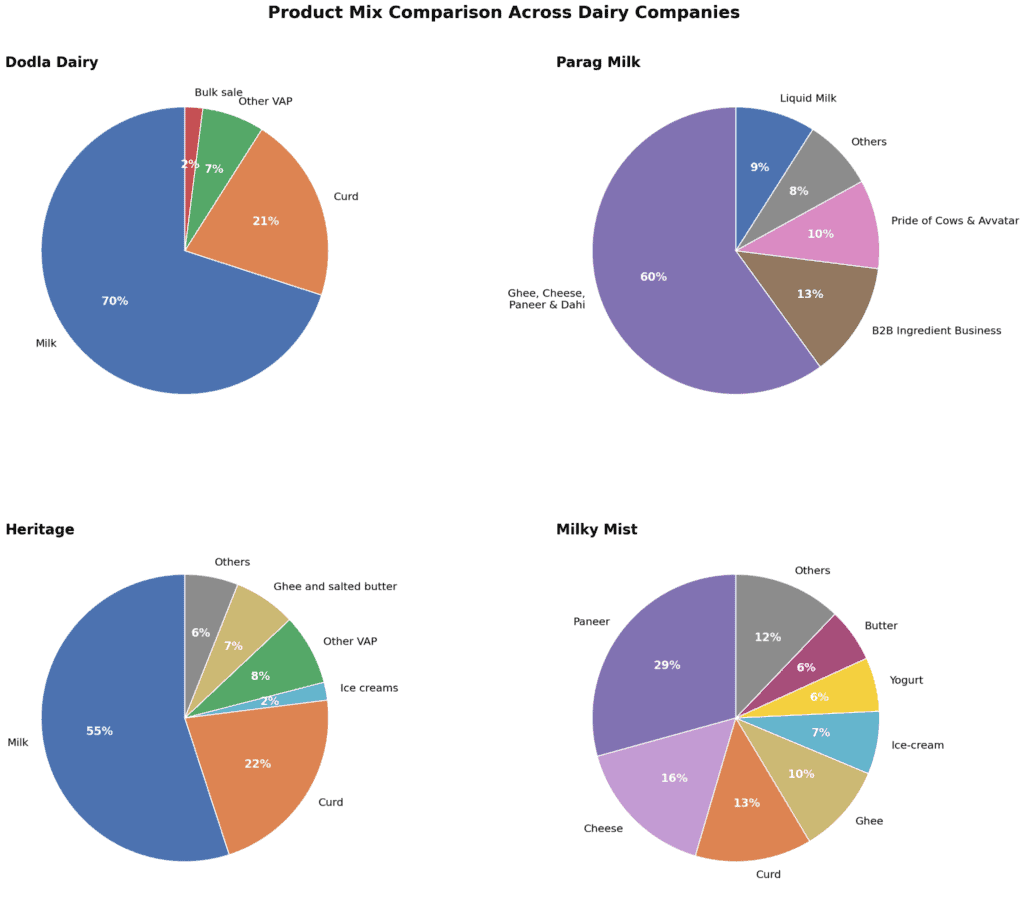
Source: Company presentations & concalls
Note: Hatsun does not disclose its product mix separately
This difference in product mix isn’t just a business-model curiosity, it shows up directly in the numbers, starting with margins.
Margins mirror the product mix
In the dairy business, EBITDA margin trends line up fairly closely with how VAP-heavy each company’s product mix is. Even within VAP, margins vary across products. Ice cream typically commands the highest margins, followed by cheese and yogurt. Other value-added products such as ghee, paneer, curd, butter and buttermilk generally operate at moderate margins, but still deliver better margins than liquid milk.
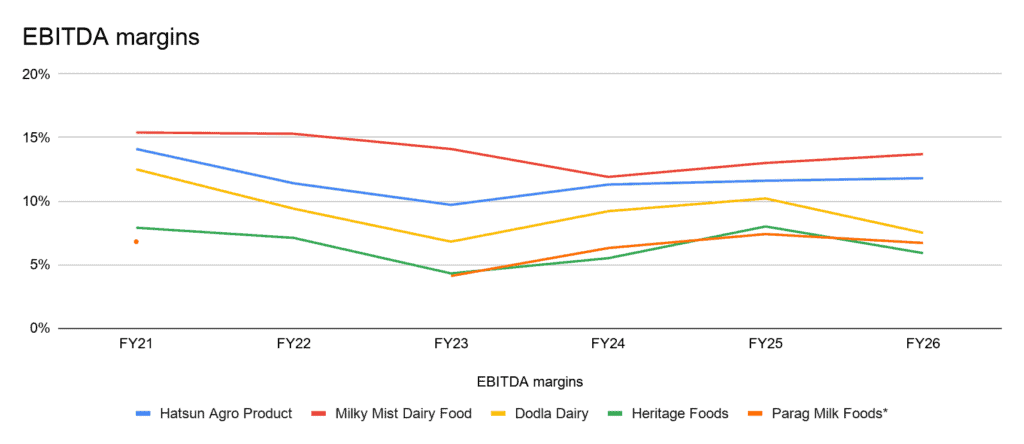
Source: Ace equity
*Note: EBITDA margin for Parag Milk Foods was -21% in FY22
Milky Mist, which derives its business entirely from value-added products, has consistently posted the highest EBITDA margins in the industry in the listed space, staying in the 12-15% range through FY21-FY26 even as the rest of the sector saw sharper swings. Hatsun, with a good VAP mix, operates in a steady 10-14% band.
Dodla and Heritage, with their milk-dominated portfolios, have relatively thin and volatile margins due to their exposure to milk procurement price cycles. Dodla’s margins have swung between 7% and 13% over the years, while Heritage has the thinnest margin profile among the group, rarely exceeding 8%. This margin volatility has accelerated the companies’ push to increase their contribution from higher-margin value-added products (VAPs). Heritage has increased the revenue share of ice creams and other VAPs, including curd, paneer and drinkables, from 26% in FY22 to 32% in FY26, and targets 40% by FY28. Similarly, Dodla is targeting an increase in its VAP mix, comprising products such as curd, paneer and ice cream, from 28% in FY26 to 34%.
Parag Milk Foods, despite having only 9% of revenues from liquid milk, also has a relatively low and volatile margin profile. This is largely due to its significant institutional B2B business, which contributes around 30% of revenues and involves supplying bulk ingredients, structurally carrying lower margins. A sizable portion of its B2B sales comprises skimmed milk powder (SMP), where there is limited scope for brand-led differentiation or pricing power. The company therefore remains susceptible to milk price cycles.
The swing factor: What companies pay farmers for milk
The low and volatile margin profiles of Dodla Dairy, Heritage Foods and Parag Milk can largely be attributed to fluctuations in milk procurement prices from farmers.
Milk procurement prices rose sharply in FY26 due to a weaker-than-usual flush season, persistent feed and fodder cost inflation, and erratic rainfall. Margins for Parag Milk, Dodla Dairy and Heritage Foods all came under pressure as a result, compounded in each case by how exposed their specific product mix is to raw milk costs.
This isn’t a new dynamic. FY23 saw a similar squeeze, when procurement prices jumped sharply, and margins contracted in step. That cycle reversed in FY24, as prices eased through the flush season and companies held retail prices steady, margins expanded again. The current FY26 pressure looks like the same cycle repeating, with prices now pushing toward fresh highs into FY27 Q1, suggesting margins across the sector may stay under strain until the next flush-season relief comes through.
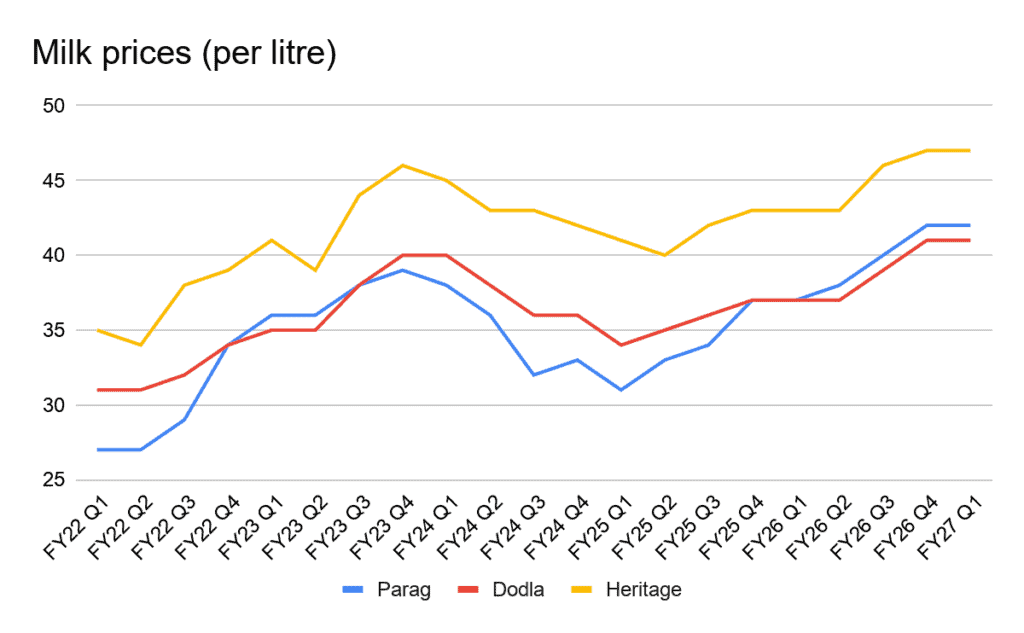
Source: Company presentations & concalls
Note: Prices for Parag Milk Foods and Dodla Dairy are based on farm-gate prices, while Heritage’s prices include logistics costs.
But margin is only one part of the financial equation. The shift towards value-added products also changes how much cash a dairy business needs to keep tied up in operations.
Working capital
While a focus on liquid milk shrinks pricing power and thus margins, this segment is very working capital efficient. Among the companies, Dodla Dairy, Heritage Foods and Hatsun Agro operate a very lean working capital cycle, with Dodla Dairy even having negative working capital days in a few years.
Working capital efficiency varies sharply across the sector, largely as a function of product mix. Dodla, Heritage and Hatsun all run lean working capital cycles, in Dodla’s case even negative, because liquid milk dominates their revenue. Milk moves and gets collected quickly, with fast turnaround from sale to cash, leaving little capital tied up in inventory or receivables. In many States, consumers even pay in advance for their daily milk deliveries.
Parag Milk sits at the other extreme, with the highest working capital cycle in the group. This is primarily driven by its significant exposure to cheese, which requires an ageing period of 6–12 months, resulting in higher inventory holding. Its B2B exposure also leads to a longer receivables cycle, further increasing its working capital requirements.
Milky Mist falls in between, running moderately higher working capital than the milk-heavy names, reflecting its almost entirely VAP-driven mix, categories that inherently carry longer inventory than plain liquid milk.
The broader pattern is clear: the further a company’s revenue mix shifts from milk toward value-added products, the more working capital it typically needs to fund the business.
Naturally, the amount of capital a business ties up in working capital feeds directly into how efficiently it puts that capital to use, which brings us to return ratios.
Return ratios
Return on capital employed shows a clear split between milk-heavy and VAP-heavy players. Dodla and Heritage, both with a large share of revenue from liquid milk, show the widest swings in ROCE across the cycle, falling sharply when procurement prices spiked and recovering when conditions eased. Parag Milk’s ROCE has stayed on the lower end and shown its own volatility due to its margin profile and a structurally high working capital requirement that ties up capital even as returns fluctuate with milk cost and inventory swings. Milky Mist, in contrast, has held a comparatively stable ROCE through the same period, helped by no dependence on liquid milk sales.
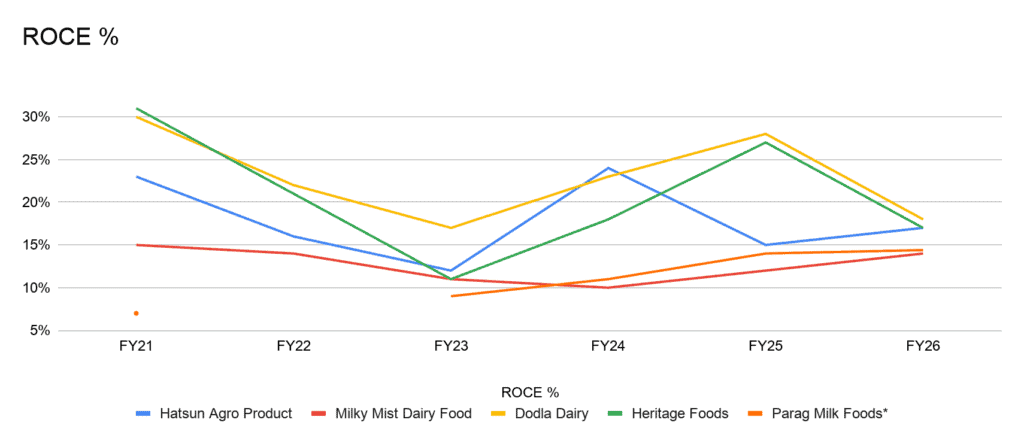
Source: Ace equity
*Note: ROCE for Parag Milk Foods was -40% in FY22
ROE for all the companies except Milky Mist broadly tracks their ROCE trends. Milky Mist’s ROE, however, has been elevated in FY26, driven largely by high leverage on its pre-IPO balance sheet. That leverage is expected to come down post-listing, as part of the IPO proceeds go toward repaying debt.
Valuations for listed players diverge a great deal, tracking the same product-mix story. Companies with a healthy VAP portfolio tend to command higher valuations, reflecting the segment’s stronger growth potential and superior margins. Milky Mist commands the highest multiple in the sector at 133x, reflecting its almost entirely VAP-driven portfolio and its pan-India expansion plans. Hatsun trades at a rich 71x TTM PE, close to its historical average, backed by strong ice cream and VAP brands and comparatively stable margins. Dodla, Heritage and Parag, more exposed to milk and margin volatility, trade at far more modest multiples of 23-31x.
Where the capital is going
Despite the margin volatility that milk price cycles keep bringing, the common thread across all five companies is that capital is still being deployed, either to expand VAP capacity or to strengthen procurement networks, as a deliberate way to protect and improve margins over the medium term.
Looking ahead
The broad outlook across the sector is for a gradual recovery from the FY26 procurement squeeze, alongside a continued, structural push toward value-added products. Nearly every major player has set explicit VAP targets over the next two to four years, Heritage is aiming to lift its VAP mix from roughly a third of revenue today to 40% by FY28 and over 50% by 2030, Dodla is targeting 32-34% VAP contribution led by curd, paneer and ice cream, and Parag is looking to scale its premium “new age” nutrition brands from about 10% of revenue to 20-25% within three to five years. The common thread is that companies are trying to structurally reduce their dependence on low-margin liquid milk, both to improve blended margins and to cushion earnings against the milk-price cycle.
On the cost side, near-term expectations are for raw milk prices to stay elevated through the first half of FY27 before easing gradually once the monsoon-linked flush season improves fodder availability. That said, this softening isn’t guaranteed: an El Niño year typically brings weaker or delayed monsoon rainfall, which can hurt fodder availability and cattle health, and in such years the usual post-monsoon price relief tends to be smaller or delayed, keeping procurement costs, and margins, under pressure for longer than a normal cycle would suggest.
The listed dairy universe is increasingly splitting into different models rather than one uniform sector. Milk-heavy businesses offer lean working capital, but remain more exposed to procurement-price volatility and structurally thin margins. Value-added businesses can command better margins and potentially build stronger brands, but they require more working capital and sustained investment in manufacturing and distribution.
For investors, the dairy sector isn’t an easy structural story to just buy and hold on to. Margins and returns stay hostage to a milk-price cycle that no company fully controls. Navigating this will call for taking active, bottom-up calls on individual companies rather than betting on the sector as a whole, weighing product mix, working capital discipline and capex direction rather than assuming a rising VAP tide lifts every boat equally. Our PMS strategies continue to track these company-specific divergences closely.







3 thoughts on “Why dairy stocks aren’t easy to milk ”
Great piece of writing containing valuable domain information..
Thank you for your feedback
great article containing valuable domain knowledge.