
When you look to invest in any sophisticated investment product, a question that you are inevitably asked is – What is your risk profile?
However, diagnosing your own risk profile is like self-diagnosing if the mild fever you’re running is just a passing infection or a new version of H1N1. Investors, typically put on a spot with this question, come up with the safest of answers – ‘I guess I am a moderate risk person’. That ambivalence allows sales people to conveniently check-off a box in their list and move forward with the rest of the rigmarole pushing the product.
In truth, risk profiling is incredibly important, and too valuable to be left entirely to the responses of an innocent investor.
The following framework is what I have evolved for understanding an investor’s risk profile and how I have employed it effectively.
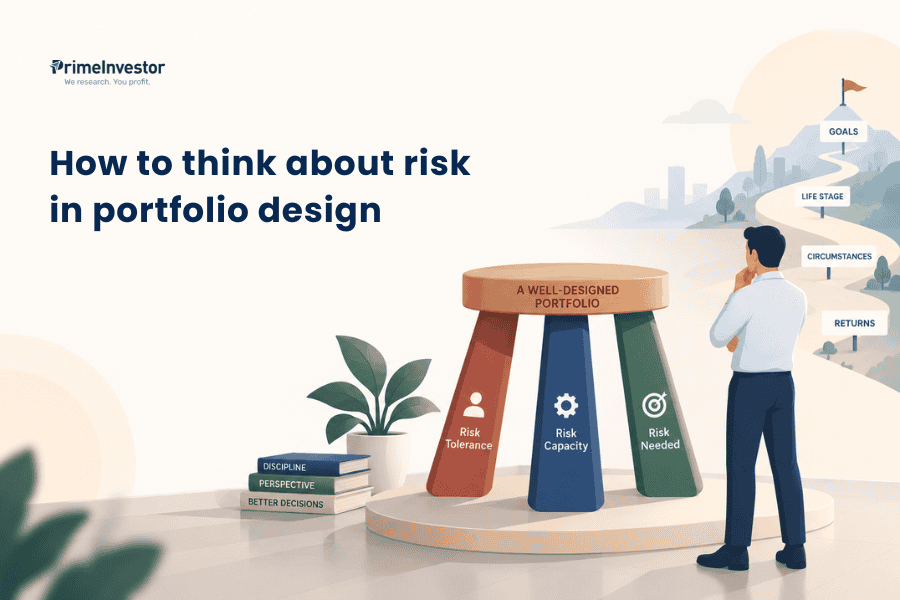
The three-legged stool
A risk profile is not one thing and it’s not some psychological profile alone.
For the purposes of portfolio design, an investor’s risk profile has three structural components to it:
- Risk tolerance
- Risk capacity
- Risk needed
Let’s look at each of these briefly.
Risk tolerance is about the person and their subjective ability to withstand market upheavals. If we assume that the long-term arc of the market bends upwards, then the ability of an investor to stomach downturns and hold on is crucial for investment success. Risk tolerance is a measure of a person’s ability to do so, and it is entirely dependent on their psyche (shaped, ostensibly, by their environment, upbringing etc)
Risk capacity is a more objective measure that looks at the investor’s circumstances and makes an assessment of how much risk they can take. A young person, for example, can take higher risk than an older person since a younger person can allow for more time to heal market wounds. Similarly, a person with no or few dependents can take more risk than one with many.
A third and often ignored dimension is the risk that you need to take. This depends on the purpose of the investment for which the portfolio is being designed. If your goal is to buy a Rs 5 crore apartment in five years’ time and you have just Rs 2 crore invested, you require returns that are significantly higher than what the market can reasonably deliver. Here, higher risk-taking becomes necessary and is no longer optional. Conversely, a person retiring in a few years with a say a Rs 25 crore corpus may not need to take on risk, even if she has the capacity and appetite for it.
Balancing between these three dimensions should be the key goal of portfolio design.
A quick analogy
Let’s use an analogy to illustrate these three aspects.
Consider a car on a highway.
There is the car itself; then there is the driver and finally a destination that s/he is driving towards.
The car could be a speed demon or a slowpoke. The driver could be an experienced daredevil or a novice ‘L’ board. Of course, the destination could be easily reachable on time or requiring you to hurry up.
The car is the risk capacity, the driver represents risk tolerance, and the distance to the destination represents the risk needed.
Picture two drivers on the same highway. One is in a sturdy sedan with new brakes and good tires, crawling along at 40 kmph because fast drives make the driver anxious. The other driver is hyper-racing a rickety hatchback at 120 kmph, because he is late and this is the only car he has. Both of them are getting it wrong, but for opposite reasons.
And therein lies the quandary about risk management.
How to balance the different factors
The first thing to accept is that these three legs will rarely agree with each other. In a decade and a half of doing this, I have found conflict to be the norm, not the exception.
Consider a few familiar situations:
● A 28-year-old professional has high capacity and (she believes) high tolerance, but her retirement goal is forty years away and may not need outsized risk at all.
● The entrepreneur ‘needs’ his corpus to grow at 18% to fund an expansion in three years, feels invincible about markets, but carries a home loan, a young family and a lumpy income. His need and tolerance are high; his capacity is not.
● The recent retiree has a low need for risk, also a low capacity, but has an expensive lifestyle (need). A poor sequence of returns in the first few retirement years can permanently impair a corpus in a way no later recovery can fully repair.
So which leg wins when these factors pull in different directions?
Here is the sequence I have come to trust.
Start with risk needed. Important, and easy to skip. Before asking how much risk you CAN take, ask how much risk the goal actually DEMANDS. Run the numbers on the goal first. Often you will discover the goal needs far less risk than you assumed – a pleasant surprise that defuses a lot of unnecessary risk-taking. Occasionally you will find it needs more than any sensible portfolio can deliver. It is far better to learn that at the design table than five years down the road.
Cap it with risk capacity. Capacity is a ceiling, not a suggestion. However urgent the need, you cannot build a portfolio that exceeds what your circumstances permit. We need to be realistic in this regard – about insurance, emergency funds, debt and dependents – before we look at actual investments.
Temper it with risk tolerance. This is the final part. A theoretically optimal allocation that you will abandon at the first 30% drawdown is worse than a modest allocation held calmly for twenty years. The key factor is this – the best portfolio is not the one that maximizes returns on paper. It is the one that will actually be adhered to.
And when tolerance and capacity point in opposite directions? When tolerance exceeds capacity, you need to apply the brakes. When capacity exceeds tolerance, build conviction slowly – start with an allocation you can live with, and let experience convince you.
When the factors disagree, change the goal – not the profile
Remember those three fingers pointing in different directions from the physics class? The portfolio is the resultant vector. When the three legs conflict, something has to give – and there is a hierarchy to what should give.
Tolerance is the least negotiable in the short term. You cannot talk yourself into a psyche you do not have. Risk tolerance can improve over time as an investor experiences market cycles.
Risk capacity can improve too – with adequate insurance, lower debt, a growing corpus – but again, gradually.
The destination, though, is the most flexible of the three.
Talking of that train journey, you can start earlier. You can lengthen the journey (extend the goal’s timeline). You can pick a nearer destination (moderate the goal itself). Or you can accept a higher chance of arriving late, while being fully aware of it.
What you should NOT do is what is routinely done: invert the process. Pick a fund or an allocation first, then reverse-engineer a risk profile to justify it. That is precisely the ‘moderate risk person’ trap from the start of this piece. Your ambivalence about risk can be used as a licence to sell whatever the advisor had already decided to sell.
A few practical implications
One person, many profiles. Risk profiling should be done per goal, not per person. The same individual may warrant an aggressive posture for a retirement three decades away and a conservative one for a house down payment three years away. A single ‘risk score’ for a person is like giving someone a portfolio because he is a Libran.
Stated tolerance vs revealed tolerance. Questionnaires measure what people believe about themselves in calm markets. Will that really happen during a market downturn? How an investor actually behaved in March 2020 tells me more than any ten-question form ever will. Where I can, I look for evidence of past behaviour before I trust stated preference.
Revisit, don’t set-and-forget. Capacity changes with life stages. Needs change as goals approach. Tolerance evolves with experience. A risk profile is a snapshot in time, not a birthsign.
Where personalization actually lives
In my previous blog post, I argued that the obsession with ‘personalized portfolios’ is overrated – that asset allocation ranges are narrow, and fund selection should be systematic. Nothing here contradicts that; in fact, it explains it.

Let experts manage your wealth
At PrimeInvestor, our Portfolio Management Services are built on one principle: protect on the downside, compound on the upside. Whether you’re starting your wealth journey or looking to bring discipline to an existing portfolio — we have a strategy for you.
Explore our PMS →The risk profile is where personalization genuinely belongs – in the planning, not the products. Two investors who arrive at the same risk profile may well end up with similar portfolios. But the work of arriving at that profile – understanding the goals, the circumstances, the psyche – is deeply individual.
If we get the three legs right, the portfolio largely designs itself. If we get them wrong, no amount of fund selection brilliance will save it.





2 thoughts on “How to think about risk in portfolio design”
Interesting read– however, I disagree. Based on this premise, if my retirement corpus is Ok, i should be investing in only FDs , which will fetch me returns just to cover inflation. However if i do invest a portion in equity , this will provide the “kicker” to my investments, which means I have more to spend, and/or leave more for my heirs –they’ll thank me for this long after I’m gone. So, imo, it is essential to take a fair bit of risk at all times — after all, uncertainty is all-pervading , that’s why we need to have a Contingency fund, no?
Hello sir, Sure, that is one way to look at it. But then I would say that your ‘goal’ is different from just retirement – you also want to build an estate for an heir 🙂