
In my previous company, FundsIndia, I used to talk to a lot of people who were in the beginning stages of their investment career. In my current role in PrimeInvestor over the past several months, I have spoken to a lot of people who have been investing for quite some time and have substantial portfolios that they are trying to improve or build upon.
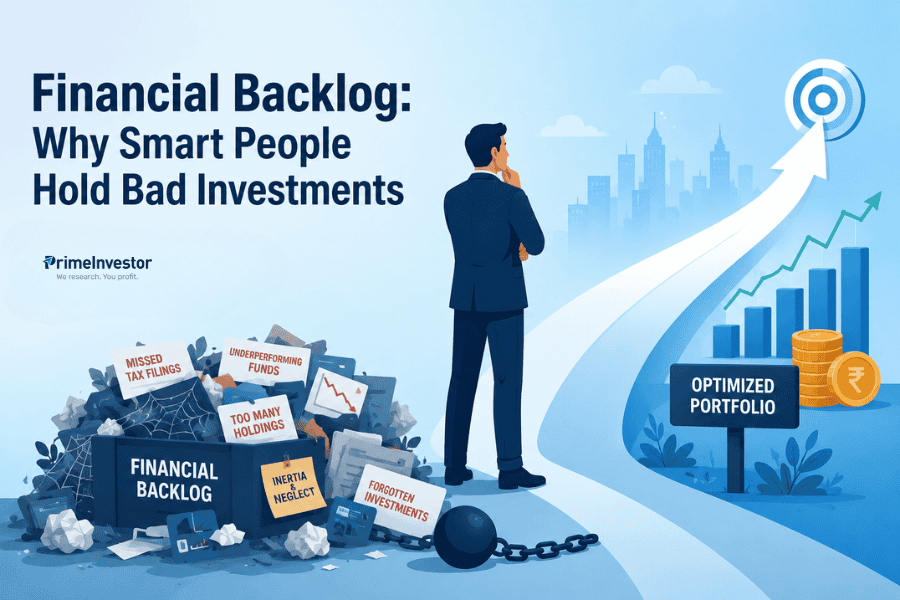
Talking to these investors, I have realized one thing: the size of your portfolio, the number of holdings that you have, or the seniority of your role or stage of career that you are in—none of these are reliable indicators of how good qualitatively and performance-wise your portfolio is. Many, many of these seasoned professionals have terrible investment portfolios.
And there is a reason why these smart, experienced people are holding bad portfolios. It’s what I would call the ‘financial backlog’. Let me explain.

From Technical Debt to Financial Backlog
In my heart of hearts, I am a technologist. I have been part of or managed technical teams throughout my career. Technical teams use a term for when they fall behind on the work that needs to be done in the projects that they are working on. It’s called technical debt or technical backlog.
What this means is that, over a period of time, there has been an accumulation of many little things that have led the project astray from the way it was supposed to be built or the way it was supposed to look. For example, when something is required in short order in a project, a production build is constructed in a hurried manner and pushed through. The project leader makes a note somewhere saying that this is something that was done in a hurry and this needs to be fixed as soon as possible. These things keep accumulating, and the “as soon as possible” almost never arrives.
As a FinTech entrepreneur, I find it easy to take technology concepts and map them to the financial realm, and this one was really right there to pattern match.
What I’ve found is that even the smartest investors carry a financial backlog that they know they need to work on but never get around to.
Let us consider some examples of the forms this financial backlog can take. Some carry significant consequences, like the missed tax filings that you have over a period of time. And some of these are quite benign, like the amount of money that you have in an FD somewhere or in your savings account that is just waiting for the “right market opportunity” to be deployed.
But the most common ones are the result of inertia and neglect—portfolios filled with too many funds and stocks accumulated over the years, but without any coherent sizing or purpose, scattered investments and forgotten holdings. The ones that, when the market is good, look like they don’t need to be disturbed. And when the market is bad, it looks like a poor time to handle them—who wants to sell for less than what it was a few months ago?
Investors don’t realize the ‘interest’ that they pay for carrying around this backlog.
My Own Financial Backlog
In my financial life, I have carried around significant financial backlogs myself, and I have rid myself of them whenever an opportunity arose.
When I started “investing”, I was a stock picker up to no good. I started with $8000 and lost most of it in a few years. I needed to clean up this portfolio and move on to saner investments. When I started work in a Fintech company (my first in the financial industry), the firm required me to clean it up. I gladly obliged.
When I moved to India, I missed filing taxes in different domiciles for a few years. This was such a stress factor for me that one day, I bit the bullet and dedicated a full month to get my act together, pay the fines, and file them all.
During my time in FundsIndia, I invested in several funds—dozens! Most of these were test transactions to figure out if the platform was working fine. As a result, I had a seriously bloated, underperforming mess of a “portfolio”. When PrimeInvestor launched the PMS, I took that as an opportunity to redeem all of them, move out, and consolidate them in one single place.
The financial backlog grows quietly. It accumulates in the shadows of our inaction, slowly wraps itself around our decisions, and eventually prevents us from moving forward.
For the HNIs I speak with at PrimeInvestor, the most crippling form of this backlog usually boils down to one thing: the fear of triggering a tax event.
Let’s look at a highly realistic scenario. An investor, let’s call him Raj. He has ₹5 Crores stuck in a messy cluster of underperforming small/mid-cap funds and thematic stocks accumulated over the last 3-4 years.
The friction point? His invested amount was ₹4 Crores. It’s now worth ₹5 Crores. If Raj restructures, he triggers roughly ₹1 Crore in capital gains. The blended tax bill (STCG + LTCG) comes to about ₹20 Lakhs. Raj looks at that ₹20 Lakh outflow and freezes. The backlog wins.
But let’s look at the actual math of inaction.
- Current State: ₹5 Cr left in a messy, low-conviction portfolio. Because of the dead weight and lack of rebalancing, the expected future XIRR is a mediocre 6%.
- Optimized State: ₹4.8 Cr (after paying the ₹20L tax) moved to a clean, high-conviction, well-rebalanced portfolio. Expected future XIRR: 13%.
The 5-Year Projection:
- If Raj does nothing: ₹5 Cr @ 6% grows to ₹6.69 Crores
- If Raj pays the tax and restructures: ₹4.8 Cr @ 13% grows to ₹8.84 Crores
By trying to “save” ₹20 Lakhs in tax today, Raj’s financial backlog costs him ₹2.15 Crores over the next 5 years. That ₹20 Lakh tax bill pays for itself in under 4 months via the higher compounding rate.
The Backlogs You Can’t See
But tax isn’t the only thing gathering dust. Just like in software, where technical debt leads to brittle systems that eventually crash, financial backlog creates hidden structural risks.
There is the Consolidation Backlog. Wealth scattered across 4 brokers and 6 folios might seem harmless now. But if the investor passes away or loses capacity, the family will spend years in legal hell just trying to transmit those assets.
Then there is the Succession Backlog. Not having a will or trust structure because “it’s a tedious process.” These backlogs don’t show up on a portfolio tracker, but they represent massive, unquantified risks to wealth preservation.
So, how do we get past this mental block? We need to reframe the tax.
Taxes Are a Toll, Not a Penalty
Taxes on restructuring are not a “loss” or a penalty. They are a toll fee. You are paying a toll to get onto the high-speed compounding highway. You don’t complain about the toll if the alternative is taking a broken, traffic-jammed road that takes three times as long to reach your destination.
Clearing a backlog is hard. I know this from my own experience. It requires making difficult decisions and facing a tax bill that feels painful today. But the peace of mind—and the mathematical certainty of better compounding—make it mandatory.
At PrimeInvestor, a large part of what we do isn’t just finding the next great fund. It provides architectural clarity to help you clear your financial backlog. We build portfolios designed to be clean, rational, and easy to maintain—so you never have to face this paralysis again. Don’t let the debt of your past decisions dictate your future compounding.







3 thoughts on “Financial Backlog: Why Smart People Hold Bad Investments”
Totally agree . I don’t know if this qualifies as Financial Backlog , but i have a similar problem — the schemes I have invested earlier were the “Regular” ones, now i want to change to “direct” , but the Capital gains /Tax impact has been deterring me from doing so– maybe i should do so in small bits over several years or do it in one go — I am confused –can somebody give a candid opinion? regds
Bite the bullet sir 🙂 At least that is what we personally do! Vidya
Good presentation Srikanth Meenakshi, keep it up,
I would like to present our small pratical case,
we had invested in shares of unlisted bank and they use to pay us regularly starting with 18% pa and before covid they use to pay 12.5% but after covid they have never paid due to accumulated loss, and soon after covid we requested them to redeem and till date they have not redeemed
you are right paying for the right guidance where money is easily transferred to the next generation is cheaper than the headache of redemption after one is no more and next generation curses the depositor
Over ₹1 lakh crore (US $ 13 billion) in unclaimed funds sits in India’s financial system. This includes ₹78,000 crore in bank deposits, ₹14,000 crore in insurance payouts, ₹3,000 crore in mutual funds, and ₹9,000 crore in dividends and shares, most of which belong to ordinary families