
Many of you would be familiar with smallcases. But if you thought that smallcase was restricted only to stocks, the scene has changed! The smallcase platform now supports mutual fund portfolios — making it easier than ever to execute and maintain one. And we’re thrilled to announce that we’re bringing our own best in class mutual fund portfolios to the platform.

We have designed two mutual fund smallcase portfolios, as below:
- Prime Index Advantage — An asset-allocated blend of equity and debt index funds. Built for investors who want the low-cost edge of indexing across market caps and asset classes, without the risk of active fund underperformance.
- Prime Pure Equity — A pure active+passive equity portfolio: no debt, no gold, no asset allocation. Built for investors who manage debt elsewhere and want equity’s full wealth-creation potential.
Both portfolios are built using the same rigorous research from PrimeInvestor that you already trust. Now available as smallcases.
Read on for how each portfolio is structured, rebalanced, and more.
What is a mutual fund smallcase?
Many of you may already know this, but let’s explain what a smallcase is before getting into our own potfolios. A smallcase is an investment portfolio (a basket of securities) built around a specific strategy or objective and is managed by a professional investment manager. The manager decides what goes into the portfolio, reviews it periodically, and makes changes when required. Changes could be adding or removing stocks (or mutual funds, now), and changing weights.
The smallcase platform hosts such investment managers and enables you to execute your investments in the portfolio including every change the manager makes. The benefit is that it provides access to professionally-managed portfolios to you and makes it easy for you to act on changes recommended.
A mutual fund smallcase is a smallcase that comprises mutual funds only. Direct plans are used here, and not regular plans. You can run SIPs in a mutual fund smallcase or invest through lumpsum (or both!). The smallcase platform has tied up with MF Utilities to execute the MF transactions.
So what’s the benefit of such smallcases?
- Building a well-structured portfolio, even in mutual funds, still requires several decisions. You need to choose the right funds, decide how much to allocate to each one, avoid overlaps, monitor performance, and make changes as markets evolve.
- A mutual fund smallcase addresses these challenges by providing a portfolio that is designed by professional managers, who does the analysing, building, selection, monitoring, and rebalancing for you. You also get the advantage of direct plans only.
- Often enough, there is a gap between knowing what changes to make and actually implementing those changes. For example, let’s say a portfolio requires reducing allocation in two funds and increasing a couple of others. You need to calculate the redemption amount, account for changes in portfolio value, and reinvest the proceeds in the right proportions. That execution gap is plugged by the smallcase platform. When the portfolio is rebalanced by the manager, the platform works out the transactions required to reach the new allocation, making implementation significantly easier.
With that, let’s get into our two mutual fund portfolios.
Prime Index Advantage mutual fund smallcase
This smallcase invests only in index funds in equity and debt, and has an 80-20 equity-debt allocation. There are no active funds held in this portfolio. While the number of funds would depend on the prevailing market cycles, it will typically comprise around 5-8 mutual funds.
Portfolio structure
Prime Index Advantage mutual fund smallcase is built around three types of index funds working together:
- Broad market index funds — These form the stable part of the portfolio, giving you participation in the overall direction of Indian equity markets across large-cap, mid-cap, and small-cap segments.
- Thematic, sector or factor index funds — These index funds are used to access return pockets that broad market indices will not fully capture. These funds could be specific sectors such as banking or auto etc, thematic such as consumption or manufacturing etc and factors such as value, alpha and so on. this part of the portfolio is likely to see more change than the broad-market index fund portion.
- Debt index funds — For the debt section, funds that are built on gilt or SDL indices which do not have specific target maturities are chosen. Sticking to gilt and SDLs removes any credit risk; these instruments are also typically more liquid than other bonds and could help limit any tracking error.
Why go passive
The passive universe in India has expanded dramatically over the past few years. What once meant little more than a Nifty 50 index or a Bank index now covers market-cap segments, factor strategies, sectors, themes, and multiple maturity profiles in debt. As a result, there is now enough variety in the passive space to build a genuinely diversified, opportunity-rich portfolio that can deliver alpha above the broad market. This is what we’re targeting in this portfolio. The benefits of Prime Index Advantage smallcase are as follows:
- A complete portfolio: As mentioned above, the passive space offers plenty of options for a diversified portfolio. Prime Index Advantage doesn’t rely on just the Nifty 50 or the Nifty Midcap 150. It blends broad-market indices, specific opportunity pockets based on the market cycle, and debt to build a portfolio that can outperform.
- Removes active management risk: Active funds can underperform their benchmark for extended periods — sometimes for reasons entirely within the fund manager’s control, sometimes not. This can call for churn in the portfolio or a period of opportunity loss. This risk is removed in passive funds.
- Access to themes not present in active funds: Some opportunities are hard to find in active funds especially in smaller sectors or narrow themes – such as new-age companies, tourism, capital goods, alpha or momentum, low volatility, dedicated SDL opportunities or specific maturities. But since there is frequently an index representing these pockets, it is possible to target opportunities that active funds may not always offer. The rules-based construct these indices follow also make it easier to assess their potential and fit into the portfolio.
- Low-cost investing: Of course, going passive also means lower expense ratios.
Suitability
Prime Index Advantage smallcase is suitable for investors with a minimum timeframe of 4-5 years. It suits any risk profile, as it combines stability with high risk-high return funds. if you want the low-cost benefit of passive funds and would like to circumvent the risks of active funds.
Prime Pure Equity mutual fund smallcase
This smallcase invests only in equity funds with no debt or gold allocation. Equity funds will be picked across categories and can be include passive funds as well where necessary. The number of funds in the portfolio will range between 5-8 mutual funds, though this is subject to change depending on fund performance and markets.
Portfolio structure
The portfolio does not follow the traditional approach of a large-cap fund, a mid-cap fund and so on. Instead, it holds funds in three layers.
- Moderate-risk funds: These funds are those which are more stable, with lower volatility. The could come from multiple categories – largecap, flexicap, value, and even broad diversified thematic funds.
- High-risk funds: These are funds that are more aggressive by nature, whether in their strategy or in their marketcap orientation. This layer aims at boosting overall portfolio returns, complementing the moderate-risk layer.
- Thematic layer: This final layer is to target specific sectoral return pockets. Each market cycle picks up a few sectors or themes. The aim of this layer is to identify these trends, allocate a good 10-15% to such opportunities, and in this way add alpha to the portfolio.
Full equity spectrum
Prime Pure Equity smallcase is designed for investors wish to participate in the full wealth creation opportunities that equity has to offer. Many investors often hold debt outside their mutual fund portfolio through their provident funds, fixed deposits, NPS and so on. For them, adding a debt allocation within mutual funds may serve limited purpose, or may not fit their overall asset allocation picture at all.
This apart, managing debt fund component can be quite straightforward if you hold debt only to balance equity. If you’re not actively targeting interest rate cycles, a short duration fund, a corporate bond fund, or even a simple gilt fund will do the job well. Debt doesn’t need active management unless you’re working with a large portfolio or a significant debt allocation. Equity is where the real complexity lies, and where active attention pays off.
It is in equity that the choices matter: picking the right opportunities in a timely manner, navigating the variety of funds across overlapping categories, assessing fund quality, blending strategies, and sizing allocations correctly. A portfolio dedicated entirely to getting these decisions right can make a meaningful difference.
Asset allocation helps contain volatility, protect downsides, and ensures that at least some part of the portfolio works in all asset cycles. When we go all-equity, that protection from debt or gold is absent. Therefore, we rely on other means to manage risk:
- One, by making the moderate-risk funds the foundation of the portfolio to limit bigger swings based on market movements.
- Two, by capping individual fund allocations especially in the higher-risk funds to mitigate the impact of returns sliding.
- Three, by picking funds that have established records of consistent performance and clear strategies. The funds we pick also cover different market segments and strategies, to allow the portfolio to perform across market cycles.
Suitability
Prime Pure Equity smallcase is suitable for investors with a minimum timeframe of 5-7 years. It needs a higher risk appetite and a willingness to pull through equity market volatility.
How we pick funds
The fund selection methodology is not something we’ve created fresh for this product — it’s the framework we’ve applied consistently in our research for years. Our mutual fund Prime Ratings forms the first filter to identify the outperformers. Prime Ratings uses different metrics to assess consistency, alpha generation, downside protection, and risks. From the quantitative shortlist, we look at qualitative factors that include fund strategies, portfolio makeup, and the market scenario to pick funds that best fit the portfolios. This holds true even in passive funds – not all index funds are good investments! Apart from tracking error, we study index construction, stock weights, index performance against relevant benchmarks and more before picking funds for the portfolio.
Review and rebalance
We monitor both portfolios continuously and will make changes when necessary — whether that means adding or replacing a fund, or adjusting allocations to the funds in the portfolio. We don’t follow a fixed rebalancing schedule; changes happen when the portfolio warrants it. This apart, these portfolios are built for the long term, with funds chosen for consistency rather than short-term momentum. Our aim is to keep churn low — unnecessary changes made with a short-term view or for the sake of it will primarily add cost and tax drag instead of adding value.
Reopening by popular demand: Prime Core & Satellite ETF: We’re also reopening subscriptions to Prime Core & Satellite ETF — our ETF smallcase that’s built a loyal following since its launch in February 2022. Subscriptions had been closed; they’re back, starting today.
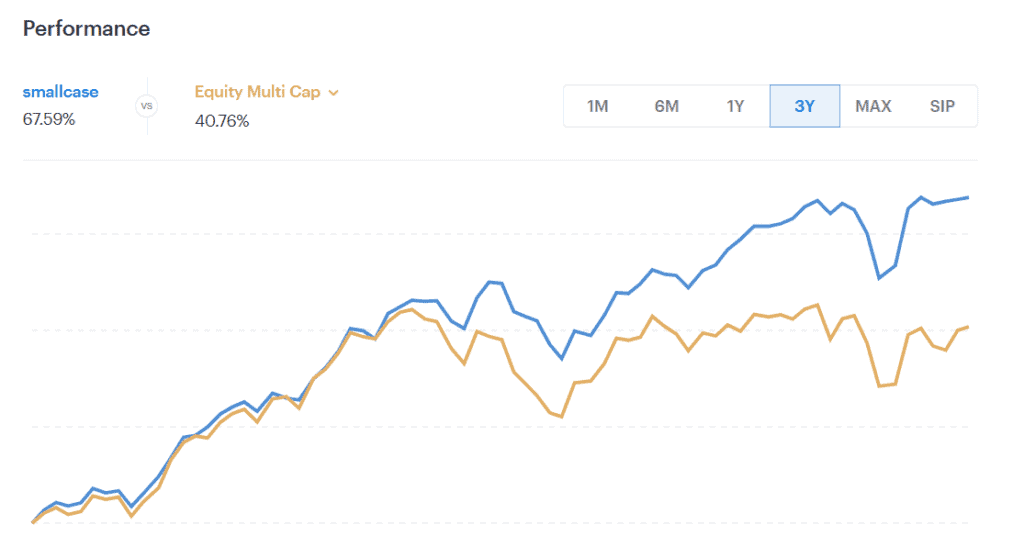
All three portfolios are now live on smallcase:
Prime Index Advantage, Prime Pure Equity, and Prime Core & Satellite ETF. If you’ve been looking for a research-backed mutual fund portfolio with a clear philosophy and disciplined management — this is it.
🎉 Launch offer: 20% off across all three portfolios
Use the codes below at checkout:
COUPON CODE : PRIME20






3 thoughts on “Launching! Our MF portfolios on smallcase”
About MF Smallcase. Prime Pure Equity Fundamentals
I am curious about this MF smallcase. What is the annual subscription amount? Is it over and above the investment money?
The smallcase portfolios are on a flat annual subscription fee. You can invest any amount you wish to – the subscription gives you access to the portfolio and all changes that are made to the portfolio (called rebalancing). How much you invest is your call. Each smallcase has a minimum investment amount, which depends on the portfolio composition. For Prime Pure Equity, this is Rs 34,000 approx. The subscription fee for Prime Pure Equity is Rs 8000 annually, and if you use the coupon code PRIME20, you can get a 20% discount on the fee. – thanks, Bhavana
Please explore another way of supporting investments to potential subscribers (restricted Google sheet like many substack US analysts do, or email to subscribers, website with model MF PF, etc.). Investing through Smallcase would mean it would open another portal account (via MF Utility). Preference is to invest directly via AMC or via Demat rather than opening multiple portal accounts for operational ease.