
February 2026 will be remembered as the month that broke the Indian IT sector’s decade-long narrative of secular growth. The Nifty IT index fell approximately 21% in a single month — its worst monthly performance in twenty-three years, surpassing even the COVID-induced collapse of March 2020. Across eight trading sessions, the sector lost an estimated ₹5.7 lakh crore in market capitalization. TCS saw its market capitalization fall below the ₹10 lakh crore mark for the first time since late 2020, ceding ground to SBI on the market cap rankings.
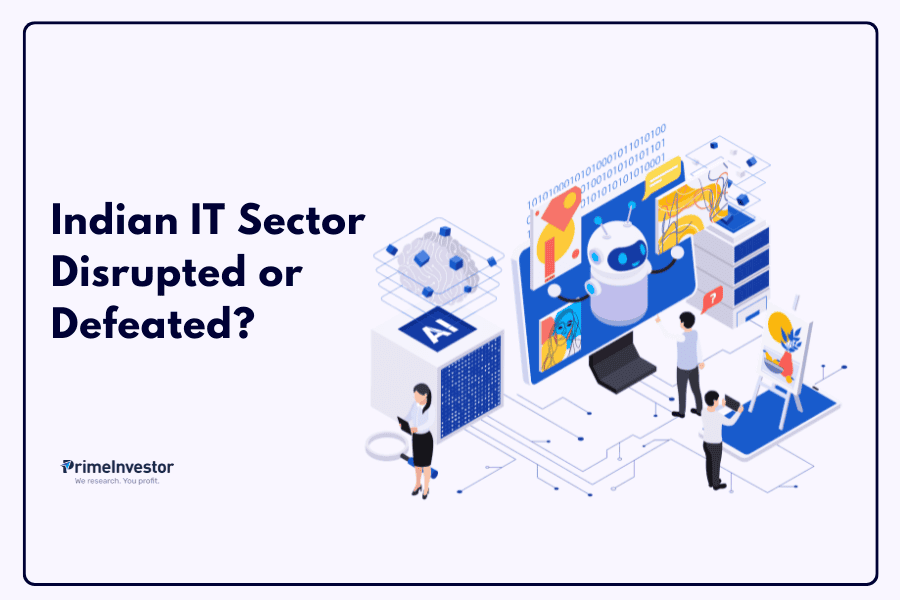
A Citrini Research report published in the final week of February amplified fears further, projecting an acceleration in contract cancellations for Indian IT firms through 2027 — a scenario that triggered another leg down in stocks. From their all-time highs, TCS has now lost over 44%, Infosys is down approximately 27%, and Wipro over 30%. What began as a valuation de-rating has evolved into a structural narrative re-set.
Background: The AI Threat That Was Already Priced In
The threat of AI disruption had already been looming large in the Indian IT services sector, especially with the advent of Agentic AI. This new form of automation poses a threat to the existing headcount-driven billing model, as it would allow clients to achieve the same results with less human capital. At first, Agentic AI seemed to focus on the lower end of the pyramid, which involved repetitive, low-code, and generic IT tasks, thereby raising concerns about utilization and demand for entry-level talent. These tasks unit testing, regression testing, ABAP configuration, data migration scripting, and L1 helpdesk support comprised the largest chunk of billable headcount in large transformation programs.
As a result, companies started to stress upskilling programs to make their workforce AI-ready and reposition themselves higher up in the value chain. Simultaneously, some companies have chosen to pursue inorganic growth to enhance digital, cloud, and platform offerings. For example, TCS acquired Coastal Cloud for $700 million, while Coforge acquired Encora for $2.35 billion, the second-largest acquisition by an Indian IT services company. These acquisitions demonstrate a conscious shift: acquiring companies with their own IP, unique engineering talent, and platform offerings that are more difficult to commoditize using AI than headcount-driven delivery models.
Current Narrative: AI as an Overlay, Not a Standalone Revenue Stream
The present narrative in the IT industry is that the “AI wins” or “AI revenues” reported are not entirely standalone sources of revenue. In most instances, AI is being layered on top of existing digital transformation mandates. The underlying contract is still cloud migration, data modernization, or application transformation. AI improves efficiency, automation, and analytics capabilities within this paradigm, rather than displacing them.
The adoption intensity is presently higher in the BFSI and Healthcare sectors, followed by the Hi-Tech sector. However, the size of the projects is still relatively small and modular. From an economic perspective, the size of the projects is not significant enough for large-cap IT companies to bid aggressively, as the cost structures and revenue models are not aligned with their size. This naturally creates a favourable environment for mid-tier IT companies, which are more nimble and better aligned for smaller, focused AI engagements.
What Went Wrong?
The market had already started discounting Indian IT stocks because of the perceived threat from Agentic AI. However, in mid-February, the sector saw heavy pressure to sell off because of two new, concurrent, and more structural threats. A compounding macro trigger added further fuel: stronger-than-expected US employment data released on February 12 dampened expectations of near-term Federal Reserve rate cuts, placing additional pressure on dollar-earning, export-dependent IT companies whose valuations are particularly sensitive to the interest rate cycle.
The initial trigger was the Anthropic Claude Cowork plugins. Unlike the previous AI offerings that mostly improved developer productivity, this version was aimed at non-coding professionals such as lawyers, analysts, managers, and teams working on legal contract reviews, compliance verification, product management, sales, and marketing. A compliance analyst checking 200 contracts per week, a legal team verifying KYC documentation, a business analyst writing functional specs for an SAP installation, these professionals, typically charging $60-120 per hour, were exactly the kind of work that Cowork is meant to automate.
Essentially, the AI disruption has now shifted up the pyramid to professionals who were hitherto perceived to be in the higher-margin and relatively protected space.
The story changed from “AI as a developer productivity tool” to “AI as your autonomous colleague.” Markets responded not only to efficiency but to substitution of capabilities.
Contrary to the requirements of developer tools, which can only be used by technical professionals, Cowork is intended to be used by non-technical professionals directly – this means that a client’s internal legal or compliance team, for instance, could theoretically perform the work that was hitherto outsourced to Indian IT companies.
Whereas before the worry was that companies would lose staff in the junior developer category but retain ownership of projects, the new worry is more systemic in nature: clients could now potentially cut out Indian IT companies entirely for compliance, legal, data, and finance-related work.
The Second Blow: Palantir and the ERP Disruption Narrative
The second shock to the industry came from Palantir’s Warp Speed solution, which proved the capability to integrate and consolidate data from various enterprise systems, such as SAP, Oracle, Siemens, and SolidWorks, in weeks, rather than the 18-24 months that a typical IT services company would take, and charge for.
To appreciate the importance, let’s take a look at the SAP ecosystem. SAP has been the leading ERP solution since the 1970s. SAP R/2 was the first version, followed by SAP R/3, then SAP ECC, and now SAP S/4 HANA. Importantly, SAP was designed as a financial record-keeping solution, where every operational transaction ultimately posts to the General Ledger. This made it superb for CFO-level reporting but woefully inadequate for real-time operational analytics. It is this very shortcoming that Palantir is now capitalizing on.
A vast majority of global enterprises are still running SAP ECC, which is almost two decades old. SAP had announced that it would stop mainstream support for ECC in 2027, but later extended it to 2030 under customer pressure. The migration from SAP ECC to S/4 HANA has thus become a multi-year money-spinner for Indian IT services companies.
In a conventional large-scale manufacturing environment, enterprises operate multiple isolated systems: SAP ECC for financial and purchasing operations, Oracle for HR and financial components, Siemens for automation, and SolidWorks for product design.
Each system maintains data in different structures, with very little integration between them. As a result, companies engage IT service providers to extract, clean, standardize, map, develop connectors, and provide integrated dashboards. These integrations, traditionally an expensive process of $30-150 million and 18-36 months depending on the complexity of the enterprise, form the revenue stream that Palantir is now competing for in the market.
Palantir’s AI platform is capable of deploying plugins across these systems, integrating data layers, and providing ERP data access in a single, integrated environment in weeks. However, the more fundamental threat to the enterprise’s structure comes from Palantir’s Foundry Ontology, a firm-specific knowledge graph that defines relationships between every entity in the enterprise: suppliers, purchase orders, production plans, quality data. Once integrated, this layer of ontology becomes the intelligence spine of the enterprise, rendering SAP essentially a data source rather than the system of intelligence. At this stage, the S/4 HANA migration and the consulting engagement it entails becomes voluntary rather than mandatory.
If the timelines of migration contracts shrink drastically, the pool of revenue related to long-duration transformation contracts will shrink as well. What was a multi-year, annuity-based billing arrangement may now become a shorter-cycle engagement. Jefferies has termed this structural fear the “SaaSpocalypse” – it is not just a margin problem but a problem with the billing model itself.
Probability of Replacement: How Real Is Client Abandonment?
Indian IT service providers have developed strong customer stickiness over the years, especially in the BFSI industry, where the relationship is weaved into the fabric of core systems, regulatory requirements, and transformation initiatives. The chances of customers suddenly deserting these established players and switching to new AI-native competitors seem remote. Business relationships in enterprise technology are not transactional; they are based on trust, delivery capability, familiarity with regulations, and depth of integration. The cost of switching, both operational and reputational, is high.
The difference, however, is subtle. It is not that customers will suddenly dismiss their Indian IT service providers. It is that the scope of projects will reduce, the timeframes for migration will compress, and new business will never begin in the first place, a slow-burning revenue decline, rather than a sharp fall.
If clients understand that AI can drive material productivity gains and lower delivery prices, the likely course of action is budget reallocation rather than vendor switching. Clients might continue to spend the same amount of money but expect more value, faster delivery, or greater coverage within the same budget. Conversely, they might increase their total budget outlays if AI unlocks new digital business or transformation initiatives.
However, this is contingent on the successful integration of AI into their service delivery models quickly enough by the existing vendors. The structural risk is timing if clients sense that new AI-native vendors can deliver the same value proposition faster and cheaper before the large-cap IT vendors have a chance to adjust, budget reallocation might gradually turn into vendor switching.
A clean sweep of relationships is unlikely unless the large-cap IT vendors fail to adjust either through the development of their own AI capabilities or through strategic partnerships with new AI platforms. The structural risk, therefore, is not displacement but the speed at which the large-cap IT vendors integrate AI into their service delivery models.
Exposure by Service Mix: Not All Firms Are Equal
Not all Indian IT companies are equally vulnerable. The degree of vulnerability is largely a function of their service mix—those with more ER&D and IP-driven revenues are inherently more shielded than those that are headcount-driven SaaS businesses.
Thus, the risk of AI disruption is lower for companies such as LTTS, KPIT Tech, Tata Elxsi and Tata Tech in the short term – their strength is in their deep engineering knowledge of the domain, not in manpower arbitrage.
On the other hand, large-cap SaaS and Generic IT companies such as TCS, Wipro, and Mphasis are under the most pressure regarding their core billing model, as Cowork and the ERP story of Palantir specifically target the workflows that these companies have been charging for all along.
Large-Cap IT Valuations: Opportunity or calls for cautious optimism?
The hard correction has forced large-cap IT companies into what seem to be historically attractive valuations. On the face of it, this offers a chance to buy into high-quality franchises at a valuation that seems to reflect extreme pessimism. The market appears to have discounted a worst-case revenue disruption scenario driven by AI-induced structural threats.
However, this doesn’t mean a simple valuation call will alone work in favour of investors as the role of AI is still evolving.
In this evolving scenario, the valuation comfort driven by headline multiples could be deceptive, as earnings downgrades may follow margin deterioration rather than any material top-line deterioration. The advantage of fresher hiring on margins in the very recent quarters may not be one that will sustain if billing on headcount becomes more challenging going forward.
Currently, the market seems to be discounting extreme pessimism, with widespread disruption across the sector. However, firms with material exposure to ER&D and IP-driven services seem less susceptible, as their value chain transcends manpower arbitrage. In fact, if firms are able to build innovative AI-led solutions or proprietary platforms, the scale advantage could once again favour mid-tier firms, where innovation cycles are shorter and execution flexibility is greater.
The Disruption Paradox: When the Disruptor Needs the Disrupted
Today, AI product firms have developed the capability to disrupt entire sectors. But without a large-scale implementation partner, most of these may be left as proof-of-concept initiatives and not necessarily as enterprise-wide transformations.
Large enterprises, and more so in the BFSI sector, have legacy systems and complexities that are deeply embedded. Indian IT firms have experience spanning several decades in this space. They not only understand the technology stack but also the workflows, compliance, data sensitivities, and integration nuances that are unique to entities such as global banks and insurers. Without this domain knowledge, even the most advanced AI capabilities may find it difficult to scale. In this manner, the disruption capability of LLM developers is multiplied and not diminished when combined with domain-savvy system integrators.
Infosys has put the new opportunity including modernisation of legacy systems using AI tools, which was otherwise not appearing viable, at $300 billion for the legacy services firms as a whole. One possible future is that these AI platforms develop into the foundational layers of enterprises, much like SAP or Salesforce has become the standard enterprise backbone. In this case, Indian IT companies could transform themselves into orchestration partners, who would integrate, customize, govern, and scale these AI systems in complex enterprise environments.
The Strategic Counter-Narrative: Partnerships and New Demand
Even as the selloff deepened, a significant counter-narrative was taking shape. At the India AI Summit in New Delhi in February 2026, two of the sector’s largest players made moves that markets chose to discount but investors should not ignore. TCS entered into a formal partnership with OpenAI, while Infosys inked a collaboration with Anthropic — the same company whose Cowork release had triggered the selloff. These are not defensive gestures. They represent a deliberate attempt to embed Indian IT services at the foundation layer of enterprise AI adoption, rather than be disintermediated by it.
The addressable market framing is also shifting. Gartner estimates that agentic AI software spending will reach $985 billion by 2030, growing at a compound annual rate of approximately 63% from 2025. The question is not whether that spending materializes — it almost certainly will. The question is whether Indian IT firms will sit at the center of that spend as orchestrators, or at the periphery as legacy maintenance providers. The answer depends entirely on execution speed over the next 12–24 months.
Conclusion: Key Takeaways
The February 2026 selloff is not a simple valuation dislocation to be bought mechanically. It is a genuine structural inflection point for a $150 billion industry. That said, the market reaction has conflated two very different categories of risk into a single indiscriminate selloff. Separating them is where the investment opportunity lies.
Takeaway 1: Differentiate by service mix, not by market cap.
Large-cap generic IT players do face a threat to their core billing model from Cowork-style automation and Palantir’s ERP compression narrative. Their valuations, though historically cheap, may reflect earnings downgrades that have not yet fully materialized — particularly if billing intensity on headcount-driven projects softens over the next four to six quarters. ER&D-focused companies (LTTS, KPIT, Tata Tech for example) and IP-led firms (Persistent, HCL Tech as illustrations) have greater structural insulation, as their value rests on domain depth rather than manpower arbitrage.
Takeaway 2: The timing risk is the real risk.
The existential scenario — Indian IT companies being eliminated from client relationships — is unlikely in the near term. Enterprise relationships, particularly in BFSI, are too deeply embedded to be severed quickly. However, if large-cap IT vendors fail to integrate AI into their delivery models at a pace that matches client expectations, budget reallocation could become vendor switching within a two-to-three-year horizon. Investors should track deal win TCV trends, billing rate movements, and headcount utilization as leading indicators of whether this timing risk is materializing.
Takeaway 3: The orchestration pivot is the only viable path for large caps.
The most probable long-term outcome is not replacement but repositioning. If AI platforms become the new enterprise backbone — as SAP was for the 1990s or Salesforce for the 2000s — Indian IT companies must become the orchestration, integration, and governance layer on top of these platforms. The TCS-OpenAI and Infosys-Anthropic partnerships are early bets in that direction. Companies that move fastest on building AI-native delivery frameworks, rather than simply layering generative AI onto existing service lines, are most likely to emerge with their revenue models intact — and potentially expanded. The disruption is real. So is the opportunity embedded within it. The critical variable is execution speed.






12 thoughts on “Indian IT Sector – Disrupted or Defeated?”
Good insights for a non-IT professional.
Thank you sir.
Fantastic take!
Thank you sir.
Excellent article . Very detailed and understandable coverage
Thank you sir.
This has to be the most informative and useful material I have come across on this complex matter! Actionable intelligence! Thank you.
Thank you sir.
This article is thick with high-sounding, pretentious jargon which ends up reading like garbage. Keep the language simple. I had to copy paste the whole thing into AI to make it readable.
I will keep it simple and clear next time.
Thanks,
Sudharsan
This is a well-written analysis. As a customer working with IT vendors, we’ve shifted from adopting AI to demanding clear productivity gains from AI tools. Many Indian IT firms are still early in AI skilling and must invest heavily to keep up with rapid tech changes. We now see AI as a way to modernize applications with lower risk and cost, opening new opportunities for IT companies that know how to leverage these tools. Supporting the article’s point on billing and budget rationalization, we’ve kept our IT budget flat, expecting a 30% productivity boost. IT companies need to move from resource-based to outcome-based billing to stay relevant in this AI-driven era.
Thanks for the positive feedback sir.
Comments are closed.