The EMS (Electronics Manufacturing services) industry was the darling of the market in the post-COVID world. Stocks such as Dixon Technology, Kaynes Technology, Syrma SGS, and Amber Enterprises surged on the back of a roaring bull run, aided by a confluence of policy tailwinds — Atmanirbhar Bharat, Make in India, the China+1 strategy, and the PLI Scheme — that provided fertile ground for the sector to flourish.
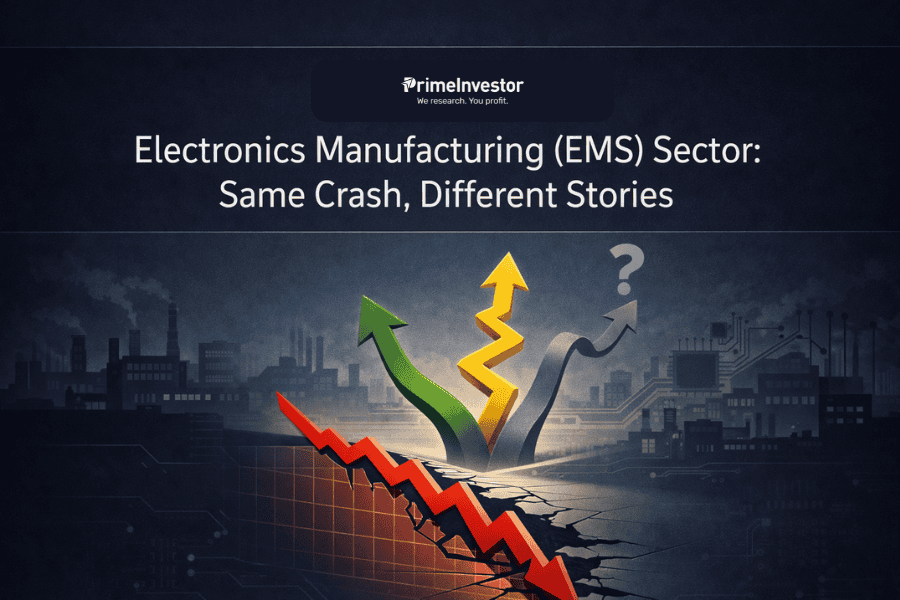
Since September 2024, however, the sector has been under significant pressure. The two industry leaders, Dixon Technology and Kaynes Technology, have shed 50% or more of their market value. The broader EMS universe has also corrected sharply, to varying degrees — driven by demand volatility, missed revenue projections, and surging input costs, particularly memory chips. In several cases, these pressures were compounded by working capital and cash flow stress.
This report attempts a deep dive into the saga — examining where each EMS company stands and how it is positioned: to struggle, survive, or thrive.
The EMS industry leaders tell the whole story
The best way to understand why the EMS crash is not one story but many is to start with the two companies at the top. Dixon Technology and Kaynes Technology are both industry leaders, both down more than 50%, and both operating in the same sector under the same macro headwinds. Yet the reasons behind their respective falls are fundamentally different — and that difference is the key to understanding the entire EMS landscape.
Dixon vs Kaynes: Same Fall, Opposite Reasons: Dixon is in a deliberate transition — steadily moving up the value chain through backward integration. It is a free cash flow generator with a robust manufacturing scale, reflected in its massive topline. Despite wafer-thin EBITDA margins, it sustains a ROCE in excess of 35%, and its inventory turnover remains exceptional. Even as inventory growth has been higher than usual, cash conversion has never been a problem. Dixon’s near-20x revenue growth in under a decade has come without straining its balance sheet.
Kaynes presents a contrasting picture. While it has always positioned itself as a high-tech EMS company, it has not yet established a durable competitive moat. Its business carries a high concentration of government contracts, and participation in open mass markets inherently means lower inventory turnover and a continuously swelling inventory — the opposite of Dixon’s OEM-driven model, which delivers stable order books and predictable working capital terms.
The deeper issue at Kaynes is one of strategic overreach. At its core, it is a PCB manufacturing and assembly company. Its long-term ambitions in OSAT, box-build, and smart metering are strategically sound in theory, but execution has proven far more capital-intensive than anticipated. To enter these markets, Kaynes has relied on acquisitions — Iskraemeco for OSAT and Sensonic for box-build — but both are loss-making with negative net assets and have added significant goodwill to the balance sheet. The real burden is structural: the funding for all this capital expenditure must be generated from the PCB core business, which itself is cash-stressed.
The smart metering vertical adds another layer of risk. It is milestone-dependent, contingent on government execution targets, and while it has boosted the topline, it cannot support premium valuation multiples on a sustainable basis. The market’s concern crystallised when Kaynes reported negative Cash Flow from Operations in FY25.
Dixon’s challenges are of a different order entirely. A guidance cut on smartphone shipments following the memory price surge, potential margin pressure, and a broader market correction have weighed on its rich valuation. Meanwhile, Dixon is expanding into fingerprint sensors, camera modules, and displays — through JVs and acquisitions that will consume capital in the near term and could elevate debt, though likely within manageable limits. Critically, Dixon is expanding from a position of strength, with the internal cash generation to absorb short-term pain.
Kaynes, by contrast, is attempting to fund multiple loss-making businesses simultaneously, without the internal cash generation to sustain the pace. Multiple QIPs have provided balance sheet support, but they have not resolved the underlying cash generation problem.
The Rest of the Pack: Same Sector, Very Different Stories
While Dixon and Kaynes illustrate the extremes, the rest of the EMS universe — Amber Enterprises, PG Electroplast, and Syrma SGS — each carry their own distinct dynamics. Some are undergoing genuine transformation, some are riding strong product tailwinds, and some are quietly accumulating risks not yet fully reflected in their valuations.
#1 Amber Enterprises – Transformation Underway, But Working Capital Needs Watching
Amber is India’s largest room AC contract manufacturer, and it is deliberately expanding into electronics through aggressive PCBA additions while consolidating its existing electronics verticals. On the surface, the story looks compelling: EBITDA growth is strong, the balance sheet has improved markedly with net debt-to-EBITDA falling to 0.26x from 1.22x a year ago on the back of a ₹1,000 crore QIP, and its EMS subsidiary has attracted PE backing from ChrysCapital.
However, Amber is in aggressive capacity build mode, and capital consumption — both in fixed assets and working capital — is high. A hot summer this year could act as a meaningful tailwind for its AC contract manufacturing business, accelerating inventory liquidation and freeing up capital. Unlike Kaynes and Syrma, Amber does not carry a goodwill overhang. But the working capital assumptions embedded in its transformation story need to be validated through sustained operating cash flow performance before the narrative can be accepted at face value.
#2 PG Electroplast – The Star of the Recovery, But What Lies Beneath?
PG Electroplast has been the standout performer in the post-correction EMS recovery — and by conventional metrics, rightly so. EBITDA nearly doubled, net worth surged from ₹396 crore to ₹2,828 crore driven by a well-timed QIP, the company turned net cash positive, ROCE hit an all-time high, and 77% revenue growth made it the sector’s best performer.
But beneath these near-perfect headlines is one number that demands explanation: operating cash flow turned deeply negative in FY25. The reason is almost entirely one item — inventory grew 272% in a single year. For an ODM player in room ACs, a near-3x inventory build is not a seasonal adjustment; it raises a fundamental question. Is this pre-positioning ahead of a blockbuster summer season, or production running ahead of actual offtake? The FY26 numbers will provide the answer.
Compounding the concern, related party advances grew 714% in the same year. In isolation, each data point might be explained away; together — negative operating cash flow, a 272% inventory build, and a 714% jump in related party advances — they are harder to dismiss. The QIP has provided balance sheet resilience, but the business’s ability to sustain itself on internally generated cash remains an open question. If inventory monetisation disappoints in FY26, what is currently a footnote will move to the centre of the investment debate.
#3 Syrma SGS – A Quiet but Compounding Tension
Syrma does not attract attention through governance concerns or headline cash flow failures. Its tension is quieter and more structural. As a precision EMS player in the high-mix, flexible-volume space, it serves industrial customers, defence procurement entities, government-linked buyers, and railway operators — all of whom are structurally slow payers, with standard payment cycles of 90 to 120 days.
This is not a cyclical problem. DSO has deteriorated from 77 days to 120 days in a single year. At that DSO on a revenue base of approximately ₹3,787 crore, Syrma is effectively financing nearly four months of its customers’ working capital while simultaneously carrying the burden of imported raw materials. The tension is invisible at the EBITDA level but becomes unmistakable at the CFO-to-EBITDA level.
The Johari Digital Healthcare acquisition adds a separate concern. Syrma wrote off goodwill of ₹322 crore against revenue of just ₹111 crore and PAT of ₹29 crore — a premium that sits uncomfortably with conservative capital allocation. The sellers retained a 49% stake, meaning Syrma does not exercise full control in this vertical.
Most anomalous of all is the trajectory of related party advances — an 18x increase in two years, the steepest of all five companies in this analysis. For a company that has consistently marketed itself on institutional credibility and technical depth, this is a troubling signal that has not yet been interrogated by the market.
Syrma is, in essence, trying to be two things simultaneously: a reliable industrial EMS partner for complex, long-cycle customers, and a high-growth medtech and export-oriented business with aspirational valuation. The working capital demands of the first are currently overwhelming the earnings quality of the second — and that tension is not yet priced in.
The Policy Reset: ECMS and What It Means for Each Player
Just as the market was recalibrating to the end of the PLI-led growth cycle, the Union Budget 2026-27 announced a significant policy shift. The government has nearly doubled the allocation under the ECMS (Electronic Component Manufacturing Scheme) programme to ₹40,000 crore, with an explicit objective of moving India from an assembly hub to a high-value manufacturing hub. This is not an extension of the old PLI story — it is a structurally different ambition.
For Dixon, the timing is particularly fortuitous. Dixon’s Electroconnect has already secured approval under ECMS for optical transceivers, and its recently acquired Kunshan Q Tech has received approval for camera module sub-assemblies — the very categories that ECMS prioritises. The acquisitions that the market treated as near-term pain are now directly aligned with the programme’s approved components. Dixon did not stumble into ECMS; it was already moving in the right direction.
For Kaynes, ECMS is a double-edged sword. Its OSAT and PCB ambitions are well-aligned with the scheme’s priorities, but cash flow discipline must precede any ability to capitalise on the new incentives. A policy tailwind is only as useful as the operational platform capable of harnessing it.
For Syrma, the component-deepening agenda of ECMS is relevant to its precision and industrial focus. But the structural DSO deterioration and the working capital squeeze it creates will absorb a significant portion of any incremental incentive before it flows through to earnings quality. The receivables problem must be addressed first.
The Bigger Picture
ECMS has the potential to generate over ₹10 lakh crore in output over six years and position electronics as India’s second-largest export category — a vision considerably more ambitious than the PLI scheme was ever designed to achieve.
But ECMS is not a rescue programme. It will not paper over balance sheet stress, fix structural working capital problems, or substitute for the internal cash generation discipline that separates companies capable of sustained compounding from those that will perpetually dilute to survive. The policy tailwind is real and significant — but it will disproportionately reward the companies that have already built the operational rigour, financial resilience, and technical capability to meet it on its own terms.
In the EMS sector, the crash may have been the same. The recovery will not be.