Recently, a Parliamentary Standing committee came out with a policy proposal that had many cheering. Why can’t the government decide the room rates that hospitals can charge? If you or a family member has been hospitalized for any reason, this may seem a very just move. After all, hospitals do ratchet up unaffordable bills even for minor ailments.
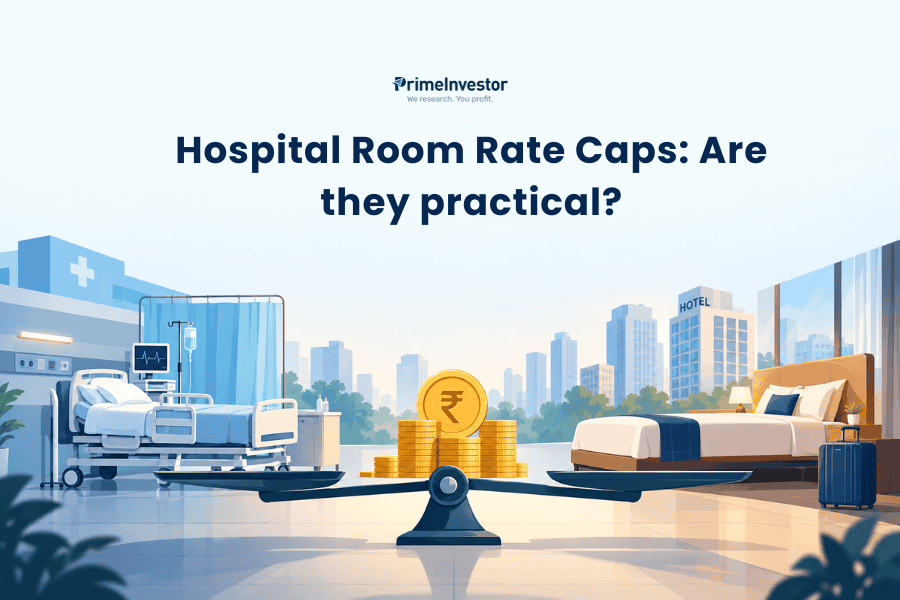
But is it practically feasible and what can it mean for investors on hospital stocks? That’s what we dissect here.
The context: One line in a voluminous report
Can private hospitals in metro cities be required to benchmark their room rates to nearby 3-star hotel tariffs? This was a recommendation from the Parliamentary Committee on Affordability and Accessibility of Healthcare Facilities in Public and Private Sector that created a lot of buzz.
Room rates are far from the central theme of the 361-page report. The report starts by setting a backdrop on why affordability and accessibility is in focus now. It highlights several areas of concern including:
- Public spending on secondary and tertiary care remains disproportionately low which pushes dependence on private care for most healthcare requirements beyond the basics.
- The ‘missing middle’, (sections of the population that are not poor enough to qualify for Government schemes but are also not in a position to afford private insurance), whose finances are left vulnerable should a health crisis strike.
- Physical availability doesn’t mean much on its own, since many Government centres face acute manpower shortages.
- Therefore, households incur huge ‘Out-of-pocket’ expenses on healthcare despite government schemes and insurance.
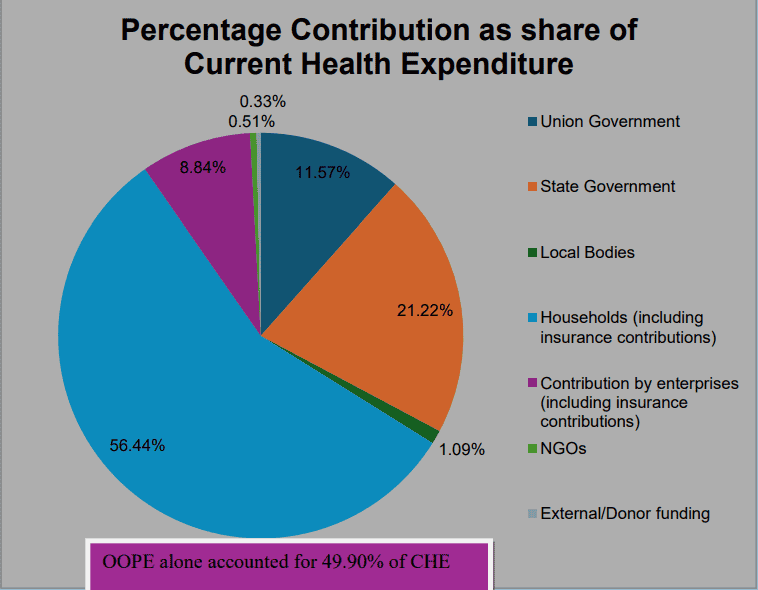
Source: Parliamentary Committee paper
Healthcare in the private sector costs more. This was also highlighted not so long ago in the latest National Statistical Office survey (80th round of the National Sample Survey January-December 2025). So stark is the difference that this topic alone has received a lot of attention in the media (and even inspired a few books on questionable practices hospitals resort to) for some time now.
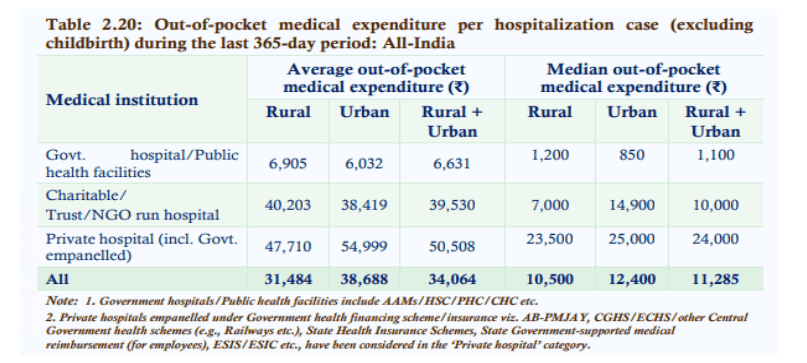
- The perceived difference in the quality of healthcare between the private sector and Government healthcare in India.
With this backdrop, the recommendations broadly fall into four buckets: Government measures (higher public spending, PPP models, skill-building, more free medicines, better dental/psychiatric care, more preventive NCD measures), private hospital measures (cross-subsidising, published rates, standardised treatment guidelines, upfront cost estimates, higher bed reservation, FDI caps, the 3-star hotel room-rate benchmark, and elimination of room-rent-linked pricing), insurance reforms, and drug/device cost controls. However, it is the paragraph below that caused a stir on hospital stocks.
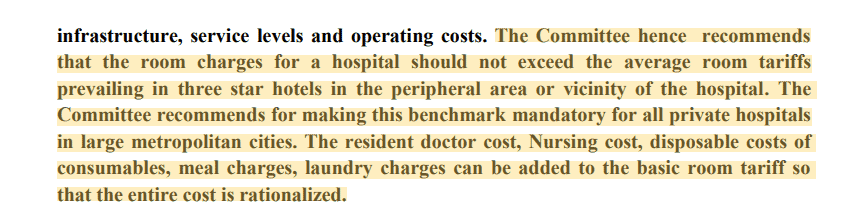
Source: The Parliamentary Committee paper
Why room rate caps are unlikely in this form
However, we believe that the likelihood of the room rate caps coming into effect in the manner proposed in the paper is low and here is why.
It is one recommendation among dozens
The room-rate line grabbed headlines likely because it is contentious and taps into a long-standing ‘private care costs too much’ narrative. But it sits inside a document that also tackles Government care quality, insurance robustness, device and drug pricing, trade margin rationalisation, and distribution practices among much else. The report’s other stated priorities (pandemic preparedness, antimicrobial resistance, oncology, Tuberculosis, geriatric care, and the growing NCD burden) all require a robust healthcare system if they are to get the attention they deserve.
Recommendation, not regulation
The room rate cap proposal is currently only a recommendation in a Standing committee report. Such recommendations if at all they turn into reality usually take a 1 to 2-year time frame. Turning a recommendation into enforceable policy requires Central legislation first. Then comes the bigger hurdle. Health is a state subject in India. Implementation would therefore depend on individual States choosing to adopt the Central model law. In the case of the Clinical Establishments Registration and Regulation Act, 2010 for instance, Tamil Nadu has not adopted it.
Before any of that, there would also need to be industry consultation to arrive at final caps, if any.
Source: Manipal Hospitals RHP
Some form of room rate caps already
The industry can argue that informal caps on room rent are already in place, thanks to insurer-set limits. Health insurance plans routinely cap eligible hospital room rent (through a fixed daily rupee amount, a percentage of sum insured, or a specified room category). Once that cap is breached, the entire bill gets settled at a proportionately reduced ratio, leaving the policyholder to cover the gap. Further, Government schemes also come with prescribed room rates and central government departments and PSUs fix negotiated’ room rates with private hospitals. In effect, private hospitals are already working with some form of room rate caps.
Rate caps can hurt bed availability
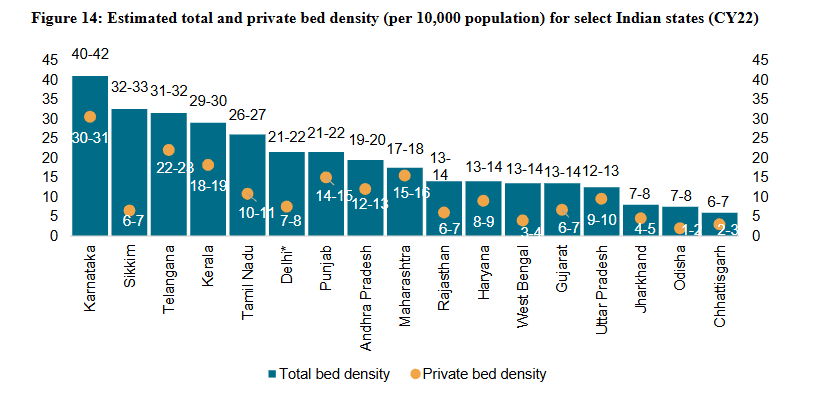
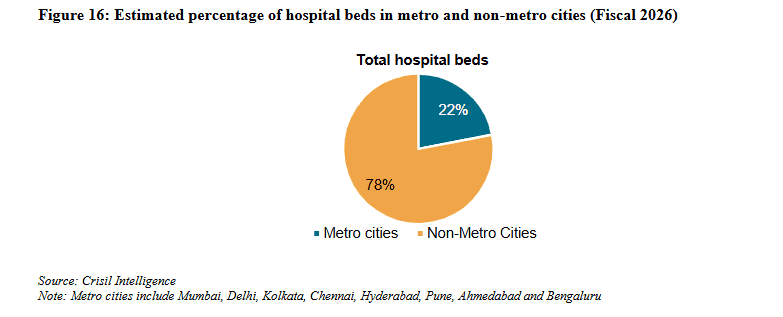
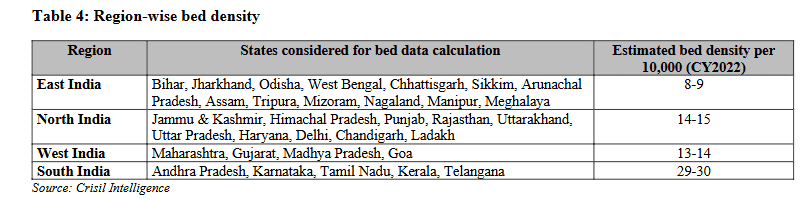
India doesn’t have enough hospital beds to begin with. The country lags globally on hospital bed density (beds per 10,000 people), and existing capacity is heavily skewed toward metros and some states, leaving other regions underserved.
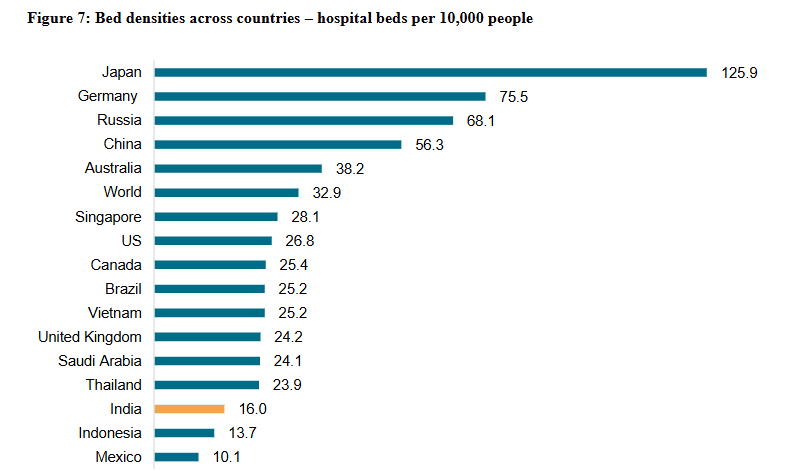
Source: Manipal Hospitals RHP
Source: Manipal Hospitals RHP
Source: Manipal Hospitals RHP
This is why listed hospital chains are in the midst of aggressive capacity expansion. ICRA estimates that 18 large chains will add over 34,000 beds between FY26 and FY30, a nearly 50% increase over their existing capacity. Interestingly, this only adds roughly 2.3 to 2.5% to India’s total private bed capacity. Sustained occupancy and faster break-even at new facilities point to the real, unmet demand for quality care.
In this context, private hospitals are already carrying the bulk of the load. They account for over 60% of inpatient care and 70% of outpatient care (per the Parliamentary Committee report), especially in urban areas. Any cap on room rates at this juncture can curtail capacity expansion by private hospitals, worsening the bed problem.
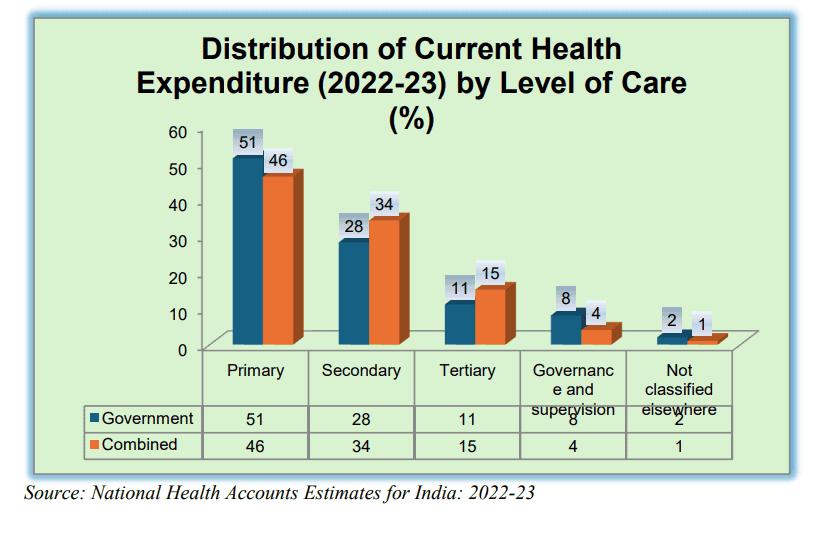
Public healthcare remains the backbone for rural and low-income populations especially in primary care. But it’s plagued by infrastructure deficiencies, workforce shortages, and overcrowding, which pushes more patients toward private care. Public healthcare spend is also skewed heavily toward primary care, leaving a secondary/tertiary care gap that private hospitals are filling. Scaling Government care to match private sector quality across a country this size isn’t just a short or medium term project.
In short, there is no near-term substitute for private hospital bed capacity.
Hospital business is challenging
There aren’t many players waiting in queue to enter the hospital business because it is almost as challenging as the airline sector, to be in. The cost per bed for a multi-specialty hospital has risen from roughly Rs. 1 crore five years ago to around Rs. 2 to Rs.2.5 crore today, largely driven by land and equipment. This inches up higher when specialities like Oncology, Cardiology, or robotics-enabled care enter the picture. Most large equipment is still imported, and currency depreciation hasn’t helped.
The Committee’s own report acknowledges this tension that rising costs for supplies, medication, and equipment combined with Government price caps under schemes like Ayushman Bharat and CGHS continuously squeeze margins for private hospitals. Which is why even while pushing for uniform adoption of the Clinical Establishments Act, the report also calls for package rates under Government schemes to be periodically rationalised, so private facilities can sustain quality care without revenue instability.
Capping returns further, in the very segment currently funding new capacity, risks slowing the expansion in healthcare that India actually needs.
What the industry expects
PrimeInvestor spoke with senior management across several listed hospitals to gauge their reaction. The consistent commentary has been that a 3-star hotel room is simply not a valid comparison point. This is also the response of Viren Shetty, Vice Chairman of Narayana Health on television.
NATHEALTH, a private healthcare body with representation from the major hospitals and healthcare sector players and presided by Sangita Reddy, Joint Managing Director of Apollo Hospitals, has already opposed the room-rate cap proposal. Managements do expect some change but just not in this form. What they anticipate is greater disclosures around room rates and procedure pricing.

Let experts manage your wealth
At PrimeInvestor, our Portfolio Management Services are built on one principle: protect on the downside, compound on the upside. Whether you’re starting your wealth journey or looking to bring discipline to an existing portfolio — we have a strategy for you.
Explore our PMS →They also point to a factor the hotel comparison ignores entirely: hospitals need far more manpower per bed than hotels do, and the need to attract and retain top doctors and nurses which is critical to quality of care. Hospitals also need to keep investing in the latest technology (robotics, post-surgical care infrastructure and more) that directly affects patient outcomes and is a key factor doctors weigh when choosing where to practice.
The takeaway
In India, regulatory disruptions can make or break a sector. Government control of pricing is one of the most disruptive forms of regulation for any sector. However, we think that the hospital room rate caps are unlikely to be implemented in their current form.
Billing transparency, standardised published rates, better insurance coverage are all possibilities. Room rates too could be impacted but the chances are that it will not be as dramatic or as drastic as has been proposed. Therefore, any market over-reaction could throw up opportunities to invest in the better players in this secular growth sector. Our earlier report on the multi-speciality hospital sector in India detailed how this sector should be assessed.
In PrimeInvestor we track the hospital sector closely and own a healthy weight in healthcare in our Prime Velocity portfolio. If interested, schedule a call with us