A couple of weeks ago, we saw a rally in the stock prices of a few pharma stocks. They were responding to news that the USFDA had approached Indian generic manufacturers to help address a shortage of critical oncology drugs in the US. It wasn’t clear which generic (USFDA approved, clinical copy of a brand-name drug once it has crossed patent exclusivity) makers had been approached, but the market made its own assumptions and conclusions, which led to the rally in select stocks.
This shouldn’t surprise anyone, given that India is the largest generic drugs maker in the world, with over a third of our pharma exports heading to the US. India is also home to the second-largest number of USFDA sites, the highest number outside of the US.
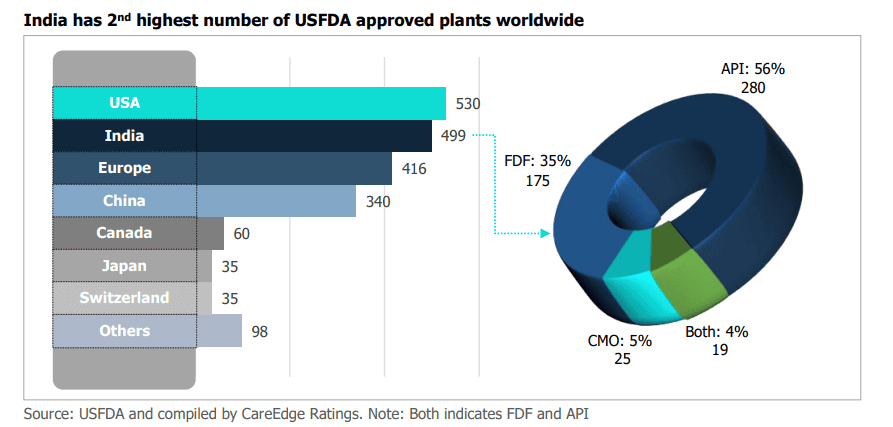
Source: Care ratings report
But it isn’t a cakewalk for pharma companies to export to the US generics market, or other regulated markets for that matter. Manufacturing sites are required to meet rigorous standards, which are verified via inspections.
We take a look at USFDA inspections and their outcomes, and how they play into the fortunes of pharmaceutical companies.
CGMP – How drug manufacturing for the US market is regulated
All drugs sold in the US need to be manufactured under Current Good Manufacturing Practices (CGMP) per the Federal Food, Drug & Cosmetic Act (FD&C Act). This is irrespective of whether they are manufactured within the US or outside of it.
Any facility that manufactures products for the US market is required to register with the FDA, listing its products. CGMP inspections are then carried out by FDA officials or their representatives to ensure compliance with CGMP requirements. An inspection can happen at the pre-approval stage, before the drug hits the US market, after a facility starts manufacturing for the US market, when it becomes subject to routine CGMP surveillance or if other circumstances or information warrant it, known as ‘for cause’ inspections.
As one would expect, inspections dipped during the pandemic years but have now ramped back up to pre-pandemic levels from 2023 onwards. A CareEdge report places the number of inspections in India at 259 in 2018, falling to single digits in 2021 before rebounding to 256 in 2024.
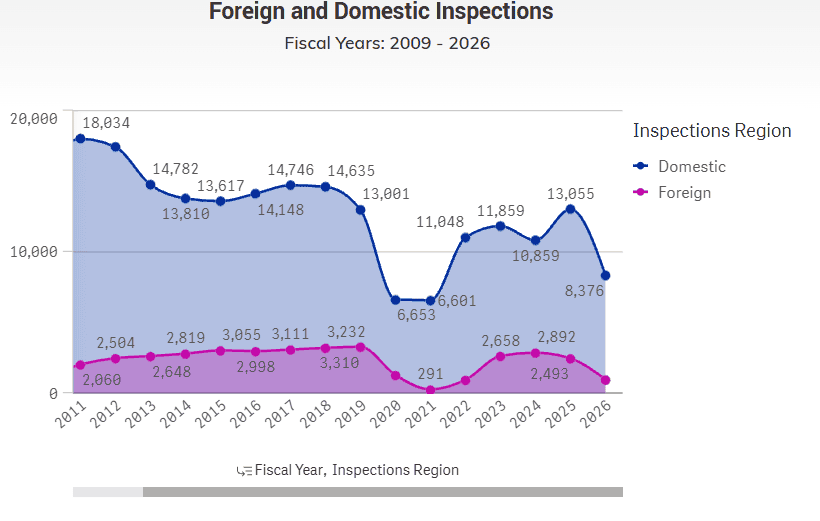
Source: USFDA
Historically non-US sites have enjoyed the benefit of inspections with notice. But in recent years, the FDA has, in an attempt to step up the regulatory oversight of non-US manufacturing sites, moved toward unannounced inspections in non-US locations too. This was after a pilot of unannounced inspections in India and China.
Inside an inspection
Unless it is an application inspection or a ‘for cause’ inspection, sites are selected for inspection on the basis of a risk-based site selection model used by the FDA. This model takes into consideration factors such as the site’s compliance history, the products it manufactures, time since the last inspection etc.
During the inspection, the inspector could cover all or a few of the following six aspects of the facility: Quality, Facilities & Equipment, Materials, Production, Packaging & Labelling and Laboratory Control. While Quality always forms a part of the inspection, the inspection could cover two or more of the other areas.
Everything that was covered in the inspection is documented in the Establishment Inspection Report (EIR). The inspection ends with the Form 483 which details the findings / violations if any. This is usually done after a discussion with the management at the close of the inspection. The form 483 is provided to the management of the company that was inspected. They usually need to respond to these findings within 15 days.
Observation classifications – the report card
The 483 is not the end. The USFDA (usually within 90 days from the inspection) sends a letter to the inspected company classifying the observations / violations based on all the evidence collected and responses of the management including proposed corrective action. The classification tells you how serious the observations are.
The following are the possible classifications of the findings in the form 483.
- NAI – No Action Indicated
- VAI – Voluntary Action Indicated
- OAI – Official Action Indicated
NAI and VAI are the outcomes an inspected company would like to have for a facility. These mean that the inspected facility was found to be CGMP compliant. In the case of NAI, no Form 483 is issued. In the case of VAI, however, while the agency found objectionable conditions, these are deemed things that the firm can correct voluntarily, and a Form 483 is usually issued.
OAI is the dreaded finding. Not just for the pharma company, but also for shareholders, if the company is a listed one. This means the inspected facility was not CGMP compliant and the organisation could face regulatory action.
Depending on the severity of the lapses, the firm could receive an untitled letter (less severe) or a warning letter (warning of more severe action and demanding a written response). This could result in stalled approvals, paused government purchase contracts, drug recalls, and import alerts.
The USFDA gives the inspected company an opportunity to voluntarily take corrective action taking into consideration several factors, including the severity of the lapses and the effect the action would have on the market (drug shortages, for instance).
Post this the company will need to take remediation measures and have a follow up inspection to verify if the facility is compliant. (Here is a useful infographic on inspections).
As in the case of this example, the USFDA has demanded a response within 15 days and corrective action from the inspected firm. The USFDA has also asked the firm to stop supplying to the US market and carry out a drug recall. In an indication of the severity of the lapses, all the products from this firm were placed on import alert meaning they cannot legally enter the US.
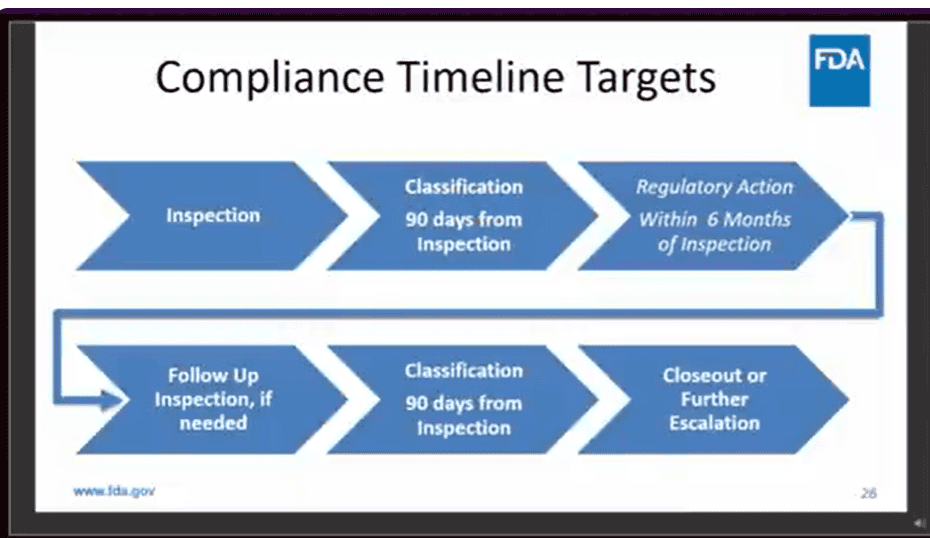
Source: Video by the USFDA
What it means for investors
When a listed company’s facility gets inspected, you’ll usually hear about it in the news, but it’s not all bad news. USFDA data from the Inspections Classification database shows that only a small percentage of inspections actually result in an OAI, and by and large, establishments come out clean even in India.
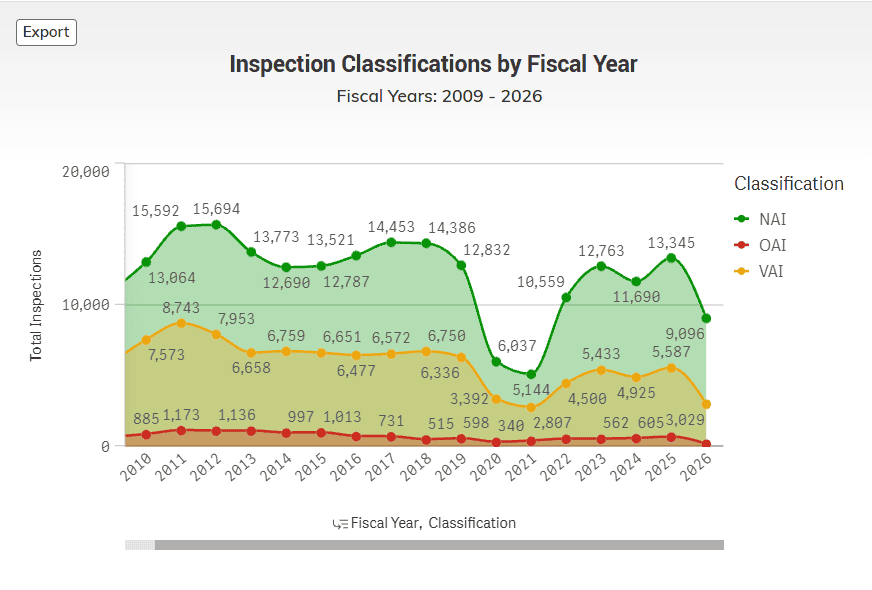
Source: USFDA
A few recent examples show just how differently these episodes can play out:
Dabur India which makes several consumer health and OTC products had one of its manufacturing facilities flagged by the USFDA for data integrity, manufacturing and maintenance lapses including finding a live bird and bird droppings in the raw material storage area. This resulted in an import alert for drugs made at that plant. The stock corrected on the day the news broke, but the impact was neither significant nor prolonged.
The things that helped in this case were that the import alert applied only to products made in one section of the plant, those products made up a negligible share of overall revenue (over 90% of Dabur’s business is domestic), and the company moved quickly on corrective action and alternate sourcing.
Granules India has a Telangana plant under a USFDA warning letter. The company has undertaken remediation, but the letter remains in place while the plant awaits re-inspection.
Torrent Pharmaceutical recently earned a clean bill of health for its oncology facility. Its Dahej facility came away with zero observations, and its Indrad plant received a VAI classification. This marks a turnaround from a rough patch between 2019 and 2022, when the company dealt with OAI ratings and warning letters.
Sun Pharmaceuticals’ Halol plant underwent an inspection in June 2025 that resulted in a form 483 with 8 observations and an OAI classification. This plant was placed under import alert in September 2025 and continues to remain so. But this is not a new or an isolated event. This plant has been having a chequered history with USFDA inspections for several years now as can be seen from the infographic below.
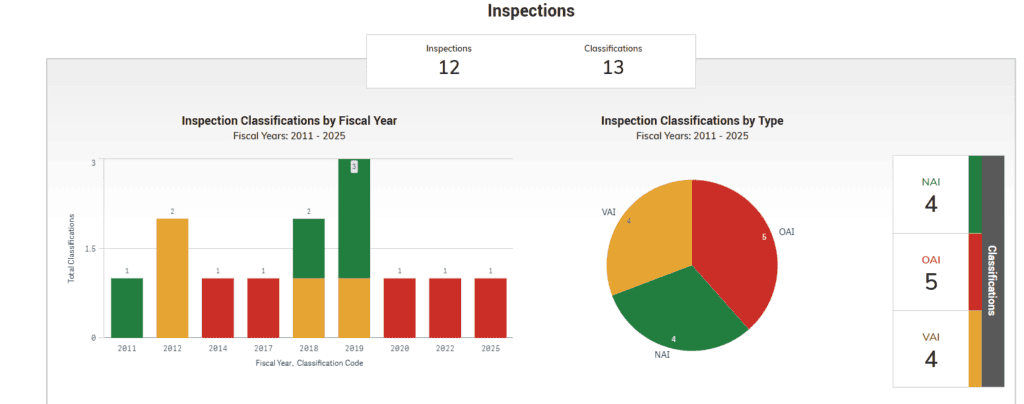
Source: USFDA database (data pertaining to Sun’s Halol plant)
A look at the timeline of inspections on the USFDA database for the Halol plant is peppered with warning letters, import alerts and even a recall when a glass particle was found inside a pre-filled syringe.
This report by Propublica (a non-profit watchdog) hints at the import of medicines from Sun’s problematic plants being allowed despite serious lapses only to avoid shortages.
Sun’s other US facing facilities too have not had a smooth ride. The Baska facility received an OAI status after inspections in September 2025 (classified as OAI in December 2025). The Dadra facility is still operating under an unresolved warning letter from the US FDA. Two of the product recalls initiated by Sun in 2026 in the US market can be traced back to the Halol and Baska facilities.
Cipla, a major generic exporter to the US, has had a largely favourable inspection record in recent months — with one notable exception. Pharmathen, its manufacturing partner in Greece that makes complex injectables (specifically Lanreotide for the US market), was inspected in November 2025. The resulting form 483 flagged serious issues. Cipla’s stock took a hit, first when the observations were classified as OAI, and again when an import alert followed in April 2026.
Lanreotide is one of Cipla’s top US products, where it held a 20%+ market share. This new development means that the company effectively has to sit out this opportunity until the issues are resolved. This weighed on both revenue / margins and forecasts. Since then, the stock has recovered some ground, helped by a strong FY27 launch pipeline, de-risking measures, a VAI rating at its own Goa plant, and a successful pre-approval inspection at its US subsidiary.
Cipla’s track record is worth a closer look, because it shows both sides of the coin. In 2023, a warning letter at its Pithampur plant delayed the launch of its generic version of GSK’s Advair Diskus (an asthma and COPD drug), and the stock corrected on the news. Pre-COVID, its Goa plant received its first-ever warning letter, delaying the launch of a generic version of Bristol Myers Squibb’s Abraxane, a cancer drug.
The company eventually overcame this and launched generic Abraxane in FY26. The Pithampur plant is still working through its OAI issues, but Cipla has since de-risked by moving the Advair launch to another site. This is now slated for FY27.
The broader takeaway from the above examples is that an OAI rating isn’t the end of the road. In the short term, it can mean stalled approvals, import alerts, and a hit to revenue and margins. But resilient companies can and do recover. They typically respond with a Corrective and Preventive Action (CAPA) plan, bring in external consultants, and push for re-inspection.
For investors, a few questions are worth asking whenever a company runs into inspection issues:
- How serious are the issues? Some issues like a manufacturing lapse are easier to fix than serious data integrity problems.
- What’s the company’s track record? Has it handled adverse findings well in the past, and how quickly did it remediate? Are they persistent issues?
- How exposed is the business? What share of revenue and profit will be hit by the affected facility?
- What’s the de-risking plan? New launches, alternate sites, diversification.
- Is the rest of the business healthy? Financial strength and management quality can make all the difference in how well a company weathers the setback.
Put together, these factors help in telling the difference between a temporary stumble from a deeper issue. Sometimes, a stock price correction on inspection news is simply an opportunity to buy a solid player at an attractive valuation.
Disclaimer: Stocks are mentioned for illustrative purposes only and are not to be construed as recommendations.