
Among the various services we offer at PrimeInvestor are PMS products that manage mutual fund portfolios. I always clarify to potential clients that for us, PMS is just the regulatory wrapper we use to deliver holistic wealth strategies—a departure from the typical stock-only PMS.
When I present this, investors almost always ask the same thing: ‘Why should I pay you to manage my mutual fund portfolio when I am already paying the fund managers?’
I completely get why they ask this question. On paper, it looks like you’re paying twice: once to the fund house, and again to us for the PMS overlay.
But that overlay is where the real value lies. Here’s why it’s worth every rupee.
A single violin does not make an orchestra
Let me start with a simple analogy (and I’ll end with another later on).
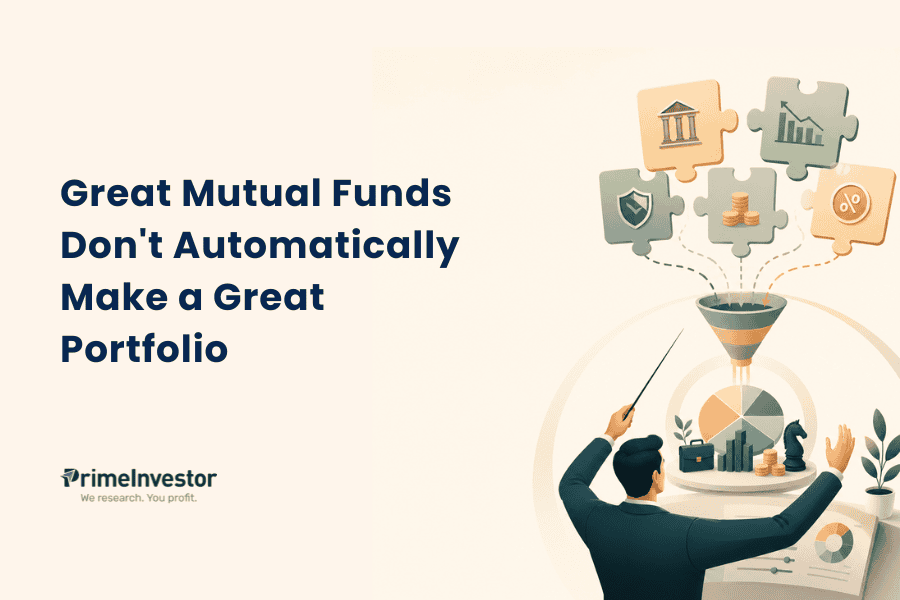
Instrumental music is enjoyable when many instruments come together to play in an orchestra. A single violin does not make an orchestra, even if played by a virtuoso. If different instruments are all playing all their own tunes in different notes, this results in a cacophony, not music! A conductor organizes separate instruments into an orchestra, and delivers a musical performance.
You see where I am going with this. Fund managers, even the best of them, are like expert players. You need a portfolio manager to make them work together and produce something of value to suit your needs.
Micro vs Macro
First, we should realize the difference between the fund manager’s mandate and that of a portfolio manager. The fund manager’s sole goal is to generate alpha over the market. He or she cannot and does not worry about an individual investor’s life goals, risk appetite or even investing horizon. The fund manager simply manages a pooled vehicle to deliver returns.
The portfolio manager on the other hand, looks at it from a higher plane – the macro level. Their vision is broader in one sense – building a portfolio out of multiple asset classes and instrument types. It is narrower in another sense – they are concerned with you, the investor. Your time frame, risk profile, need profile, and goals.
The Blind Spots
Because fund managers operate in silos, they have blind spots that can severely impact your wealth.
The most common is the overlap trap. An investor might buy five different ‘best-in-class’ flexicap funds, believing they are diversifying. What they don’t see is that all five funds likely hold the same top ten stocks. The fund managers are doing their jobs perfectly by picking the best companies, but the investor’s portfolio is dangerously concentrated. A portfolio manager catches this cacophony and strips out the duplication.
Then there is mandate rigidity. A small-cap fund manager is bound by rules to stay mainly invested in small-cap stocks, even if they believe the market is dangerously overvalued. They cannot move to cash. A portfolio manager, however, can tactically reduce your equity allocation and shift that capital to debt or arbitrage funds to protect your downside. Portfolio managers manage the *risk* of the total portfolio, not just the return of a single fund.
The Contextual Edge
A fund manager does not know you. They don’t know your tax bracket, they don’t know you are buying a house in two years, and they don’t know if you are prone to panic-selling.
A portfolio manager weaves your investments into the fabric of your life. They map funds to your specific goals—using an equity fund for a retirement that is twenty years away, and a low-duration debt fund for a car purchase next year.
They closely track fund performance to make sure that the weeds choking portfolio returns are pruned in time. They monitor for your desired asset allocation and correct drifts through rebalancing.
The Behavioral Moat
Finally, there is the unglamorous reality of investing: human emotion. When the market drops 15%, a mutual fund manager will give out a standard media interview asking everyone to “stay the course.”
But watching your hard-earned money evaporate is terrifying. A portfolio manager acts as a behavioral coach. We contextualize the fall within your specific portfolio, reminding you of your long-term plan and stopping you from making a ruinous, emotional exit at the worst possible time. Preventing one panicked mistake can pay for a decade of PMS fees.
Ingredients and the dish
I promised to end with another analogy.
You can go to the market and buy the best ingredients for your kitchen – the best spices, best lentils, best nuts, best veggies, best meat, and so on.
But can you just lay them all jumbled on your kitchen table and have them magically transform into a delicious dish? Or can you just throw them all into a pot, light the stove and wait for a dish to appear?
Saying that paying fund managers and paying portfolio managers is paying twice as much is like saying paying for the ingredients and the cook is paying double.
When it comes to the cook, we fully well realize that without their expertise, there is no well-cooked meal. It is time we do the same for portfolio managers.




7 thoughts on “Great Mutual Funds Don’t Automatically Make a Great Portfolio”
Excellent points Srikanth.
however, we will still be following herd mentality even in PMS. If you have 100 clients, i dont think you will tailor your PMS services for each investor. So i dont think the edge of PMS what you are talking about it is as sharp as you make it look like.
All the retain investor needs is PERSONALIZED INVESTMENT SERVICE and not based on macros of the economy, market etc.
Hello sir, Thanks for the comment, but I disagree with your opinion on ‘personalization’. I wrote about it on LinkedIn recently. Please see here – https://www.linkedin.com/feed/update/urn:li:activity:7491054080325414913/
The write-up was excellent, but there’s one concern.
Not every investor can move to a PMS because of the high minimum investment requirement. Many of us have been with Prime Investor from the beginning, relying on your portfolios, research, and reviews to make informed investment decisions with relatively smaller amounts.
It would be wonderful if you could consider introducing a service specifically for small-time investors who value your research but don’t meet the PMS eligibility criteria. Whether it’s a model portfolio, research-based investment ideas, or a subscription service tailored for retail investors, it would help bridge the gap and keep your long-time community engaged.
Loyal early subscribers would truly appreciate an option that allows us to continue our investment journey with the same trust and guidance that Prime Investor has provided over the years.
We hope to serve more customers after SEBI reduces the minimum to Rs 25 lakh 🙂
Mr Srikanth,
You’ve built a great research engine. The harder, less monetised skill is managing the portfolio – the tensions you’ve highlighted are where most retail investors get stuck.
The value of active portfolio management breaks into three parts:
Asset allocation to control systemic risk
Rebalancing/optimisation to capture alpha
Risk-adjusted return management to improve capital efficiency
This is a distinct, sellable layer on top of research. I agree it is worth the fees.
You have a good point. An orchestra conductor plays the vital role in bringing in a great team to produce beautiful music. So the need for someone to do the same for our portfolio is a given.
The one area which I think is still a challenge – that even a PMS cannot narrow down to one person! The PMS still operates on a sort of equivalent class of people.
According to you when should nifty enter a bull market crossing above 26300 ? Since earnings are not being able to catch up the expectations is it possible nifty stay sideways for another 3 years ?