
The author is an experienced content writer and editor. She specializes in simplifying complex regulatory developments across tax, law, and finance for professionals and businesses. Her expertise spans domestic and international taxation, VAT, and financial regulations, with a focus on India, the UAE, and global markets. Views expressed are personal and not necessarily the views of PrimeInvestor. This article is educational in nature .Consult an expert for your own tax and regulatory needs.

Can you really buy a Dubai apartment for just 20% down and secure a 10-year visa while paying zero tax? If this sounds too good to be true, that’s because it often is—at least for Indian investors.
In 2025, Indians constituted the largest group of foreign real estate buyers (approximately 22% of all foreign buyer transactions). But many are discovering that the UAE’s “tax-free” Golden Visa comes with unexpected Indian tax obligations, FEMA compliance requirements, and strict eligibility criteria that promotional materials rarely mention.
In this article, we cut through the marketing hype to examine what Indian investors actually need to know before investing in UAE real estate under the Golden Visa program—from residency versus tax residency to the three-pronged compliance framework that determines whether your investment becomes a genuine opportunity or a regulatory headache.
UAE’s Real Estate Sector
UAE’s real estate sector attracts Indian investors for multiple reasons. Rental yields are strong at 7-9%, far higher than the 2–4% typically seen in major Indian cities, along with better capital appreciation prospects. Investment also provides a natural hedge against currency risk. UAE’s proximity to India ensures ease of access and property management. A transparent regulatory framework, political stability, and high living standards enhance investor confidence. UAE government’s incentives, including the Golden Visa and no personal income tax (PIT) regime, further strengthen its appeal.
Golden Visa Program
UAE’s Golden Visa Program is a 10-year renewable residency program that allows foreign nationals to live, work and study in the UAE. It is widely open to investors, entrepreneurs, professionals, athletes and students, who meet the monetary thresholds and other criteria. The Visa holder can also sponsor family members’ stay in the UAE. Further, he can stay outside the UAE for more than the usual period of six months without affecting the validity of the Visa.
As regards real estate investments, an individual can apply for the Golden Visa if he owns or acquires an immovable property exceeding AED 2 million.
Many developers and intermediaries claim that the investment threshold can be met by booking an off-plan property, valued over AED 2 million, by paying only about 20% upfront. This view that has recently attracted significant interest among Indians. However, investors should be cautious, as UAE authorities have clarified that Golden Visas cannot be obtained through fixed-fee arrangements or agents and must strictly comply with official eligibility criteria and approved government channels. If the transaction is not found to be genuine, there are chances of rejection of the Golden Visa.
Moreover, a critical point to note here is that though the Golden Visa grants residency, it does not determine tax residency. In order to be a tax resident of the UAE, the individual must be physically present in UAE for 183 days or more in a consecutive 12-month period. A similar condition has also been mentioned in the India-UAE tax treaty.
Indian Regulations: Three-Pronged Compliance
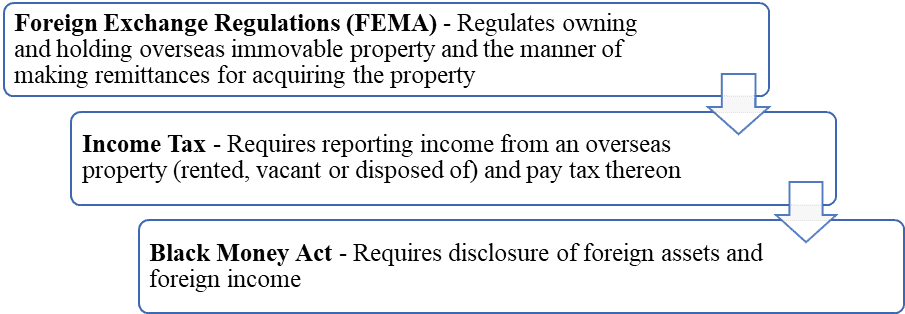
Indian residents must know that investments in UAE real estate is primarily governed by 3 regulations:
1. Foreign Exchange Regulations
FEMA permits Indian residents to invest in overseas real estate under the Liberalised Remittance Scheme (LRS) up to USD 250,000 per financial year. Family members may pool their LRS limits. Banks collect tax at source (TCS) on remittances exceeding a certain limit, though it can be claimed as a credit in the tax return.
In limited cases, immovable property can also be acquired under the Overseas Direct Investment (ODI) route, mainly where an Indian entity invests abroad or where a resident individual invests in a foreign entity rather than directly in property. However, for most individuals, LRS remains the appropriate and practical route.
2.Tax Implications
The UAE is widely perceived to be a tax-free jurisdiction, which is largely true from a local standpoint as it does not levy PIT on rental income or capital gains tax on sale of properties. The UAE government only levies 4% Dubai Land Development (DLD) fee on sale of property and certain administrative fees (akin to stamp duty and registration fees levied in India on the sale of a property).
However, for Indian residents, the tax analysis does not end here. The critical question is not whether income is taxed in the UAE, but whether such income is taxable in India.
Taxability in India depends on the residential status of the individual and the manner of receipt or accrual of income in India. Besides, the fact that the income is not taxed overseas (as there is no PIT in the UAE) does not mean that it will not be taxed in India too. In fact, it is taxable in India as per the normal tax provisions discussed below:
- For non-residents, ideally such income (rental income and capital gains on sale of property) will not be taxable in India, unless the proceeds are received in India. Practically, cross border advisors ensure that such proceeds are received and retained outside India so that there is no tax liability in India.
Thus, for non-residents, income from immovable property will not be taxed in the UAE as well as in India. Realizing this benefit, many Indians do think about becoming non-residents in India for a few years, acquiring off-plan properties in the UAE, selling it before the construction is completed and enjoying tax-free capital gains. A word of caution here – recently, the Bangalore Tribunal rejected Flipkart co-founder Binny Bansal’s claim for being taxed as a non-resident and emphasised the importance of substance and continuity of personal and economic ties and the need to substantiate a claim of residential status.
- Coming to the next category – returning Indians are typically categorized as “resident and not ordinary residents” (RNORs) for a period of 2-3 years post their return to India. They are also subject to the same tax provisions as non-residents. However, while they are RNORs, they must get to the drawing board and decide whether they wish to hold their UAE property and apply for the Golden Visa or sell the property without paying any tax in India before they become Indian residents.
- Finally, Indian residents (RORs) who continue to hold immovable property overseas even after returning to India or acquire such property under the Golden Visa Program will be taxed as follows:
- rental income from immovable property will be taxable as Income from House Property (IFHP). Vacant property will also be taxed as IFHP. Standard deductions will be available;
- capital gains on the sale of property will be taxed at the applicable rates for short term and long term gains; deduction can be claimed under sections 54, 54EC or 54F if the reinvestment is made in Indian assets.
Tax treaty implications: The India-UAE tax treaty allows the UAE to tax income from immovable property located in the UAE (i.e. rental income and capital gains). However, for individuals, the tax payable in the UAE would be Nil as there is no PIT or capital gains tax there. Thus, Indian residents will be taxed in India as per the normal domestic tax provisions. Further, they cannot claim a foreign tax credit as there was no tax in the UAE.
3.Reporting of Foreign Assets and Foreign Income
Indian investors often believe that overseas investments and income need not be disclosed in India. However, the regulations require all resident Indians (not being non-residents and RNORs) to report foreign income and assets. In fact, Budget 2026 has introduced a 6-month window for residents to come clean and disclose such information if they have not disclosed earlier. Thus, a resident taxpayer must disclose the UAE immovable property as well as income therefrom in his annual tax return.
Conclusion
The Golden Visa Program can indeed be viewed as a Golden Opportunity for genuine Indian investors – both literally and figuratively – when the investment unlocks long term residency incentives, economic growth and tax benefits.
However, the allure of a “tax-free” jurisdiction can be misleading if viewed in isolation. For Indian residents, FEMA compliance, residential status under tax laws, Indian taxability and stringent disclosure requirements significantly affect outcomes. The absence of taxation in UAE does not automatically translate to a zero-tax investment for Indian investors.
Therefore, the investment in Dubai real estate must be made with careful planning and consideration such that the benefits from the investment are sustainable in the long term.
The author expresses gratitude to CA. Juhi Kajaria for her research and contributions to this article.







2 thoughts on “Dubai’s Golden Visa Promise: Tax Haven or Tax Trap for Indians?”
Congratulations on a well timed article. Have also heard that a few of the agents talk about obtaining a bank loan in the UAE since rates are supposedly lower there. AFAIK, RBI expressly frowns upon such transactions wherein the LRS is used as margin/ downpayment and the balance funded through leverage. Any insights on this ?
Meanwhile, wishing you and the team the very best as you transition to a PMS model.
Thank you sir.
Comments are closed.