The pharma sector has been one of the outperforming sectors in the Indian listed space in the past two years. Even within the pharma sector though, CDMO ((contract development and manufacturing organisation) stocks have been standout performers. But CDMO players also trade at pricey valuations. Therefore, every quarter, markets tend to evaluate their results against growth expectations. Here we take stock of how CDMO players fared in the second quarter of FY27.
Nifty 500 companies cumulatively posted north of 20% revenue and PAT growth this quarter. Some CDMO playrs however aced these growth rates. Divi’s Laboratories and Laurus Labs clocked topline growth in excess of 30%, outpaced only by their operating profit growth. Piramal Pharma and Sai Life Sciences clocked topline growth in excess of 20%, though with a hint of margin pressure. But we also had Syngene, Neuland and Cohance that did not have such a strong quarter.
In this article, we dissect the factors that drove this uptrend for the stars of the quarter. We also take a look at what comes next.
Why CDMOs are a different beast
First a little context. The CDMO / CRDMO business is unlike any other.
- It is lumpy. Orders are lumpy, and that translates directly into lumpy numbers. Very often companies are faced with the clients de-stocking at their end which means a slow-down in orders that directly hits their top line and margins. Since these effects are more likely to even out over a 12-month period rather than a 3- month period, management of CDMO / CRDMO companies routinely stress that the business should be looked at on an annual, not quarterly, basis.
- Disclosure is thin. CDMO service providers operate under strict confidentiality agreements. This means that as investors we get far less visibility on clients, molecules and projects than in any other business.
- Research outcomes can be binary. If a company is handling research work for clients, the result can go either way before a molecule reaches ‘late stage’ or moves into the commercial stage.
- Lead times are long. CDMO companies must put up capacity upfront and be ready to hit the ground running when the business comes in. This means taking a calculated risk on whether the business will come in or not.
To take a more detailed look at the nuances of the sector, you can read the deep dive of the CRDMO space in India that we did in October 2025 through a two-part series:

Let experts manage your wealth
At PrimeInvestor, our Portfolio Management Services are built on one principle: protect on the downside, compound on the upside. Whether you’re starting your wealth journey or looking to bring discipline to an existing portfolio — we have a strategy for you.
Explore our PMS →- Part I: https://primeinvestor.in/reports/the-crdmo-landscape-in-india/
- Part II: https://primeinvestor.in/reports/the-crdmo-landscape-in-india-part-ii/
In the above reports, we also spoke about the China+1 opportunity, whether it was indeed translating into more business for Indian CDMO players, and which players were best placed to benefit.
With that background, let’s look at the four common themes that stood out in the Q2 FY 27 results.
The common themes
#1 Validation batch supplies & molecules progressing to commercial
The sector is opaque on specifics about projects and molecules. Even so, the management of Divi’s Laboratories highlighted that they typically work on about 60 to 70 projects across stages, from pre-chemistry to commercial, and that several older validated molecules have now moved to commercialisation, translating into business growth. Supply of products in the validation stage was one of the factors behind the uptick in Divi’s Custom Synthesis revenue.
Management of Laurus Labs too similarly attributed the quarter’s performance to “successful delivery of critical late-stage programs as well as commercial API supplies to multiple global partners”.
Sai Life Sciences also reported one molecule being added to late phase and another moving from late phase to commercial.
This suggests that these players are now reaping the rewards of pipelines and client relationships that have been built up over the years.
#2 Revenue mix shift toward CDMO
Divi’s didn’t just clock handsome topline growth. It also saw a shift in revenue mix in favour of the higher-margin Custom Synthesis business. The Generics:Custom Synthesis mix stood at 45:55 in FY26 and moved to 38:62 in H1 FY27.
A similar trend stood out at Laurus Labs too. The CDMO business grew 86% YoY for the quarter and 77% for the half year. CDMO accounted for 42% of H1 FY27 revenue as against 32% in the previous half year. Margins have naturally followed.
This points to not just revenue growth but also an improvement in the quality of growth.
#3 Peptides & other new modalities – the next big thing
The other common thread was the ramp-up in new modalities, with special attention on peptides.
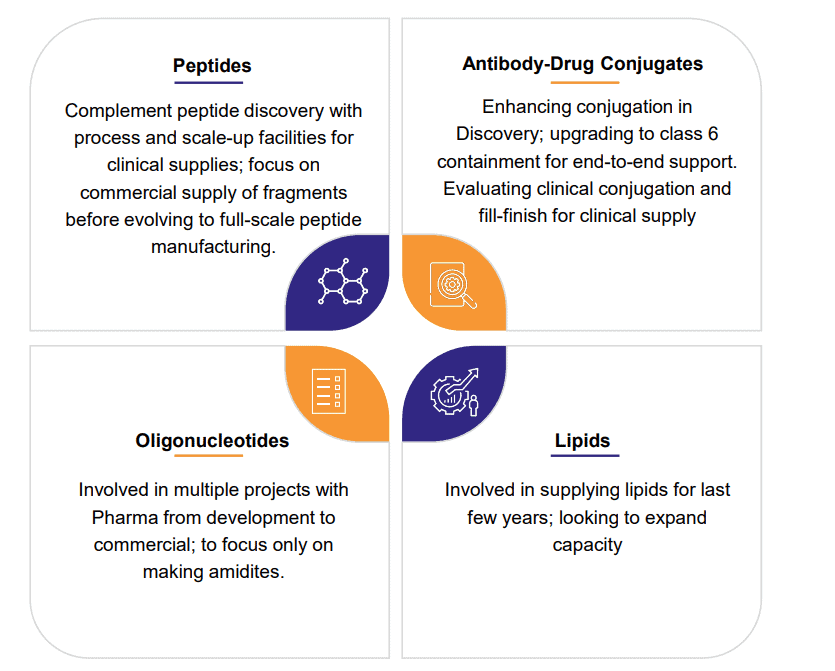
- Sai Life Sciences: Management noted that they have received several enquiries for integrated engagements in new modalities, specifically peptides. A peptide development lab has been commissioned, with more labs under construction. Master planning is underway for a new peptide plant in Telangana, with groundbreaking targeted in Q4 FY27. Management also called out focused investments in peptides, ADCs and oligos.
- Divi’s Labs: It is impossible to talk about peptides without speaking of Divi’s. Management indicated several projects in the validation phase, with several peptide fragments being validated. The company is actively expanding capacity with an SPPS (Solid Phase Peptide Synthesis) line. Divi’s management clarified that its peptide work will cater only to innovators and not generics. The company is building capabilities across the entire value chain, from building blocks to dipeptides, tripeptides and large peptides. While there has been no explicit mention of the same, based on the plans Eli Lilly has spoken of about making India a global supply chain and export hub, there is reason to believe that they could be one of Divi’s clients.
- Cohance: In its Q2 FY27 presentation, it said it aims to expand flow chemistry and peptide capabilities over the next 12 to 24 months, both organically and inorganically.
- Neuland: Its capex is largely driven by a new R&D and Peptide block, with dedicated peptide labs. The CEO clarified that Neuland’s intent is full peptide API (upstream plus downstream – upstream means crude/fragments via SPPS/LPPS reactors and downstream means purification).
Source : Sai LifeSciences Presentation
#4 Better days (even better days) are coming
Almost every management team pointed to a better second half.
- Sai Lifesciences: Historically, H2 has been stronger than H1 for Sai Lifesciences. Management too echoed this in their concall commentary and said that they will maintain their 15-20% revenue growth and 28-30% EBITDA margin trajectory. Drivers include new capacities being commissioned, integrated CRO-CDMO cross-selling to global pharma clients, and a molecule transitioning from late-stage clinical to commercial.
- Piramal Pharma: Management expects a strong H2 and revised FY27 revenue guidance to 19-20%, from early-to-mid teens. The reasons attributed to this were H2 being historically stronger, strong RFP conversions (22 new customers added in H1, 28 molecules in Phase 3), strong momentum in ADC services and scale up in the Complex Hospital Generics segment especially the Kenalog acquisition.
- Divi’s Labs: Management pointed to maintaining the current clip in H2, with continued strength in Custom Synthesis. The three dedicated validation programmes (that management has specifically called out as they are dedicated units) are also progressing toward commercialisation. Backward integration benefits from Unit III Kakinada too are expected to keep accruing.
- Syngene: While the revenue degrowth guidance for the full year was maintained, management indicated a stronger H2, with likely resumption of Zoetis supplies, flow-through of manpower cost optimisation, and ramp-up from the first manufacturing contract signed at its US Bayview biologics site.
- Laurus Labs: Similarly pointed to sustaining the momentum in H2.
- Anthem Biosciences: Posted 7% topline growth in Q2 and a dip in H1 thanks to deferred customer deliveries. However, management indicated full-year growth of about 10%, which implies a sharp acceleration in H2.
- Cohance: CEO Umang Vohra pointed to a better second half after the company was hit by destocking at customers’ end. Drivers include commercial reload orders in small molecules and two newly commercialised products.
A closer look at the stars of the quarter
Divi’s Laboratories – a standout quarter
Divi’s delivered its strongest quarterly earnings to date for the quarter ended September 30, 2026. Consolidated revenue surged 35.4% YoY to Rs. 3,676 crore and the company clocked an all-time-high EBITDA margin of 42.6%. The drivers were a surge in Custom Synthesis validation batches (up by 50%) and sharp raw material cost efficiencies.
The company has three dedicated capex projects that are nearing approvals. Management says that once launched, utilisation will be high and will scale up quickly. One is near commercialisation, with the other two expected to move toward commercialisation in the next one or two quarters, subject to approvals.
Management indicated a capex of about Rs. 2,000 (+/- 20%) crore per annum, going toward scaling peptide capacity with multiple 3,000-litre SPPS lines, expanding flow chemistry and deepening backward integration. This capex trend is expected to continue over the next 2 to 3 years – an indicator of growing business in the offing.
Laurus Labs – Rewiring the business
Laurus has been on a capex spree committing over Rs. 5,000 crore across a multi-year window up to FY27, with incremental plans of Rs. 3,000 crore skewed heavily toward API and CDMO. The company’s goal is to lift CDMO revenue contribution to about 50% by FY30.
The efforts toward transformation (to move away from historical dependence on HIV / ARV tender business) have been deliberate and underway for a few years with the outcomes being clearly visible now.
- ARV dependence: Down from about 50% to about 33% of the business. The ARV business itself has stayed relatively stable at Rs. 650-750 crore per quarter, but its contribution to the topline keeps falling.
- The transformation: Started to take shape between FY22 and FY23 with close to Rs. 4,000 crore of capex announced between FY22 and FY26, to build dedicated R&D and manufacturing capacity for small-molecule CDMO, precision fermentation and emerging modalities, even at the cost of short-term margin compression in FY23-FY24.
- The pipeline buildup: Over 100 CDMO projects, mostly small molecules, are progressing, with commercial execution kicking off.
- Peptides: Laurus inaugurated its peptide manufacturing facility ahead of schedule, with a stated total SPPS capacity of over 16,000L. Management says that rather than making fragments, they will do the complete synthesis, purification and isolation, offering the API and not just fragments. Large-scale peptide API manufacturing will include both GLP-1 and non-GLP-1 opportunities.
- Platforms and capabilities: In H1 FY 27, investments (inorganic acquisitions) have been made in two technology platforms for oligonucleotides and peptide resins. Over the last five years, capabilities have been built in peptides, precision fermentation, and cell and gene therapy / ADCs. Management says the only areas it is now lacking in are monoclonal antibodies, cephalosporins and penicillins.
- Capex guidance: Capex is not slowing down and is guided to be Rs. 3,000 crore for FY27 to FY28.
The Laggards – what went wrong
Syngene: Waiting for recovery
While Syngene has the credit of being India’s first real CRO that later expanded into an integrated discovery, development and manufacturing provider, it has had its share of challenges. Here it is not a question of just Q2 FY 27 alone but of challenges spanning from before. Revenue growth has slowed sharply across FY24-FY26 before contracting 12% YoY in H1 FY27. Operating EBITDA margins compressed from 32.6% in FY22 to 24.6% in FY26 and 15.2% in H1 FY27, dragging ROCE down.
What’s behind it:
- Zoetis dependence: The commercial biologics ramp-up relied heavily on the Zoetis contract. But this was hit by customer destocking and a pause in offtake during FY26 and H1 FY27 which left newly built capacity underutilised.
- The biotech funding winter: Historically, over half of revenue came from early-stage Discovery Services and Dedicated Centers and this was hit causing project cancellations and slower FTE additions.
- Investing ahead of demand: Heavy investment in large biologics plants meant upfront employee, utility and depreciation costs against flat revenue, with biologics tech transfer, validation and audits taking 18-36 months before commercial revenue.
- Leadership reset: Long-time CEO Jonathan Hunt stepped down, Siddharth Mittal took over as MD & CEO in July 2026, and Kiran Mazumdar-Shaw moved to Executive Chairperson. Workforce right-sizing led to exceptional severance charges in the last few quarters.
What management said
- Revenue guidance: a low single-digit decline in local currency terms for FY27.
- Zoetis supply is back-end loaded, with batches manufactured in H2 and delivered in Q4. Manpower cost optimisation is complete, with other opex initiatives still underway.
- Management targets a return to double-digit growth from FY28, with CDMO as the central growth driver, helped by demand for biologics capacity, the BIOSECURE Act, China Plus One and the India-US dual-site model. Focus areas are peptides, oligonucleotides, ADCs and small molecule capacity.
This overall indicates that a glimmer of hope might be in the offing although the timing of this is unclear.
Neuland Laboratories, Cohance Lifesciences & Anthem Biosciences
Neuland saw revenue degrowth of 13%, with margins compressed to 22% and net profit also lower. Part of this was on account of a high base. Management however, held its growth stance. The CEO said H1 was “largely consistent with expectations” and that “expectations of growth remain intact for this as well as the following financial year”, without giving away any guidance.
Cohance had the toughest quarter on the block, with sales down 14.21% and net profit down 96.58%, hit by destocking at the customer’s end. Management expects a better H2 with commercial reload orders in small molecules and two newly commercialised products.
Incorporated in 2006, Anthem is a CRDMO that also sells specialty ingredients. It has developed platforms in RNA interference (RNAi), antibody-drug conjugates (ADCs), peptides, lipids and oligonucleotides, and stands out in India for its breadth of capabilities in both small molecules and biologics. It also manufactures complex fermentation-based APIs. While Q2 revenue was up nearly 8% H1 revenue was down 7% thanks to a 20%+ fall in Q1, attributed to timing shifts in deliveries to key customers, with deliveries concentrated in the latter half. However, the company has one molecule that has progressed to the commercial stage. The company has also reaffirmed capex at Rs. 1,200 crores. The company is also diversifying its client base that was once biotech-focused to include ten big pharma clients.
What next? One good / bad quarter doesn’t matter
As we said earlier, in the CDMO sector one good quarter doesn’t always translate into consistent performance. It is important to keep an eye on the next two quarters and also take a look at past track record for evidence of consistency in performance and durability and depth of client relationships.
Valuations too have run up for many players and are firmly in expensive territory.
Several key players are in the midst of a multi-year capex cycle: Divi’s at about Rs. 2,000 crore per annum, Laurus at Rs. 3,000 crore for FY27-FY28 on top of its earlier commitments, Anthem at Rs. 1,200 crore for Unit 4, and Sai at Rs. 1,100-1,300 crore.
The indicators to track are approvals and commercial launches of the dedicated projects at Divi’s, the peptide ramp-ups at Laurus, Sai, Divi’s and Neuland, and whether H2 delivers on the promises management has made.
How to play it
As we highlighted in our earlier series, this is one where an investor has to take a bottom-up approach. It is also not a sector that lends itself to a buy-and-hold approach. It is better used as a tactical addition with limited exposure in the portfolio. Preference should go to:
- Size and diversification of the player
- Nature and durability of relationships with clients
- Capabilities in new modalities
- A positive compliance track record
- Geographical diversification
- Financial health
We have narrowed down on a CRDMO candidate that ticks these boxes, and it figures in two of our PMS schemes. Schedule a call to know more!