
General

What should you do with your international funds?
With fears of a global slowdown and US recession taking hold, many investors are asking the question – what should I do with my international funds? This FAQ attempts answers.

With fears of a global slowdown and US recession taking hold, many investors are asking the question – what should I do with my international funds? This FAQ attempts answers.


In this analysis, we look at indices on the ‘Quality’ factor. There are two NFOs running now – DSP Midcap 150 Quality 50 Index fund (there’s already the ETF version of this) and Aditya Birla SL Nifty 200 Quality 30. These two indices join the Nifty 100 Quality 30 index, on which there is an already existing ETF (from Edelweiss).

Chief Investment Officers (CIOs) or star fund managers bidding goodbye to an AMC, or even the MF industry, has become a commonplace occurrence in India. The recent bull market has seen many well-known fund managers, from Kenneth Andrade of IDFC to Sunil Singhania of Nippon quit their MFs to seek greener pastures in managing PMS schemes or AIFs.
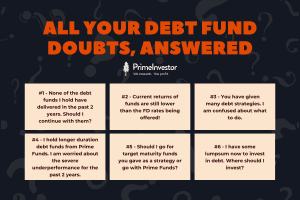

It is true that debt funds have been a washout in the past 3 years. For an investment of 1-2 years, FDs would have marginally (although not significantly enough) returned higher than liquid and ultra short duration funds.


In this quarter’s review, we have made some changes to Prime Portfolios to replace underperforming funds with newer ones. We have explained whether you need to exit or hold the funds we have removed.

We have only a few changes this quarter with some interesting additions in the equity aggressive category and in debt as well. We have also added a couple of themed funds to capture a visible up trend in the economic activity.


As per the above table, we are not yet in a bear market, though it would seem to be just round the corner. But what the data shows is that the period taken to recover from the onset of a bear market back to regaining the previous peaks can be as short as three months or as long as 74 months.

The world of passive investment options is a growing one, and the ETFs available now number over 100.
Because passive investing has gained such a name for itself, you may think that anything passive is a great investment. No. There are ETFs which make good investments and those that do not, just like with active funds.
Target maturity funds have triggered interest in the present rising rate scenario. But many of you appear confused between this category of funds and constant maturity funds. We hope to provide some clarity on this, with this article.
When we decide to do something in our life, there could be many reasons that guided our decision. But more often than not, there is
In this article, my endeavour is to talk about mutual funds from a practical point of view. Wherever possible, I have used examples and illustrations from real life to explain the ideas that I tried to communicate.

This week, we’re issuing an invest recommendation on another theme that’s starting to break out of a long slump. This theme makes for a good portfolio differentiator as most other diversified equity funds, as yet, have not moved overweight by much on it.
Hold On
You are being redirected to another page,