India’s commercial real estate market has witnessed a strong upcycle over the last few years, led by robust demand for Grade A office space. Office leasing reached a record 83.3 million sq. ft. in 2025 (Source: JLL), driven by India’s cost advantage over global office markets, a large English-speaking and technology-skilled workforce, and rising demand from Global Capability Centres (GCCs), technology companies, BFSI firms, and flexible workspace operators.
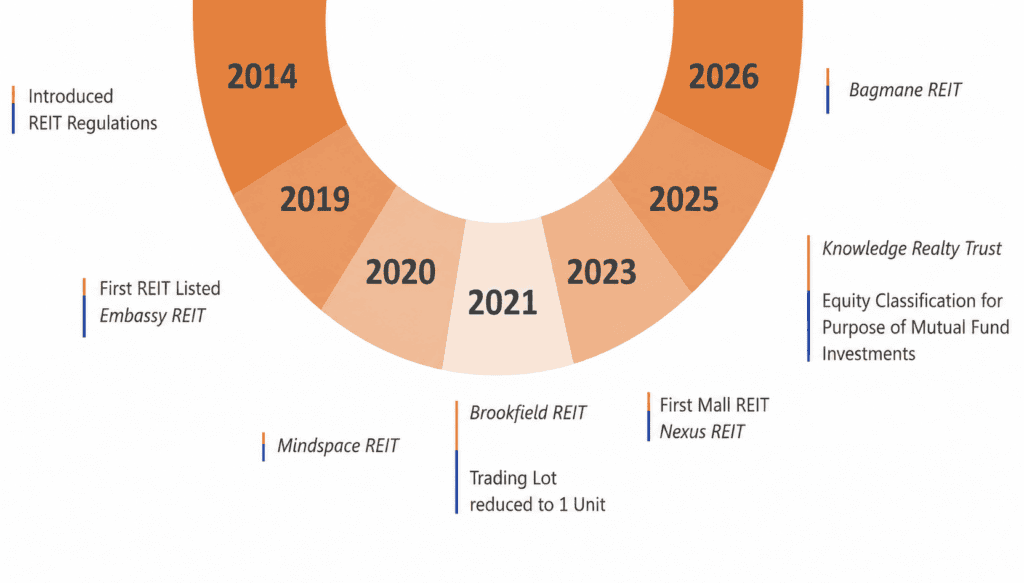
Source: Indian REIT Association: REIT Primer
India’s listed REITs currently own around 163 mn sq. ft. of commercial real estate, compared with an estimated REITable universe of over 520 mn sq. ft., indicating significant headroom for future expansion.
The potential for institutionalisation of India’s commercial real estate market supports this opportunity. Institutional ownership remains relatively low at around 20%, compared with 67% in Singapore and 98% in the US, suggesting considerable scope for greater institutional participation as the market matures.
REITs have emerged as an important mechanism for this transition, allowing developers and institutional investors to monetise stabilised assets, recycle capital into new developments and broaden investor participation. As the stock of Grade-A commercial real estate continues to expand, REITs are likely to play an increasingly important role in the ownership and financing of India’s commercial real estate market.
A large share of India’s Grade A office assets are concentrated in Bengaluru, which continues to be the country’s largest office market, supported by sustained demand from Global Capability Centres (GCCs), flex space operators, technology firms and BFSI firms. Other major office markets include Mumbai, Hyderabad, Pune, Chennai and the Delhi-NCR region, all of which have attracted significant institutional investment in recent years.
Let us now turn to the REIT landscape. India currently has six listed REITs, five of which own predominantly office assets, while one is focused on retail. Office REITs are the most popular as the underlying assets enjoy long-term leases with multinational corporations and Tier 1 domestic companies, providing stable rental income and predictable cash flows.
What drives REIT returns in India?
India’s listed REITs currently offer annual distribution yields of around 5% to 6%. These yields tend to move in line with bond yield movements in the market. When the risk-free rate rises (yield on the 10-year gilt), the market prices of REITs decline, propping up their yields.
# 1 Interest rate moves and REIT capital gains
While REITs are normally bought for their distributions, Indian listed REITs have delivered significant capital appreciation as well in the last three years. The table below shows that several listed REITs have outperformed the NIFTY 50 in terms of unit price gains over this period.
However, these results should not be extrapolated blindly. During these three years, interest rates in India declined from their peak as the Monetary Policy Committee (MPC) cut policy rates by 125 basis points. This propped up secondary market prices of REITs.
Whether REITs deliver capital gains from here therefore depends on the interest rate direction. Policy rates now seem to have bottomed out. Should inflation risks return and the MPC raise rates from here, the market prices of REITs could well decline, erasing some of these gains. If rates stay on hold, gains could flatline.
#2 REIT Trading volumes and Liquidity Risk
While the distribution yield is calculated on the last traded price of a REIT, that price could be misleading if secondary market trading in the REIT’s units is thin or sporadic. Newly listed REITs typically experience muted secondary market activity until anchor investor lock-in periods expire. As these restrictions are lifted, units held by anchor investors are absorbed by a broader investor base, improving market liquidity and price discovery. Therefore, it may be better for investors to consider REITs that have been listed for a while to avoid mispricing.
#3 REIT NAVs: Premiums, Discounts and Valuation
Apart from their distributions, the market also values REITs on the book value of their assets. REITs are required to have their entire asset portfolio valued by an independent appraiser once in every six months. The per-unit book value is published as the REIT’s Net Asset Value (NAV). The NAV also plays a role in the pricing of REITs.
However, as shown in the table above, listed REITs actually trade at varying premiums or discounts to their NAV. This is because the NAV represents the book value of the REIT on the last valuation date. But the market price reflects projections of future cash flows, growth prospects in the REIT’s asset portfolio and risks to its cash flows and values.
Two factors to note here:
1) REIT units trade daily, whereas NAV is updated twice a year. Market prices, therefore, adjust more quickly to changes in real estate market dynamics than NAVs do.
2) The valuation assumptions adopted by independent appraisers may differ from the market’s expectations for rental growth, occupancy and capital values.
#4 REIT Occupancy rates and Rental growth trends
A REIT subsists on rental income. Therefore, trends in occupancy and annual escalations are a key decider of future income trends. Here’s how the listed REITs fare on this score.
High occupancy provides visibility on rental income and reflects the attractiveness of a property’s location and tenant base. While all three office REITs continue to report occupancy levels above 90%, certain factors are causing vacancies across their portfolios.
Embassy Office Parks REIT’s occupancy was dragged down because of SEZ regulations, since some of its assets are located in a Special Economic Zone (SEZ). Once a SEZ tenant vacated, the space could not be leased to a non-SEZ occupier, resulting in vacancies. Recent regulatory changes permitted floor-wise SEZ denotification, which improved occupancy levels. Despite this challenge, Embassy has delivered a healthy five-year rental CAGR of 7.9%.
Brookfield India REIT has experienced greater volatility in occupancy than its peers, largely reflecting the expiry of a few large leases within its portfolio. This highlights the importance of tenant diversification, as a concentrated tenant base can result in larger swings in occupancy when significant leases expire. Brookfield India REIT illustrates the impact of acquisitions on rental growth. The acquisition of the Downtown Powai assets increased its average in-place rent from ₹65 per sq. ft. per month to ₹84 in FY24, reflecting the premium nature of the acquired properties.
Mindspace Business Parks REIT, on the other hand, reports lower average in-place rents than its peers. This is because of asset location rather than quality. A significant proportion of its assets are located in Hyderabad, Navi Mumbai and Pune, where office rentals are generally lower than in premium office markets such as Bengaluru’s Outer Ring Road and Mumbai’s BKC and Powai.
# 5 REIT asset acquisition strategy and portfolio growth strategy
While higher occupancy and rental escalations can provide some growth visibility for REITs, wealth creation from a REIT depends on how actively it expands its portfolio of rental assets, without resorting to excessive debt or equity dilution. Such expansions lift both the NAV and the distributions. Here’s how the listed REITs are expanding their portfolios.
While each listed REIT is pursuing portfolio expansion, the route to growth has differed. Broadly, there have been two approaches.
The first is a development-led strategy, followed by Embassy REIT, Mindspace Business Parks REIT and Bagmane REIT, where the REIT expands by developing office assets on land already owned or controlled by it. This allows the REIT to create new leasable space, while retaining greater control over project design and execution.
The other is an acquisition-led strategy where the REIT acquires stabilised, income-generating assets. An important nuance here is whether the acquisition is from the sponsor pipeline or the assets are acquired from the market directly. A REIT may go from being sponsor-dependent in its initial years, to developing its own leasable property or acquiring from the market in later years. Across development, redevelopment and acquisition projects, REITs generally target minimum returns of around 15%, indicating a consistent focus on value-accretive growth.
While their growth strategies differ, the nature of the assets being added to these portfolios is similar. A common feature is the focus on integrated office parks rather than standalone office buildings. In addition to office space, these developments typically incorporate hotels, solar parks, retail, and food & beverage outlets, creating integrated business ecosystems. While office assets remain the primary source of rental income, these complementary assets diversify revenue streams and enhance the overall attractiveness of the development.
Hotels located within large office parks, for example, benefit from a captive customer base comprising employees, business travellers and corporate events. This can support relatively stable occupancy levels and contribute to the net operating income for the asset.
Environmental sustainability has also become an increasingly important differentiator. Multinational occupiers, particularly Global Capability Centres, are placing greater emphasis on leasing green-certified buildings to meet their internal ESG commitments. As a result, developers with sustainable, high-quality office assets are better positioned to attract and retain premium tenants, supporting occupancy and rental growth over time.
#6 REIT Distribution trends and payout history
Finally, REITs are bought mainly for their ability to pay out regular and rising distributions. The table below captures trends in the distributions of listed REITs.
Of the listed REITs, Embassy Office Parks REIT and Mindspace Business Parks REIT have delivered more consistent and growing distributions over the years, reflecting the stability of their rental cash flows. The only notable exception was Embassy Office Parks REIT in FY24, when distributions declined due to higher interest costs and working capital outflows arising from the refund of security deposits.
Brookfield India REIT, on the other hand, has yet to return to its FY22 distribution levels. However, this should not be viewed as a reflection of weaker operating performance. Lower distributions have been driven by a combination of factors, including lower portfolio occupancy and unit dilution following the issuance of new units to fund acquisitions.
Why India’s REIT Market Growth Will Stay Gradual
While the Indian REIT market has a long growth runway, its expansion is likely to be gradual. One of the key constraints is the requirement for REITs to distribute at least 90% of their Net Distributable Cash Flows (NDCF) to unitholders. While this supports regular income for investors, it limits the amount of internally generated capital available for acquisitions and new developments. As a result, REITs often rely on debt or equity issuances to fund portfolio expansion, particularly during periods of strong commercial real estate demand.
This has led some large developers to reassess their REIT plans. For example, DLF Cyber City Developers and Phoenix Mills have deferred or shelved proposed REIT listings, citing factors such as higher compliance requirements and the reduced financial flexibility associated with the REIT structure.
Key Risks of Investing in REITs
There is a tendency to view REITs as a high-yield vehicle that competes with bonds and fixed income instruments. However, investors should note that REITs are riskier than highly rated bonds as both their capital value and distributions are variable and not fixed.
REIT market prices are highly vulnerable to movements in interest rates and asset values. Their distributions too are linked to the performance of the underlying assets and can be affected by occupancy levels, lease renewals, rental growth and property valuations.
Leverage is another important consideration here. As REITs distribute the majority of their cash flows, external funding becomes an important source of capital for acquisitions and development. Higher interest rates can increase financing expenses and reduce distributable cash flows. Investors should therefore monitor leverage levels and debt maturity profiles when evaluating a REIT.