If you’re wondering why, in 2026, we’re still explaining what AI is, it’s a fair question. By now, your cab driver, your uncle’s WhatsApp group and probably even your dog have an opinion on it.
But I’m about to ask a rather obvious question: Is AI in a bubble? To answer that, we need to understand what’s being built, who is paying for it, and where the returns are supposed to come from.
That’s what Part 1 of this short series is about. Part 2 gets to the more contentious question: whether the money pouring into AI makes economic sense.
Quick disclaimer: I’m not an AI expert. Everything here comes from podcasts, a lot of reading, and AI tools patiently explaining things to me for the fifth time. If I could follow it, you can. If you’re a tech bro, feel free to skip to Part 2 (once published), where I may well be wrong in interesting ways 🙂
Key takeaways
- AI is a four-layer stack, and each layer earns very different returns. A winning technology can still produce losing investments.
- Amazon, Microsoft, Alphabet and Meta are on track to spend roughly $700–725 billion on capex in 2026, almost all of their operating cash flow. Whether that pays off is the whole debate.
- Cheaper AI (which is possible from more efficiency in chips) does not necessarily mean fewer chips are needed. Lower costs can drive much greater AI usage, offsetting the gains from more efficient chips and models. Whether this happens on a large enough scale to sustain today’s AI infrastructure spending remains uncertain.Why financing matters in AI
1. Understanding the AI ecosystem
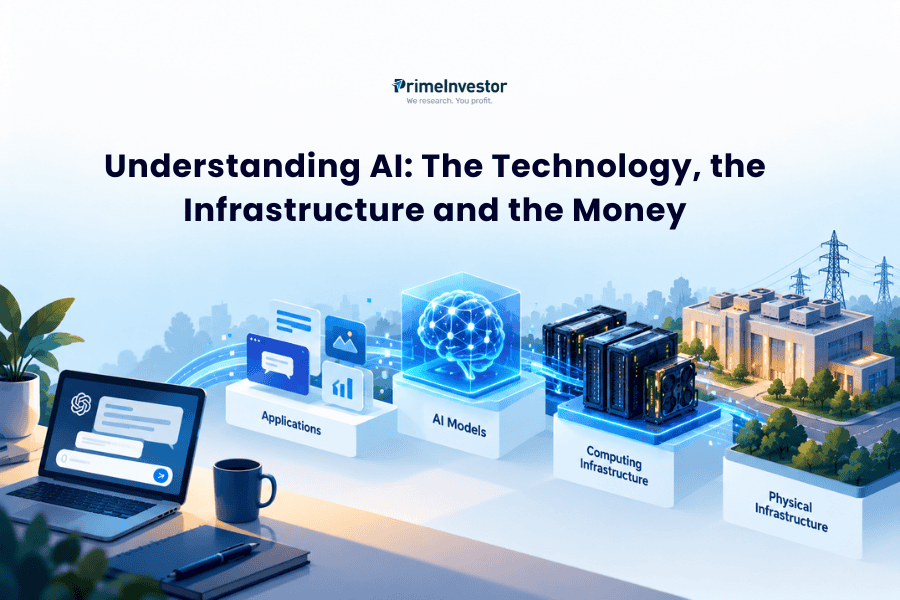
AI is not one industry. Think of it as a stack with four layers, and the money is made (or lost) very differently at each one.
Layer 1: Applications, where users meet AI
Examples: ChatGPT, the Claude app, Microsoft Copilot, Cursor
This is the layer most people see: AI assistants, coding tools, customer-service bots, and specialised tools in healthcare, finance and design. These companies win only if customers find the product useful enough to pay for, and if the revenue beats the cost of serving them.
Layer 2: AI models, the intelligence behind the applications
Examples: OpenAI’s GPT, Anthropic’s Claude, Google’s Gemini, Meta’s Llama
Models are the systems trained to understand and generate language, read images, write code and answer questions. Building them takes enormous data, computing power and money, and the companies compete on capability, reliability, speed and cost. A brilliant model is not automatically a profitable business. The maker must still find customers, price sensibly and recover what it spent building and running it.
Layer 3: Computing infrastructure, the engines that run AI
Examples: NVIDIA GPUs, Microsoft Azure, CoreWeave
Models run on specialised chips, mainly GPUs, that perform the vast number of calculations required to train and run AI. Nvidia designs and supplies the chips, while cloud providers such as Microsoft Azure and AWS, and specialised GPU cloud providers such as CoreWeave, rent out computing capacity.
The chip supplier (Nvidia), the computing provider (such as Microsoft Azure, AWS and CoreWeave. Note that Microsoft and Amazon also build AI applications. We are restricting it to mentioning this category of business ) and the model builder (Anthropic, OpenAI and others) all benefit from the AI boom, but their business models, capital requirements and risks are very different. They also stand to make money from AI at different stages of AI adoption.
Layer 4: Physical infrastructure, the buildings and power behind it all
Examples: Equinix, Vertiv, electricity and grid providers
Data centres, power supply, cooling and networking form the physical infrastructure that keeps AI computing running. They need heavy upfront investment and take years to build, and then they need steady customer demand to earn their keep. Power availability in particular is now one of the main constraints on how fast new capacity can come online.
Some companies straddle layers. Microsoft, for instance, sells applications (Copilot), builds its own models, and runs cloud capacity (Azure). But the economics of each layer stays distinct.
Illustration: A PrimeInvestor analyst asks AI to read a company’s annual report
- Application: ChatGPT is where the analyst types the request and reads the answer.
- Model: An OpenAI model interprets the report and shares its findings
- Computing: GPUs and servers, rented through a cloud provider, do the calculations.
- Physical: Data centres, electricity and cooling keep those servers running.
You see that one request thus has four layers, and possibly four different companies earning four different returns.
That is why the AI story has to be judged layer by layer.
A great application can make its developer rich without making every infrastructure owner rich, and a chip supplier can prosper even if some of its customers eventually struggle.
That is the primary idea we carry in this series into the next part: AI succeeding as a technology does not guarantee that every business built around it succeeds.
2. Why does AI need so much capital?
The four biggest spenders are on track to put roughly $700–725 billion into AI-related capital expenditure in 2026, about 75% more than the record $410 billion of last year (Forbes, 7 Oct 2026).
CreditSights estimates that roughly three-quarters of this goes to AI infrastructure, and the same article says the spending will consume nearly all of these companies’ operating cash flow this year. On the other side of the ledger, Microsoft says its AI business (both Azure related AI revenue and Microsoft’s own AI applications) passed a $37 billion annual revenue run rate, more than double of a year earlier.
While this adds to the topline, it is still a fraction of what is going out. Google Cloud’s demand backlog of over $460 billion is certainly promising but a backlog is not revenue.
Why so much? Training a large model takes enormous computing power, and serving it to millions of users takes more, every day. Companies must buy chips, build data centres, secure electricity and lay networks before the customers show up.
The hyperscaler’s dilemma
Suppose a tech giant believes AI computing demand will boom. If it invests early, it grabs customers and capacity before rivals do. If it waits and demand arrives early, it loses business to its rivals. Now suppose every major competitor reaches the same conclusion. Each investment looks rational on its own. Added together, the industry could end up with more capacity than customers will pay profitable prices for.
While capacity is scarce, customers pay premium prices and providers earn fat returns. Once capacity runs ahead of demand, prices fall and utilisation weakens. The data centre still works and the chips still run; the revenue just no longer justifies what was spent. Strong demand is not the same as strong returns.
What Aswath Damodaran adds: earnings and cash tell different stories
When companies build AI infrastructure, the cash is spent upfront, but the cost is charged to profits over several years through depreciation. Reported earnings can therefore look stronger than free cash flow suggests.
Meanwhile, that same spending becomes immediate revenue and profit for chipmakers, network-equipment suppliers, power companies and data-centre owners.
AI capex can boost suppliers’ earnings today while leaving builders with a large investment bill to recover. The test is whether the cash AI generates over time justifies the capital committed to it.
The chip clock vs. the building clock
A data-centre building can last decades. The chips inside it get overtaken by faster ones much sooner. If a company spreads a chip’s cost over many years but the chip becomes obsolete earlier, reported profits overstate the picture. Analysts disagree about how long AI chips stay useful, and the answer matters a great deal for returns. I will come back to it in Part 2.
The question that matters is simple: will the cash AI generates over time justify the capital going into it?
3. Training, inference and the token-price puzzle
Two terms explain how AI eats computing power.
- Training builds or improves a model by processing huge amounts of data so it learns patterns. It is expensive, and companies repeat it to make better models.
- Inference is what happens every time a trained model answers a question, summarises a document or writes code. Each use costs computing power, and the cost varies with the model, the task and how much text is processed.
Inference is where usage turns into recurring revenue and recurring cost. A model can attract millions of users, but the outcome depends on what they pay, directly or through their employers, compared with what it costs to serve them.
The puzzle: token prices are falling, yet GPU demand keeps rising. How?
A token is a small chunk of text or data a model processes: a word, part of a word, or punctuation. You ask a question and the model reads input tokens and writes output tokens. A long chat, a complex task, or an AI agent making dozens of model calls burns far more tokens than a simple question. Providers often charge per token, though some products use subscriptions.
If AI is getting cheaper, shouldn’t the hardware behind it get cheaper too? Not necessarily, because the price of a service and the volume consumed are different things. (Numbers below are illustrative only.)
Price falls 80%, consumption rises tenfold, and total spending doubles. When AI gets cheap, people may ramp up their usage, start running it across thousands of documents, writing and testing code, or leaving agents running all day.
Tokens are not GPUs
A token is a unit of work; a GPU is the hardware that produces it. Better models, better chips and smarter software can squeeze more tokens out of the same GPU, so a job that once needed ten GPUs might one day need fewer. That is a genuine threat to hardware demand.
Therefore, two forces are pulling in opposite directions:
- The efficiency effect: better models, chips and software cut the computing needed per unit of AI output.
- The volume effect: cheaper AI invites more users, longer conversations and more autonomous agents, so total computing needed grows.
Economists call a version of this the rebound effect: make something cheaper to use and people use enough more of it to eat up the efficiency gain. It is the intuition behind the bullish case you hear from many tech enthusiasts.
The catch: the volume effect only wins if usage grows faster than efficiency improves and prices fall. Nobody can promise that.
What this means for infrastructure companies
Strong GPU demand today tells you usage is surging. It does not tell you whether the owners of that capacity will earn good returns. That depends on how much capacity the industry builds, how well it is used, and what customers will pay. If usage keeps outrunning supply and customers are willing to pay a stable price for that usage, the heavy upfront spending looks smart. If capacity races ahead of demand, providers can face falling prices and thin returns even while AI adoption keeps rising.
So the question is not whether AI usage is growing. It is whether the revenue and profit from that growth justify the capital committed to it.
4. Where will the returns come from?
There are two broad sources of value in AI. There are two broad ways to benefit from AI:
- Companies selling AI: Companies sell AI models, applications or computing capacity to individuals, businesses and governments. Their returns depend on how many customers pay, how much they pay, and what remains after the costs of developing and running AI.
- Companies using AI: Companies adopt AI to improve their own businesses. A bank may automate processes, a software firm may help developers code faster, a manufacturer may reduce waste, or a government may use AI in defence and public services. Here, the returns come from lower costs, higher productivity, new revenue or better outcomes.
The distinction matters because the companies that create value through AI need not be the same companies that capture the most profit from it. AI providers may enable substantial productivity gains for their customers, but competition and falling prices could limit how much of that value they retain.
For investors, the question is not simply who sells AI or who buys it. It is which companies can turn AI demand or AI-driven productivity gains into sustainable profits and cash flows.
For example: An AI tool may create ₹100 worth of economic benefit for a customer, but the AI provider might capture only ₹10 of it as revenue – and even less as profit. The customer retains the rest of the benefit.
For investors, the question changes with which layer a company sits in:
Showing that AI is useful, is a technological achievement. Showing that it is profitable for a given company is an economic one. In other words, AI’s usefulness is becoming clearer. What remains uncertain is how much of that value individual companies will capture and whether their current valuations adequately reflect the costs and risk.
5. Why financing and debt matter
The build-out is not paid for by existing profits alone. AI hyper-scalers are also raising equity, borrowing, and signing long-term commercial deals to fund infrastructure. That adds a layer of risk, because shareholders absorb losses when returns disappoint, while lenders still expect to be repaid on schedule.
Take a company that borrows heavily to build a data centre. Its plan depends on landing customers, keeping the facility busy, and earning enough to cover running costs, interest and the original investment. If demand arrives, debt speeds up growth and boosts shareholder returns. If demand disappoints, prices fall or customers cut their commitments, the bills still arrive.
Structures get harder to read when financing runs through special-purpose entities, long-term capacity commitments or obligations spread across several companies. These are not automatically a problem, but they make it harder to see where the risk finally sits.
The source of demand matters too. A customer paying for AI with revenue earned from its own end users is one kind of evidence. A customer that depends on investor money, borrowing or fresh capital injections is another, and a shakier one.
This does not make all AI spending circular, or all borrowing a red flag. It means the right questions are: who is paying, where is that money coming from, and can the resulting cash flows carry the investment? These matter most when so much capital is committed before the industry’s long-term economics are clear.
What comes next: is AI in a bubble?
AI may be one of the most consequential technologies of our time. It could reshape businesses, lift productivity and create new markets. None of that tells us whether today’s investments will earn adequate returns.
A bubble is when asset prices detach from economic reality. It does not mean the technology is useless; it means the money invested, the capacity built, or the valuations attached may exceed what the eventual economics can support.
The cleanest parallel is the late-1990s telecom boom. Companies laid vast amounts of fibre-optic cable, betting that internet traffic would explode. The internet did transform the world. But much of that fibre sat unused (dark fibre) for years, prices collapsed, and many of the firms that built it went under. Railways in the 19th century tell a similar story. The technology won; many of the investors who funded it did not.
The same split applies to AI:
- AI can become indispensable to businesses.
- AI infrastructure can be used for decades.
- Some AI companies can become extraordinarily profitable.
- And many of the companies investing in AI today could still earn poor returns or fail.
Coming in Part 2:
- Whether today’s AI boom shows the marks of a bubble, and the best arguments from both optimists and sceptics.
- How long AI chips really stay useful, and why it matters for reported profits.
- What an AI correction could mean for global markets, and for India through three channels: US bond yields, foreign investor flows and market valuations.
Inputs: various podcasts, and first principles explained by AI tools.